The expense report has a peculiar talent: it makes intelligent adults forget why they spent money. A meal becomes $63.18. A software subscription becomes $249. The meeting, project, client and permission that made the purchase sensible have evaporated, leaving a finance team to reconstruct the plot from a receipt and a vague memo. Itamar Jobani knew the ritual. While working as a software developer at a healthcare company, he dreaded the monthly encounter with its reimbursement tool. He searched for something better. When he did not find it, he and fellow developer Omer Rimoch started building.
- PayEm connects requests, approvals, cards, invoices, purchase orders, payments and ERP reconciliation.
- It serves finance and procurement teams at mid-market and multinational companies, with hundreds of customers reported globally.
- Its quoted $247 million financing total included roughly $47 million of equity and a $200 million warehouse credit line.
- Top Group's Nipendo acquired the shares in July 2026 for a reported $500,000, with up to $3.5 million more committed to stabilization.
- The copyable idea: collect the business context before money moves, then keep it attached through the ledger.
The purchase should remember why it exists
PayEm launched around 2020 with a proposition that was more interesting than “a nicer company card.” An employee could request funds through a custom form. The request could route through a policy-aware approval chain. Once approved, money could arrive on a physical card, virtual card or vendor-specific card with its own limit. Receipts, invoices and accounting dimensions followed. The transaction could then reconcile into NetSuite, QuickBooks, Xero or another connected system.
That sequence matters. Most old expense systems begin after the event, when the money is gone and somebody asks what happened. PayEm begins with intent. The manager approves a reason and a budget, not merely a line on a statement. The card is a controlled endpoint for that decision. This is why the company's preferred phrase, “request to reconciliation,” is more than SaaS alliteration. It describes where the missing context travels.
Request
purpose + budget
Approve
policy + owner
Pay
card + bill
Capture
receipt + coding
Reconcile
ERP + audit trail
For a single-office business, that can sound elaborate. For a company with several subsidiaries, currencies and accounting instances, it is the point. PayEm built role-based access, entity separation and a single interface over multiple ledgers. A finance leader could see spend by subsidiary, department, vendor or employee. A procurement team could create a purchase order, attach a payment method and preserve the trail. The employee got a straightforward way to buy; finance got fewer archaeological digs.
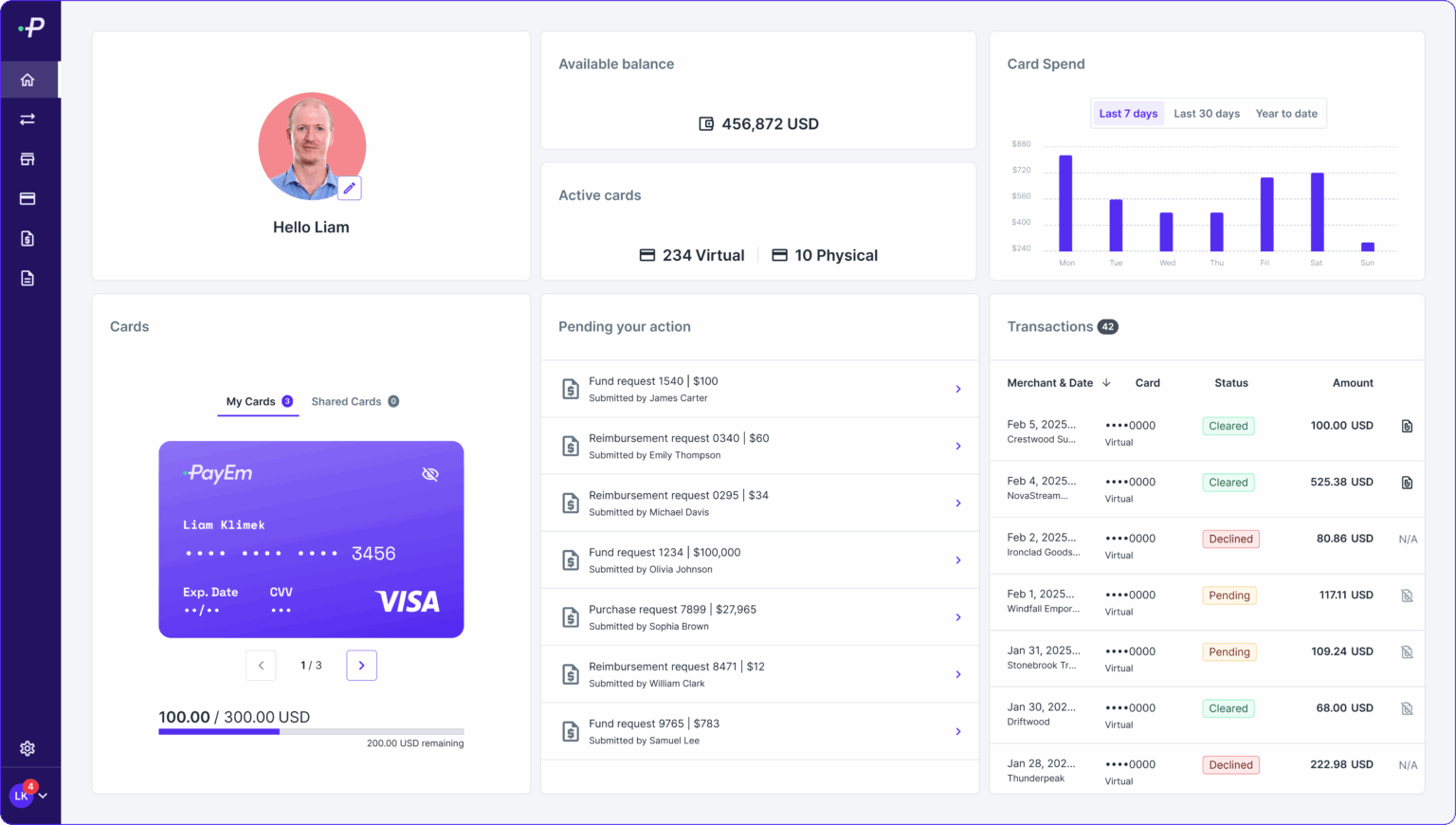
The card was visible. The real product was the paper trail around the card.
A large number made of two different kinds of money
PayEm emerged from stealth in 2021 with $27 million in seed and Series A funding. By January 2023, the company said its customer count had grown 300 percent over the prior year and revenue had risen 550 percent. It announced another $220 million. That was the number made for headlines.
But $220 million was a package: $20 million in equity and a $200 million warehouse credit facility from Viola Credit and Mitsubishi UFJ Financial Group. A warehouse line is not a pile of operating cash. PayEm could draw it to finance short-term customer payment activity, allowing cardholders monthly terms. The facility could grow with transaction volume and generate economics for lender and platform. It was fuel for the financial product, not simply fuel for payroll and product development.
The distinction became impossible to ignore three years later. Audited figures reported for 2025 showed about $6.4 million in revenue, $5.7 million in net loss, $15.8 million in assets and $17.1 million in liabilities. The first thing to fail was not the thesis that finance teams needed cleaner workflows. It was financial balance: the company was still losing nearly as much as it earned and had negative equity. Cost cutting and debt reduction started before the sale.
The buyer changed the ending, not the premise
In July 2026, Top Group Software bought PayEm through Nipendo. The reported price for all shares was $500,000. Top Group also committed up to $3.5 million, mainly to reduce liabilities and stabilize the business. Existing equity instruments and options were to be canceled, and workforce reductions formed part of the plan to reach operational break-even.
The price is startling. The product combination is almost boringly logical. Nipendo spent nearly two decades on the supplier side of procure-to-pay: purchase orders, invoice automation and buyer-supplier interaction. PayEm approached spend from the employee and payment side: requests, company cards, expenses and reconciliation. Together, they can follow organizational spending from the first request through supplier payment, employee card and general ledger.
That is what changed the strategic mind. PayEm had pushed beyond cards into procurement and vendor payments, but the task of being a global card program, a workflow company and a broad procurement suite is expensive. Inside Nipendo and Top Group, its cards and spend controls become components of a larger system. The acquisition trades standalone ambition for distribution, supplier infrastructure and a path toward break-even.
What an operator can steal, legally
First, ask for context at the moment of intent. A required project, entity, budget owner and business purpose are easier to collect before approval than after month-end. Second, let policy produce the payment method. A vendor-specific virtual card or a card tied to a purchase order is more enforceable than a handbook. Third, integrate where accounting truth lives. The interface may delight an employee, but finance software earns renewal when the ledger closes cleanly.
Cost also changes the fit. PayEm generally sells by quote. Its AWS Marketplace listing shows a $5,000 12-month Basic Plus contract and a $100,000 Advanced listing, but those are marketplace dimensions, not universal menu prices. The real bill depends on scope, usage, payments and contract terms. Buyers should model implementation and integration effort alongside the license, then test the one metric that matters: whether the system removes more manual work than it creates.
PayEm's story resists the tidy moral. The company found a genuine irritation, built a broad answer, won hundreds of customers and still arrived at a severe restructuring. The financing headline was technically true but conceptually muddy. The acquisition price was brutal but not the entire transaction. Between those numbers sits a good product lesson: money becomes easier to control when the reason for spending travels with it. Between those numbers also sits a harder company lesson: context can save an expense report, but only cash flow can save the company that makes it.