The first version of Concur came in a box. Inside were 3.5-inch floppy disks holding QuickExpense, a Windows program designed to rescue business travelers from the paper receipts breeding in their briefcases. It was 1993. “Sleepless in Seattle” was in cinemas, the Pentium chip was new, and three friends in the Seattle area - brothers Rajeev and Steve Singh and engineer Mike Hilton - had decided that expense reporting was annoying enough to build a company around.
They were right about the annoyance and repeatedly wrong about how to package the cure. That distinction is the useful part of the story. Concur first aimed shrink-wrapped software at individual users. In 1996 it moved upmarket, selling client-server software to big companies. Then it built a web product but still asked customers to install and run it like traditional enterprise software. Each version worked a little. None unlocked the business.
Same pain, four wrappers
The decisionThe web product was not the cloud product
The distinction sounds fussy now. It was existential then. Concur had made software accessible through a browser, but customers still bought a license, installed the application and carried the operational burden. The founders had modernized the interface without changing the economics. Rajeev Singh later called the company’s history “a series of pivots.” The last one - selling the application as a hosted service - created the growth story.
Concur made that move in 2001, near the floor of the dot-com crash. The public company’s market value had fallen to roughly $8 million. Conventional wisdom was hardly inviting: enterprise buyers worried about putting financial data on somebody else’s servers, and major software executives questioned whether cloud applications could make money. Concur nevertheless moved from an on-premise business toward an all-subscription one.
“We stuck with the original idea, but we had to be willing to change.”Rajeev Singh, co-founder
What failed first? The consumer model. Expense reports feel personal, but the buyer is the organization that writes the policy, pays the card and needs the ledger entry. What changed their minds? Not a sudden love of cloud jargon. The installed versions were not growing fast enough, while hosting let Concur update one system, sell recurring access and serve customers without a fresh installation at every company. The founders preserved the problem and replaced the buyer, architecture and revenue model around it.
The machineA receipt is only the opening scene
Today SAP Concur is less one app than a traffic controller for corporate spending. Concur Travel books flights, hotels, rail and rental cars while applying company policy. Concur Expense absorbs card transactions and receipt images, routes reports for approval and pushes data toward reimbursement and accounting. Concur Invoice captures supplier bills, extracts fields, matches purchase orders and maintains an audit trail. Request handles permission before the money leaves. Analytics turns the exhaust into a view of where it went.
Travel
Book inside policy, track itineraries and support duty of care.
Expense
Capture the receipt, match the card and route the claim.
Invoice
Extract, match, approve and report accounts-payable spend.
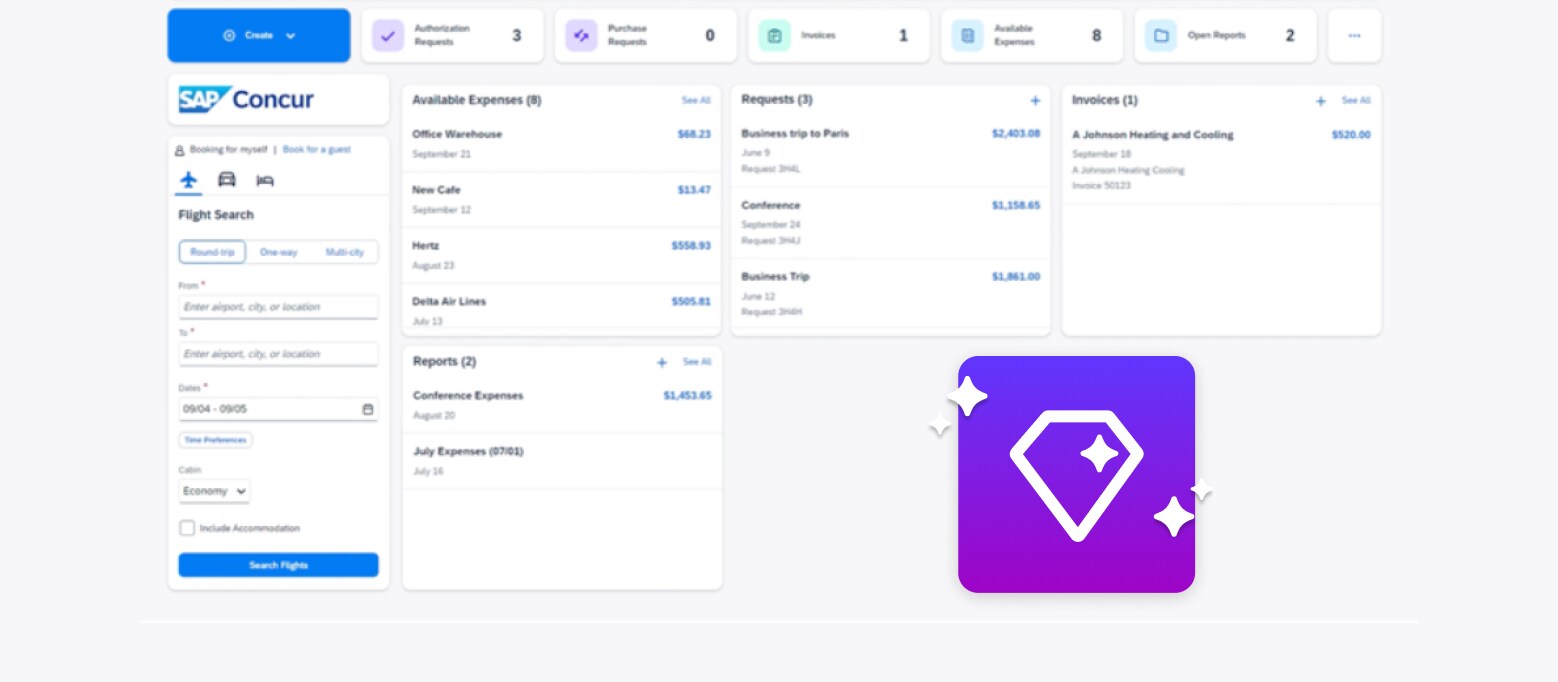
That connected path is the product. A traveler takes a photo of a hotel bill. ExpenseIt reads it, the card feed supplies the charge, policy logic looks for exceptions, an approver sees the risk, and the ERP receives a cleaner record. The employee wants reimbursement. Finance wants control. Travel managers want safer bookings and supplier leverage. Auditors want history. Concur sells one workflow to all of them.
users rely on SAP Concur worldwide, according to the company. It says more than 46,000 organizations use the platform and one billion expense transactions moved through it in a single year.
The customer list explains why breadth matters: PwC has standardized expense processes across 50 countries; Standard Chartered uses connected travel and expense data; manufacturers, universities, public agencies and entertainment companies share the same need for policy that survives borders. Cirque du Soleil’s old process involved pieces of paper moving through internal mail while shows moved every week. Its Concur deployment brought thousands of annual trips into one visible system. The circus, for once, wanted fewer moving parts.
The economicsSeven dollars per report, billions for the network
SAP Concur publishes U.S. entry pricing of about $7 per expense report for its Base plan and $11 for Plus, both with unlimited users. Premium is quoted. The final bill depends on report volume, travel, invoice, analytics, audit, support and implementation choices. The model is attractive because the trigger repeats: every employee trip, mileage claim or client dinner can produce another paid unit of work.
SAP paid $129 a share for Concur in December 2014, an enterprise value of about $8.3 billion. Concur then had more than 25,000 customers in over 150 countries, roughly 4,900 employees and a revenue run rate above $700 million. SAP was not buying a clever receipt camera. It bought subscription revenue, a travel ecosystem, millions of users and a position between corporate spend and the general ledger.
The modern competitive set attacks that position from several directions. Ramp and Brex pair software with corporate cards and emphasize real-time controls. Navan joins travel with expense in a cleaner, card-led experience. Expensify chases ease. Coupa and SAP Ariba reach into wider procurement. Tipalti and Stampli specialize in payables. Reviewers often score newer rivals higher on usability and setup. Concur answers with global reach, travel content, compliance, security and hundreds of connectors. Its very complexity is both moat and complaint.
The next pivotSoftware that wins by becoming less visible
SAP Concur’s latest ambition is to make travel and expenses “practically manage themselves.” Joule, SAP’s AI assistant, can answer policy questions, help assemble expense reports and guide compliant bookings. A receipt-analysis agent uses the receipt plus surrounding clues such as maps and itineraries to improve itemization. Booking Agent searches within policy. New approval tools surface risky submissions and explain why they deserve attention.
Partnerships supply data that software alone cannot. Mastercard transactions can create expense entries as the purchase happens. American Express virtual cards can be managed inside the workflow. Visa integrations widen real-time card coverage. Microsoft 365 Copilot is becoming another front door: employees can upload receipts, check report status or book travel without opening Concur. A 2025 alliance with American Express Global Business Travel produced Complete, an attempt to join booking, servicing, payments and expensing in one experience.
This will not work merely because an agent can produce fluent text. Expense systems act on money, employment policy, taxes and audit records. The acceptable error rate is lower than it is for drafting an email. Concur’s advantage is the policy context and transaction history already inside the system; its burden is earning permission to act without turning convenience into an untraceable mistake.
The copyable bitKeep the pain. Change everything around it.
Founders can copy Concur’s precision about pivots. The company did not wander from expense reports into an unrelated fashionable market. It changed who paid, where the software ran and how revenue arrived. It also treated disagreement as operating machinery: Rajeev Singh described internal fights as constructive, with founders able to argue one day and move forward the next.
Buyers can copy a different discipline: map the whole transaction before buying a feature. Receipt capture is useful, but value compounds when the card feed, travel booking, policy, approval, reimbursement and accounting entry agree. Start with the handoffs that create duplicate work or blind spots. Automate those before adding another dashboard.
Where the model earns its keep
Multinational operations, frequent business travel, intricate policy, regulated data, many card programs and deep ERP dependencies.
Where the weight shows
Small, single-country teams with simple card-and-receipt needs may prefer a lighter product with faster setup and bundled card economics.
The conditions matter. Concur’s playbook works when the underlying pain is stubborn, the workflow repeats and recurring delivery improves both product and economics. It works less well when customers need bespoke deployments, cannot trust a hosted system, or do not generate enough transactions to justify integration. The product itself can be too much machine for a small finance team. A moat to PwC can feel like a maze to a 30-person startup.
Still, the original observation has aged well. Receipts are tiny documents with an irritating ability to expose the whole company: its policies, systems, hierarchy and appetite for administrative pain. Concur has spent more than three decades following that little piece of paper. Its next trick is to make the paper, the report and perhaps the interface recede - leaving behind a transaction that arrives already explained.