At Elsevier, an expense claim could become a small administrative boomerang. One incorrect line was enough to send a report back through the process. Its finance team faced more than half a million line items annually. Local workarounds accumulated. Its expense system had become a map of everything the original system could not quite handle.
- Emburse connects expenses, travel, invoices and payments.
- Its practical pitch: catch problems earlier and stop entering information twice.
- The buying decision depends on workflow complexity, integrations and the right product.
That is a useful place to begin understanding Emburse. Expense management sounds like a filing problem. In practice, it is a coordination problem. An employee, a manager, an accountant and a country’s tax rules must agree about the same purchase. The receipt is the easy part.
The receipt that came back
Elsevier’s Oracle iExpense setup lacked mobile receipt capture, according to Emburse’s customer account. Categories multiplied across countries. What failed first was the fit between a global organization and a system unable to accommodate its local requirements cleanly.
Elsevier chose Chrome River, now called Emburse Enterprise, for its configurable country rules and workflows. Travel and expenses manager Maria Garcia described the attraction as handling those requirements “all within one central system.” The case study reports a 75% reduction in expense categories and centralized processing of 45,000 annual claims.
The revealing result is the smaller taxonomy. Software often promises to give people more choices. Here, the useful thing was making fewer choices necessary. Emburse’s expertise sits in that unglamorous territory: configurable rules, approval paths and the accounting connections that keep a purchase from becoming a clerical expedition.
A company assembled around the problem
Emburse has an unusually tangled family tree. The original card startup appeared publicly in 2015; Y Combinator lists Peter Lai and Roger Gu as founders. Its name later became the name of a much larger organization.
In March 2019, Certify and Chrome River announced a merger valued above $1 billion, with K1 Investment Management taking majority ownership. The combined business acquired the original Emburse that July. In January 2020, the wider group adopted the Emburse name, bringing together brands including Abacus, Captio, Nexonia and Tallie.
The logic was breadth. A small company and a multinational law firm might both submit receipts, but they do not need identical controls. In 2024, Certify became Emburse Professional and Chrome River became Emburse Enterprise. Those changes unified names while retaining existing functionality. Buyers still need to distinguish the applications underneath the surname.
Move the check upstream
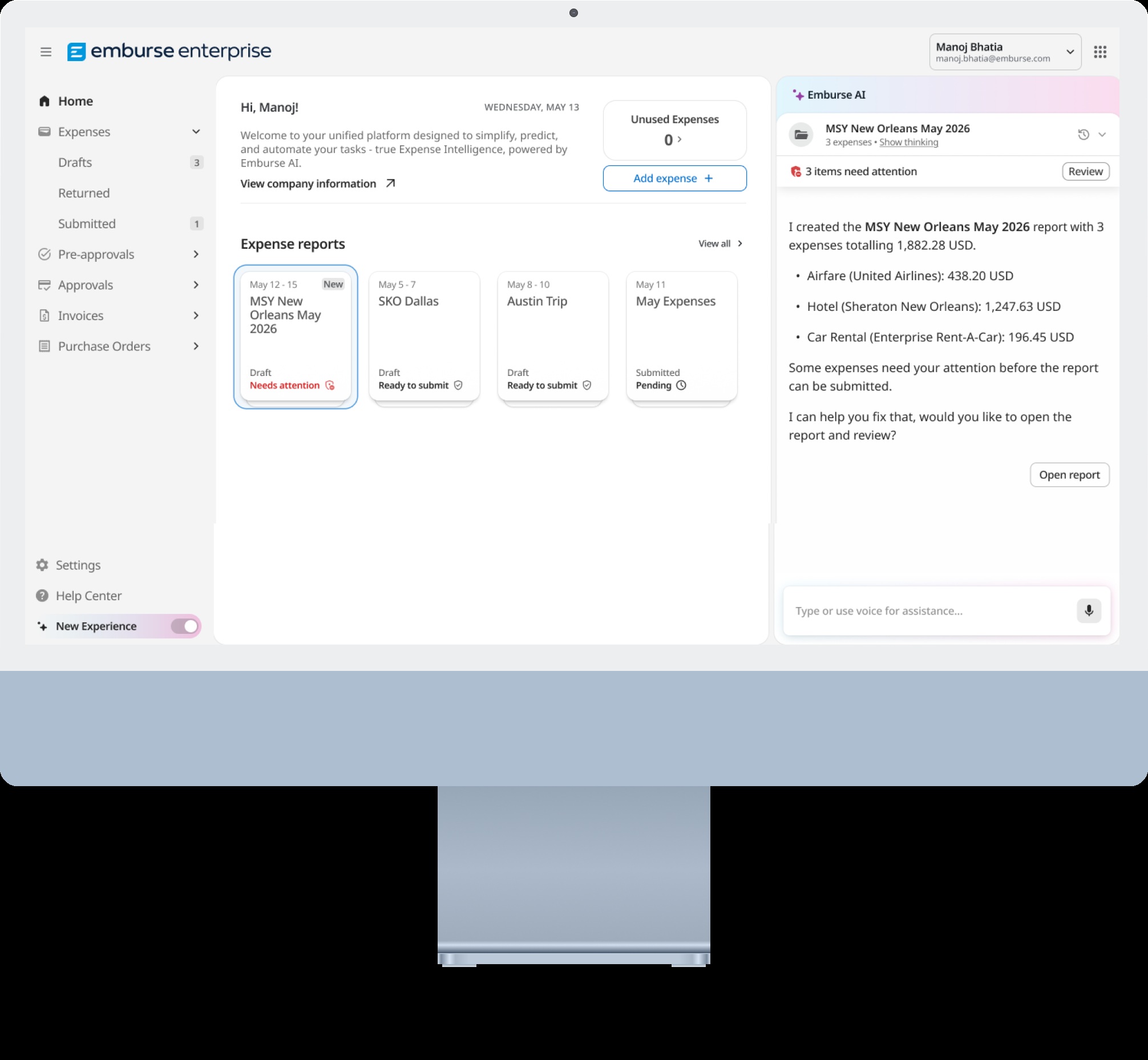
Today, Emburse calls its approach Expense Intelligence. The idea is to validate and categorize spending earlier, with policy checks before submission and information flowing into finance systems. In its October 2026 announcement, the company reported more than 12 million professionals across over 20,000 organizations in 200 countries and territories. Its customers span businesses, government agencies and nonprofits.
Consider travel. Emburse acquired TRIPBAM in July 2023, adding technology that monitors existing flight and hotel reservations and automatically rebooks when a lower price is available. A booked room remains a price worth checking. The acquisition’s financial terms were undisclosed; the potential savings depend on an eligible lower rate actually appearing.
A booked room remains a price worth checking.
In September 2026, Emburse announced AP for Professional and Spend, combining invoice processing, approvals, purchase-order matching and vendor payments. In August, it announced a Direct Travel partnership linking Avenir, powered by Spotnana, with its expense capabilities. These additions show the ambition: connect the booking, the purchase, the approval and the payment.
- 01CaptureReceipt + transaction
- 02CheckPolicy + context
- 03ApproveRoute exceptions
- 04ReconcileConnect accounting
Eight hours, found in the plumbing
Garmin supplies a more grounded test. Its expense process relied on spreadsheets and manual work. Employees waited for reimbursement; accounts payable had information to enter and duplicate expenses to find. Emburse’s customer story describes mobile submission, automated duplicate checks, ERP integration and ACH reimbursement.
The reported result was eight hours of AP time saved each week, with faster reimbursement for more than 2,300 users. This is a vendor-published case, not a promise for every deployment. Still, its mechanism is instructive. Connecting the expense system to the ERP removed work that otherwise had to be done by hand.

Services belong in this story, too. A configurable system needs people who understand what to configure. Emburse sells implementation and administration support alongside its applications. Its careers page describes employee learning through eCornell and names collaboration among its values. Those are the employer’s stated commitments; the buyer’s practical question is whether the support team understands the rules that make their organization unusual.
The bill for a shorter paper trail
Emburse makes money through software subscriptions and services. Its US Spend pricing lists Basic at $8 and Plus at $12 per expense-submitting user monthly, with a 15-user minimum. That implies minimum monthly subscriptions of $120 and $180 respectively. Optional guided implementation costs $1,500. These are published prices checked in October 2026, not a quote for Enterprise.
Against alternatives such as SAP Concur, Ramp or Brex, the useful distinction is Emburse’s range of workflows and support for existing systems. Spend lets customers connect supported corporate cards. Professional and Enterprise address different levels of complexity. Emburse itself directs organizations with demanding international tax, grant or matter-based requirements toward other products in its portfolio.
Payments add another distinction. Emburse describes itself as a software and financial technology platform; licensed partners provide the regulated money movement. A buyer should therefore check the payment arrangement as carefully as the expense interface. The approval screen and the route money takes are connected parts of the purchase, with different providers potentially responsible for each.
There is a useful test for the promise. Ask a vendor to demonstrate a missing receipt, a disputed charge and a purchase that crosses an approval limit. Decide who owns each exception after the software flags it. If the same people still have to chase the same information through separate systems, a cleaner dashboard will have limited value. This is a purchasing method rather than a prediction about Emburse: measure the work left over, and compare it with the work you already do.
The lesson readers can copy is straightforward: follow one expense from purchase to ledger. Count the retyping, the approval detours and the rules stored in someone’s memory. Then test those exact steps in a demonstration. Automation earns its fee when those handoffs disappear. A faster receipt photograph, by itself, leaves most of the problem waiting on somebody else’s desk.