Payroll software is easiest to admire from far away. Up close, it is county taxes, garnishments, overnight shifts, retroactive raises, employees working two jobs at two rates and a late timecard arriving after everybody thought the run was finished. Greenshades Software has made a 24-year business out of that closer view. The Jacksonville company does not promise to make payroll disappear. It promises to let an employer run the strange version it actually has - and keep its hands on the controls.
That puts Greenshades in an interesting corner of the human-capital-management market. The giants - ADP, Paycom, Paylocity, UKG and Dayforce among them - sell broad suites and, often, the comfort of handing more work to a provider. Greenshades sells a connected cloud platform for payroll, HR, tax compliance, benefits and time, but its sharper idea is operational sovereignty. Customers can schedule an off-cycle run, revise a deduction, hold their own tax funds and approve the result on their timetable.
The target is not every corner bakery. It is the U.S. mid-market employer whose workforce makes a clean demo look fictional: staffing agencies with constant rehires, healthcare groups with shift differentials, manufacturers moving people between departments, transport businesses crossing jurisdictions and nonprofits whose finance systems have been around longer than some employees. Greenshades says more than 4,000 companies use its platform, supporting over 2 million workers.
The wedge was taxes, not “the future of work”
David Rosas and Matthew Kane started Greenshades in 2002, when filing payroll taxes electronically was still new enough to be a product thesis. The company signed a customer that first year and, according to its anniversary history, still had that customer two decades later. By 2009, Greenshades served clients in all 50 states and had handled more than a million tax forms.
The expansion was patient. A hosted employee portal arrived in 2004-05. Paystubs, W-4 and I-9 workflows, profiles and basic timesheets followed in 2008. Benefits management appeared in 2013. In 2018, the pieces became an all-in-one payroll platform with a mobile app. The sequence matters: Greenshades did not begin with an enormous HR suite and hunt for a reason to exist. It began with an expensive, deadline-driven problem and accumulated the adjacent jobs.
That tax ancestry is still visible. The current platform calculates federal, state and local taxes, handles year-end W-2s, 1099s and 1095-Cs, watches ACA requirements and builds filing reports. Greenshades says it processed 3.8 million year-end forms for tax year 2024. This is not decorative compliance. For a temp worker who changes work locations, the correct withholding can change with the map.
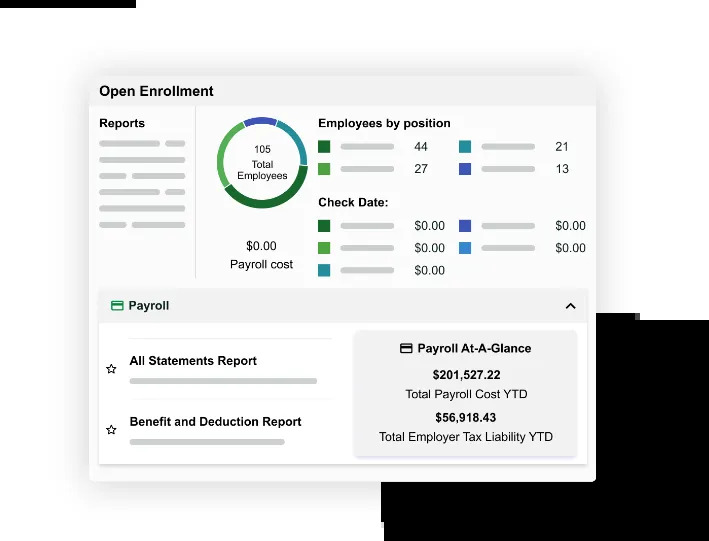
The product is the seam between systems
Greenshades is easiest to understand as a payroll layer that refuses to make the rest of the stack move out. It has deep roots in Microsoft Dynamics GP, NAV, AX and SL, and now integrates with Dynamics 365 Business Central and Finance. It also connects to Bullhorn and Avionté in staffing, Sage Intacct in finance and Acumatica in cloud ERP. An API exposes employee, payroll, benefits, deduction and reporting data.
placements + hours
pay + tax + approval
costs + journal entries
That architecture explains the pitch to staffing firms. A candidate can flow from Bullhorn into payroll; tax codes can follow changing work locations; labor cost can be tagged by client, placement and job; the completed run can post back to the ledger. What looks like a series of features is really an attack on re-keying. One record moves through hiring, time, pay, tax and accounting without a payroll administrator rebuilding it at each border.
“Greenshades gave us the capability to take our existing processes and automate them.”Jennifer Korbely · BurgerBusters
What changed, what failed, what it cost
The customer stories are unusually specific about the moment inertia broke. Farmers Union Mutual Insurance had an on-premise Microsoft Solomon system that made remote work awkward. Then Microsoft moved toward ending support and the insurer chose Business Central, which did not include payroll. Its adviser presented several replacements. Vice President Monica Vetere said competing quotes were high for a small company; Greenshades won on cost, integration and a design that seemed simple. The implementation was not a magic import. Vetere entered tax codes, benefits and deductions with a consultant in biweekly sessions. That hands-on work became training.
Sapphire Recruitment faced the same platform cliff at greater complexity: roughly 500 weekly employees across six states, with Dynamics GP nearing end of life and quarter close taking at least a week. It moved to Business Central and Greenshades with Implementation Specialists. The transition caused no reported payroll interruption. Sapphire says close fell to two days and employee self-service freed six to eight administrative hours each week.
Parks Marina had a more blunt calculation. Growth had increased payroll work enough that the company expected to hire another administrator. After consolidating onboarding, HR and payroll in Greenshades, one administrator could continue managing the process. The company puts the avoided salary at about $50,000. Andvaris, a staffing business operating across 12 states, says its move away from ADP cut payroll costs by a factor of four. Neither result should be treated as a universal ROI promise, but both show where the money hides: labor around the software, duplicate entry and provider fees.
The copyable lesson is not “buy Greenshades.” It is to price the whole workflow. Count the people printing paystubs, reconciling exports, correcting jurisdiction codes, waiting on a provider and answering employees who could retrieve a document themselves. Then test a replacement on the ugliest pay cycle, not the cleanest. A demo that cannot survive the late timecard, the rehire and the county-line change is theater.
A narrow difference in a very broad market
In 2025, new CEO Vince Murdica described Greenshades' strategy as the opposite of one-size-fits-all HCM: build for vertical markets with specific regulation, geography and organizational complexity. The company entered the Acumatica ecosystem that January, adding to its Microsoft, Sage and staffing integrations. In August, Accel-KKR Credit Partners provided growth financing to the WayPoint Capital Partners portfolio company.
The strategy also bends toward service. Flex Payroll Agent adds a named specialist who prepares and validates each run inside the customer's own Greenshades environment. The employer keeps real-time access and final approval. It is a clever compromise for a finance team that needs labor relief but does not want payroll to vanish into a ticket queue.
There are tradeoffs. Quote-based pricing makes comparison harder. Public user reviews praise flexibility, automation and responsive people, but some also describe reporting friction, rising cost, connector mismatches, slow resolution and rough product rollouts. A TrustRadius reviewer put the fit plainly: Greenshades works best when an in-house payroll team uses an ERP with a connector already built. Without that connection, much of the advantage can evaporate.
- Map every ERP, ATS, time and general-ledger handoff.
- Bring a real multi-state run with overtime, rehires and corrections.
- Ask who owns tax accounts, payments, filings and late penalties.
- Price implementation, forms, filing services and support, not just seats.
- Skip the complexity premium if your payroll is small, stable and single-state.
That last condition matters. Greenshades is unlikely to earn its keep for a tiny, uncomplicated employer that wants payroll fully outsourced. Nor is it automatically right for a company whose ERP lacks a proven integration, whose team has no appetite for implementation or whose priority is the broadest possible talent suite. The platform works when control has economic value - when the exceptions recur often enough that they are no longer exceptions.
Payroll will never have the glamour of the software categories built around creation, conversation or prediction. It has something sturdier: consequences. A missed social post waits. A missed paycheck does not. Greenshades has spent two decades in that gap, selling mid-sized employers a machine for getting the complicated answer right while letting them keep the keys.