Payday is a peculiar test of software. Nobody applauds a correct payslip. Get one wrong, however, and the employee does not need an analytics dashboard to notice. Mercans has built its business around that asymmetry: employers want increasingly complicated international payroll to produce an utterly ordinary result. The right person gets the right money, on time.
Consider the arithmetic in its GSK customer story. Mercans reports that the pharmaceutical company’s total cost per payslip fell from $14 to $6.50 after a payroll overhaul. Accuracy rose from 95% to 99.9%, while processing time contracted from five to seven days to 48 hours. Those are Mercans’s published case-study results, tied to a particular implementation. They are also a useful opening question: what was making a payslip so expensive?
The $14 payslip meets its replacement
In Mercans’s account, GSK already had Workday, but payroll and time-and-attendance systems remained scattered among local providers. The weak point was the connection between them: manual work, inconsistent information and limited visibility. Mercans deployed G2N Nova, connected inbound Workday data and introduced different time-capture tools for office and blue-collar employees. Bank files and general-ledger outputs became automated. The lesson is practical: buying an HR system does not finish the journey from employee record to bank payment.
For a buyer, the useful distinction is between the price of software and the cost of getting work done. A lower license fee can sit beside hours of reconciliation. A more automated service can move work out of the payroll team while introducing implementation costs elsewhere. The sensible comparison includes both. Measure the entire run, from collecting changes to correcting the final exception.
A global dashboard needs a global engine
Mercans sells payroll software, outsourced payroll operations and Employer of Record services. Its technological argument starts below the dashboard. HR Blizz is the application people use; G2N Nova is the calculation engine. Gross-to-net, shortened to G2N, describes the journey from an employee’s gross earnings through deductions to take-home pay. That journey changes with the country.
The company says its proprietary technology performs native payroll calculations across 160 countries on a single codebase. Its pitch is that customers can replace a collection of local calculation systems with a common engine. The distinction matters because a shared interface can conceal very different machinery underneath. A buyer should care where the calculation happens, who updates it and who answers when the result is challenged.
Mercans’s technology page reports 4,000 live HR Blizz customers and two million employees on the platform. These company-reported figures indicate the scale it claims for the software. The more revealing design choice is that the same platform supports different operating arrangements, allowing an employer to change how payroll work is divided without necessarily changing the underlying system.
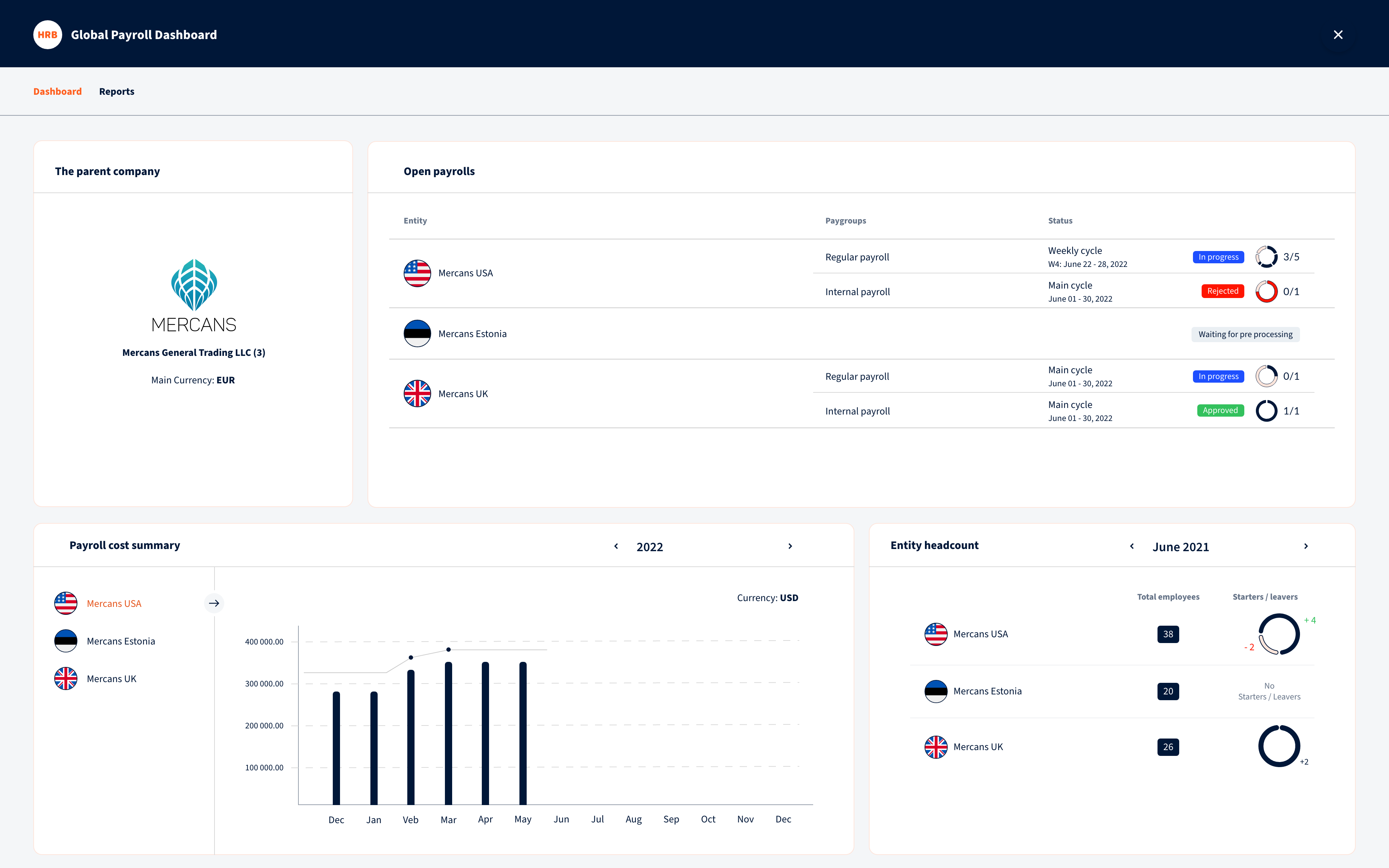
HR Blizz includes employee and manager self-service, payroll analytics, leave management, time and attendance, expenses and data exchange. Employees can retrieve payslips and manage personal information; payroll administrators can inspect pay groups, processing status and costs. These are modest tasks individually. Repeated across countries and pay cycles, they become the operating system of payday.
The product offers three delivery arrangements. With SaaS, the employer uses the software to run payroll. Fully managed payroll assigns the operation to Mercans. Co-managed payroll divides responsibilities between the two. This gives an internal payroll team a consequential choice about control, capacity and expertise. The contract needs to make that division legible down to approvals and corrections.
The company that chose a narrower job
Mercans’s history begins with London incorporation in 2003. Its own timeline places the launch of PEO and EOR services in 2007, a global payroll technology platform in 2009 and G2N Nova in 2023. Software therefore became part of a business that already understood employment services. That sequence helps explain its continuing combination of products and people.
A sharper strategic decision arrived in November 2022. Mercans separated talent management and HR advisory from its software and managed payroll operations, assigning the carved-out business the Mesaar brand and separate management. The announcement followed reported payroll-related revenue growth of more than 40% and a doubling of global headcount. Mercans presented focus as the reason for the change; it described the separated business as performing strongly.
“The carve-out will maximize the prospects for that business by creating a more agile and focused company.”Tatjana Domovits · founder and Group CEO · November 2022
The decision made the payroll proposition easier to understand. Mercans could concentrate its software and managed operations around HR Blizz while the other business pursued its own clients. Today’s catalog still includes HR advisory, mobility and incorporation support. The historical carve-out is best understood as an organizational decision, rather than evidence that every adjacent service disappeared forever.
The handoffs were the trouble
DSV provides a second view of the problem. Mercans describes the logistics company’s previous arrangement as SAP on-premise technology plus manual processes. Expansion required a payroll solution that could connect to SuccessFactors, handle more complex operations and improve employee access. The constraint was a workflow struggling to keep pace with the business.
Mercans says it deployed G2N Nova, integrated SuccessFactors and time clocks, introduced local-language self-service and automated reporting. It also established single sign-on and role-based access. Its case study reports payroll processing falling from five days to four hours and costs declining 35%. The numbers belong to that vendor account; they should not become a forecast for an unrelated employer.
There is something readers can copy without buying anything: map each handoff. Who supplies hours? Who owns changes to bank details? Who checks an unusual result? Which report requires someone to retype an already approved number? The GSK and DSV stories suggest that integration and process ownership deserve attention before a procurement team starts comparing attractive screens.
The price depends on who does the work
Mercans’s UK payroll-software page describes a fixed monthly fee plus a per-employee charge. That establishes a pricing structure for that offering, rather than a universal global rate. Employers evaluating the service should specify their countries, pay frequencies, employee numbers, integrations and desired division of responsibility. Otherwise, apparently comparable proposals may price different jobs.
Employer of Record adds another job to the bundle. Mercans offers employment through its provider entities for clients hiring without establishing their own local entity. Payroll calculation is part of that service, alongside employment administration. An employer with an existing entity and an experienced payroll team may need software or managed payroll instead. The right starting point is the employment arrangement the business actually requires.
The fit becomes less persuasive when the organization has little cross-border complexity, or when the savings depend on retiring systems it must keep. A migration also needs usable employee data and people authorized to resolve exceptions. Those are practical conditions for evaluating the proposition, not predictions that a particular implementation will fail. Automation can accelerate a well-defined process; an unresolved ownership dispute remains somebody’s job.
AI gets a job before the approval button
Mercans announced Enhanced Payroll Validation with AI Insights in October 2025. Its current HR Blizz presentation also promotes Instaroll, a continuous calculation workflow in which changed inputs trigger recalculation before an approver locks the run. The product demonstration separates calculation, validation, reports and approval. That is a more useful way to examine payroll AI than asking whether the software has a chatbot.
The operational question is whether the system exposes exceptions early enough for someone to act. A surprising deduction needs an explanation. An altered input needs a traceable history. The demonstrable value lies in the review workflow and the reliability of its outputs. A compelling animation cannot establish either; buyers need to run representative cases through the process.
The ecosystem matters here, too. Mercans announced official HiBob Technology Partner status in May 2025, including payroll and EOR marketplace listings. Avasant’s 2025-2026 assessment describes a separate collaboration with Deloitte on quality management and risk controls. Together, the two relationships address different enterprise concerns: connecting employee information and governing what happens after it arrives.

Mercans describes its workplace as remote-ready and hybrid, with more than 50 nationalities and an emphasis on autonomy and training. That is the employer’s account of its culture. It fits the staffing problem the product creates: a shared platform still needs people who understand local payroll, implementation and customer questions. The machine does not remove the need for specialists.
In payroll, trust has paperwork
In August 2024, Mercans announced approval of its Processor Binding Corporate Rules, a framework governing personal-data transfers within the group. For a service built around employee records, the relevance is direct. Data protection belongs in the operating model alongside calculations and payment files. It is part of the product an enterprise is buying, even when it never appears on a payslip.
Mercans competes in an established field. ISG named it a Leader in its 2025 Multicountry Managed Payroll Services quadrant alongside providers including ADP, CloudPay, Dayforce, Neeyamo and SD Worx. Everest Group’s 2025 EMEA assessment placed it among Major Contenders. Different assessments reward different combinations of capability and market presence; neither label settles a country-specific buying decision.
On September 3, 2026, Mercans also announced Leader placement in the IEC Group’s Global EOR Study. Its argument remains consistent across the product and employment businesses: owning more of the infrastructure should make one provider more accountable. The test for a customer is pleasingly concrete. Can it follow a changed employee record through calculation, review and payment without losing track of who is responsible? That is how an ambitious global platform earns an uneventful payday.