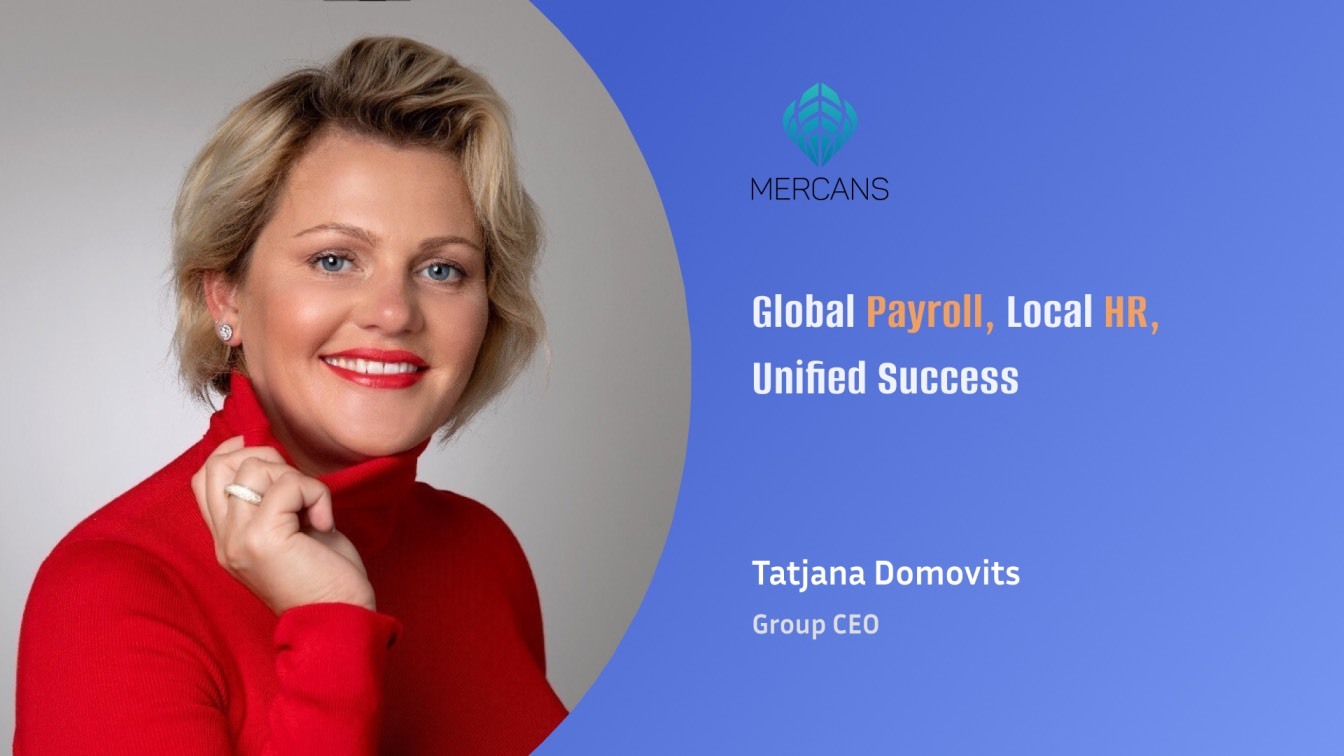
Tatjana Domovits noticed the time before she set out to change the software. Working in EY's audit practice, she could see how much manual effort went into payroll. The numbers were supposed to explain a business. The work required to produce them suggested a business of its own.
Her next move had a pleasing lack of theatre: she applied for a payroll job. Before attempting to digitize the process, she wanted to understand it from inside. There is something quietly persuasive about that sequence. First inspect the work. Then do the work. Only then propose a machine to help.
Today, Domovits is Mercans' founder and Group CEO, overseeing a business built around paying people across borders. Its familiar vocabulary includes HR Blizz, the payroll platform, and G2N Nova, its calculation engine. Her story begins with a less imposing idea: an everyday task can deserve much better tools.
The auditor changes sides
Audit offers a particular view of an organization. You examine the evidence left behind by decisions, transactions and routines. Payroll offers a closer encounter with the routine itself. A salary has to travel from an employment arrangement, through calculations and approvals, to the person expecting it. A neat total at the end can conceal an untidy journey.
Domovits' move makes sense in that light. She had identified an operational problem, then sought the experience needed to address it. The interesting detail is her willingness to become a learner again. Recognizing inefficiency is easy enough from a distance. Learning why people continue to work that way requires proximity, patience and occasionally a very long spreadsheet.
Her formal background includes an MA in Finance and a BA in International Business Administration. Those subjects are close companions in the business she now leads. Payroll brings together the arithmetic of a particular payment and the organizational puzzle of operating in different countries. The tidy-looking output depends on both.
That combination gives this career its shape. Domovits moved toward a task that repeats, with the intention of changing how it repeats. There is no need to dress the decision up as an epiphany. An auditor found manual work, decided it could be improved, and went to learn more. It is a serviceable beginning for a software business.
A software idea with 160 sets of complications
Mercans dates its beginnings to 2003. Its company history records service coverage reaching 100 countries in 2012 and 160 in 2018. These are useful milestones because they describe the accumulating scope of the problem. Adding another jurisdiction brings another body of local detail into a system that customers still want to operate coherently.
Domovits has described skepticism about building proprietary payroll software for 160 countries. In July 2022, when Mercans announced her appointment as Group CEO, the company presented native multi-country processing as the heart of its strategy. She described the result in a sentence that reads almost like a reply to the earlier doubters.
“Mercans has succeeded in breaking a misconception that building a multi-country payroll software is impossible.”
Tatjana Domovits, July 2022
The appeal of the idea is obvious from the user's side: one place to manage work that otherwise crosses many desks and systems. The difficulty lives underneath. A consistent interface cannot simply wish away local requirements. It has to accommodate them while keeping the overall experience intelligible. Simplicity is expensive to build when the underlying work remains complicated.
This is where Domovits' early interest in operational efficiency becomes a business proposition. Customers want a process they can understand and oversee. The person receiving a salary wants the right amount to arrive. A payroll company has to satisfy both perspectives, although only one of them is likely to appear in a procurement presentation.
- 2003Mercans begins
- 2012100-country service coverage
- 2018160-country service coverage
- 2023G2N Nova launches
The company needs more than a founder
A founder can spot the opportunity. Building the organization to pursue it introduces a different set of decisions. Domovits' public career includes a series of appointments that show Mercans developing its management and technical leadership around her.
In 2022, the company appointed Vishwanathan Arunachalam as chief operating officer. His remit covered day-to-day administration, sales and operations, alongside growth in software services. That is a substantial bundle of responsibilities to put into another executive's hands. It also describes the practical transition from carrying a business to organizing the people who carry it.
That July, Mercans added its long-serving CTO, Andre Voolaid, to the board. Domovits welcomed his payroll knowledge and experience developing the company's technology. Bringing a technology executive into governance gives software decisions a place alongside the commercial ones. For a business selling its own payroll system, those conversations belong close together.
Later in 2022, Steve Goldberg joined the board, bringing experience spanning HR leadership, product strategy and industry analysis. Domovits emphasized the independent perspective he could add. The appointments suggest a founder building a wider circle of judgment: operations, technical development, and an outside view of the market.
It is tempting to tell business stories through one person's certainty. These decisions offer a more useful version. A company needs people who know different things. Giving them responsibility means accepting that a founder's view becomes one contribution to a larger conversation. A good meeting occasionally has the decency to change somebody's mind.
Listening gets a place in the diary
When Domovits described her working day in 2023, she included regular conversations with IT, implementation and compliance teams. She also said she reserved at least thirty minutes daily to help employees with personal or professional difficulties. It is an unusually concrete detail in an executive's account of leadership.
The minimum daily time she said she devoted to helping employees with difficulties, in her 2023 interview.
A diary entry is a useful test of an abstract value. Listening takes time that could have been assigned to something else. It also creates a route for information to travel upward. Someone implementing a system, answering a client's question or handling an exception encounters details that a strategy document may smooth over.
Mercans extended that conversation to customers in February 2024 by launching a Customer Advisory Board. The plan included regular discussions and quarterly conference calls, with enterprise customers contributing to the development of HR Blizz and G2N. Domovits framed it as a way to understand what customers needed from the next stage of the products.
There is a practical connection between those two kinds of listening. Employees see how a service is delivered. Customers see where it fits into their own work. Inviting both perspectives makes the neat diagram answerable to the messy experience. Software can be demonstrated in an afternoon; living with it supplies a much longer examination.
The company around her now handles a broader employment brief. Its Employer of Record services cover tasks such as contracts, onboarding and local reporting, alongside payroll. That puts a founder who began by examining the payment process in charge of services that reach back toward the beginning of an employment relationship.
For Domovits, that breadth increases the value of the conversations she describes. A client may arrive with a payroll question whose answer depends on something decided earlier. Someone has to recognize the connection. Her emphasis on bringing implementation, technology and compliance teams into daily discussion fits a business where the handoffs deserve as much attention as the individual tasks.
Who gets the time back?
Domovits has connected automation with a personal aim for women working in payroll: more flexibility and more time with their families. The connection gives efficiency a beneficiary. A shorter process can mean something beyond a lower figure in an operating report.
That perspective asks a fair question of any technology project. Once a task takes less time, what happens to the time? It can disappear into more work. It can also create room for learning, responsibility or a life outside the office. The software alone cannot settle the question. Management has to participate.
Her 2025 account of leadership emphasized trusting established teams and making opportunities for women through flexibility, mentoring and support for career re-entry. These are specific organizational choices. They also move the discussion beyond the visible fact of a woman holding the CEO role, toward the conditions under which other women can build careers.
For Domovits, the question now reaches further than an individual payroll run. Her stated priorities include using payroll information to anticipate costs and risks, while keeping the experience understandable for employees. The ambition is to make the accumulated information useful before the next decision, as well as accurate after the last one.
Still answering the original question
In September 2026, Mercans announced its placement in the Leader quadrant of the IEC Group's Global EOR Study. Domovits' response focused on the operating model: owning infrastructure and building compliance into the platform. The emphasis was on responsibility for the work across the markets a customer enters.
That response has a recognizable relationship to her early career decision. The auditor wanted to get closer to how payroll happened. The executive now argues for a company that takes responsibility for more of the machinery behind it. The scale has changed; the interest in how work actually gets done remains visible.
Her career makes a case for paying attention to work that rarely earns a standing ovation. Payroll's recurring deadline offers little romance, but it supplies an excellent test. A promise has to become a payment. Domovits built her business around the distance between those two things, and the people whose time is spent closing it.