engineering-software
(17)
Jama Software and the expensive art of agreeing what to build
A brilliant product can still drown in contradictory requirements. Jama Software sells engineering teams a way to keep the promise, the change and the proof connected.

Onshape wants engineers to lose the files, keep the ideas
The people who helped build desktop CAD returned with a browser, a shared database and an awkward question: how much of engineering is really file management? Now part of PTC, Onshape is selling teams a different way to work.

AGI makes the expensive mistakes happen on screen
Before a satellite misses its connection or a test flight loses its signal, AGI lets engineers rehearse the consequences. Its lasting bet: the government should buy reusable mission software instead of commissioning the same mathematics again.
IMAGINiT and the hidden cost of clicking Print
Engineering firms buy powerful software, then spend precious hours feeding it. IMAGINiT has built a business around the small, stubborn chores that stand between a clever design and a finished job.

PETEX wants the whole oilfield in the equation
A well can improve while the field around it suffers. PETEX built its software business around that awkward fact, connecting reservoirs, wells and pipelines so engineers can see what their decisions really do.
The Gearbox Whisperers Teaching Electric Cars to Lose Their Whine
Inside SMT's stubbornly practical bet that the fastest route to a quieter, tougher electric powertrain is to stop passing its parts between disconnected simulation tools.
PhysicsX Wants Engineers to Stop Waiting for Physics
Born from Formula One's impatience, PhysicsX turns expensive simulations into near-instant engineering answers. Its real product is not a magic oracle but a carefully governed loop of data, models, validation and engineers who know when to call the old solver back in.
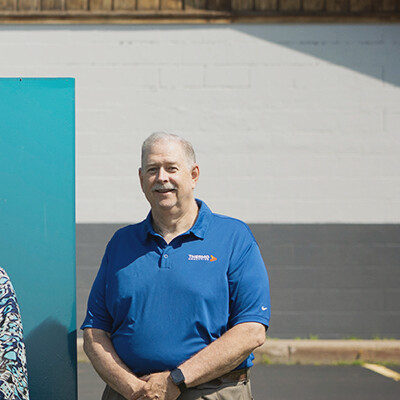
Tom Hogan Sells the Future in Degrees, Not Decibels
Before a battery overheats, a cabin chills its passenger or a vehicle reveals itself in infrared, engineers can model the outcome. Tom Hogan's job is to make that invisible foresight legible to the people who buy it.
NI Made the Test Bench Programmable. Emerson Bet $8.2 Billion It Could Make It Bigger
For nearly 50 years, NI has sold engineers a stubbornly useful idea: the instrument is better when software calls the shots. Now the company has Emerson's scale, an AI assistant named Nigel and the harder task of modernizing without breaking the systems customers already trust.

ThermoAnalytics Finds the Heat Mistake Before the Prototype Gets Expensive
The employee-owned Michigan firm turned contract engineering for Ford and the U.S. Army into software that predicts hot batteries, uncomfortable humans and visible military hardware - while those problems are still cheap enough to fix.
Detroit Engineered Products Built a Shortcut Through Engineering’s Slowest Loop
Every design change can send an engineer back through CAD, meshing and simulation. DEP built MeshWorks to break that loop - then turned the same playbook into a global engineering business.
BQE Had a Hit Billing App. Then It Bet $25 Million on Architects’ Messy Back Office.
The software company began with a garage-built fix for timecards and invoices. Thirty years later, its sharper idea is that architecture and engineering firms should not need a scavenger hunt to learn whether a project made money.
Novineer Is Teaching 3D Printing to Stop Guessing - Before the Plastic Gets Expensive
A seven-person Florida startup wants to replace the print-break-redesign loop with a photograph, a toolpath and a useful prediction. Its bet is simple: the next advance in industrial 3D printing may come from software that understands how the machine actually lays down material.
Autodesk
Autodesk is a design and make software company whose tools power the buildings, products, movies, and infrastructure of the physical world. Best known for AutoCAD, the company now spans architecture, engineering and construction (Revit, Civil 3D, Forma), product design and manufacturing (Fusion, Inventor), and media and entertainment (Maya, 3ds Max, Arnold). With roughly $6 billion in fiscal 2025 revenue and a near-fully subscription business, Autodesk's stated mission is to empower everyone, everywhere to design and make anything - increasingly with cloud platforms and AI woven into the workflow.
Vinci
Vinci (Vinci4D, Inc.) is a Palo Alto physics-AI startup building a foundation model that simulates how hardware will behave before it is manufactured. Its system runs full manufacturing-resolution physics - thermal, thermo-mechanical and warpage analysis for advanced semiconductor packaging and 2.5D/3D chips - up to 1,000x faster than traditional finite-element tools, without meshing and without training on customer data. Founded in 2023 by Dr. Hardik Kabaria and Dr. Sarah Osentoski, the company emerged from stealth in December 2025 with $46M in total funding and has been benchmarked by over half of the world's top 20 semiconductor companies.

Nominal
Nominal builds the software stack that lets hardware engineering teams test, validate, and operate complex physical systems - fighter jets, nuclear reactors, satellites, rockets, robots - as fast as software teams ship code. Its platform unifies high-frequency telemetry, logs, video, and simulation data so teams can analyze and trust every test. Founded in 2022 by veterans of the U.S. Navy, Anduril, Palantir, and Lockheed Martin, Nominal reached a $1 billion valuation in 2026 and now counts four of the five largest defense contractors among its customers.
Synopsys Inc
Synopsys is the quiet giant behind the world's chips. Its electronic design automation (EDA) software, semiconductor IP, and AI-driven design tools are used to design and verify nearly every advanced silicon chip on the planet - from smartphone processors to AI accelerators. Founded in 1986 by Aart de Geus and led today by CEO Sassine Ghazi, the Sunnyvale company turned the impossibly hard task of laying out billions of transistors into a software problem, and now layers AI on top of it. Its 2025 acquisition of simulation leader Ansys pushed it deeper into multiphysics and systems engineering.