There is a small indignity buried inside the creation of a car. An engineer changes a rib, a panel or a housing. The geometry moves. The simulation model that proved the old design safe no longer fits. So the team cleans the CAD, rebuilds the mesh, reconnects thousands of virtual pieces and runs the analysis again. The glamorous word is innovation. The daily reality is more like preparing the same elaborate spreadsheet after somebody nudged a column.
Detroit Engineered Products has spent much of its life attacking that indignity. Founded by Radha Krishnan in Troy, Michigan, in 1998, DEP began as an engineering services and software company. Three years later it launched MeshWorks, a computer-aided engineering platform built around a simple, valuable idea: preserve the intelligence already inside a simulation model. Morph it into a new shape. Parameterize what can change. Automate the boring connections. Then let engineers explore more designs before time and budgets close the door.
That makes DEP an odd and useful hybrid. It licenses software, but it also supplies the specialists who know where a model will break. It runs optimization projects, trains customer teams, designs products, performs crash and durability analysis, and fills technical roles. The company is neither a pure software vendor nor a traditional consultancy. It is a consultancy that kept productizing its scar tissue.
The loop DEP wanted to shorten
A finite-element model is not merely a pretty digital object. It is a product chopped into mathematical pieces, loaded with materials, joints, thicknesses, forces and boundary conditions. When the underlying design changes, much of that setup can become stale. Conventional workflows often bounce back to CAD and then return through meshing before another solver run can begin.
MeshWorks attacks step two. Morphing and parameterization keep a reusable model in play, while automation handles repetitive preparation. The solver still does the physics.
MeshWorks sits between design geometry and the specialist solvers that calculate crashworthiness, noise, heat, stiffness or fatigue. Its modules cover meshing, modeling, CAD and CAE morphing, parameterization, multidisciplinary optimization, process automation, post-processing, reduced-order modeling and electrification. ConceptWorks pushes the intervention earlier, allowing structural engineers to sketch and assess concept members at the CAE level before detailed CAD exists.
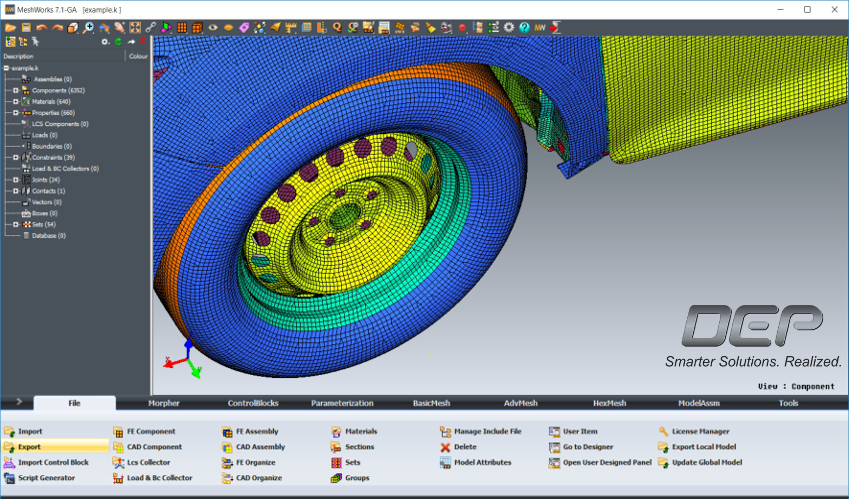
The distinction from broad CAE suites matters. Altair, Ansys, Siemens and Dassault Systèmes offer enormous portfolios of solvers, preprocessors and lifecycle tools. DEP’s wedge is narrower: CAD-independent morphing, fast parameterization and automation tied to people who have done the work on production programs. In some accounts it will complement a solver rather than replace one. The 2026 partnership with AVL makes that explicit: MeshWorks prepares and optimizes models that move into AVL EXCITE for dynamic and acoustic simulation.
“Physics-based simulation is here to stay.”Radha Krishnan, founder and president
The receipts are measured in kilograms
DEP’s case studies are anonymous about the customers, but refreshingly specific about the work. On an existing SUV platform, a MeshWorks-driven multidisciplinary optimization process varied gages and shapes against crash, noise and vibration, and durability requirements. DEP reported roughly 10 kilograms of mass savings with minimal changes. On a cylinder head and block, its “minimalistic” approach used topology optimization to find load paths, recreated ribs in MeshWorks and passed an optimized CAD model back to the design team. DEP reported 10% less mass while meeting performance targets, plus 60% time savings against a design-of-experiments approach.
The transmission-housing example tells the whole business story. A North American powertrain company wanted less weight without sacrificing noise, vibration, durability or stiffness. DEP created a parametric model, varied ribs, fillets and wall thicknesses, scripted post-processing, and integrated the workflow with Isight. The engagement took 12 weeks and included training the customer’s engineers. DEP did the consulting project, supplied the proprietary tool, automated the repeat work and transferred the method. That is four revenue motions hiding inside one housing.
Selected published outcomes
These percentages come from different DEP materials and different projects, so they are examples, not a universal benchmark. That caveat is also the practical lesson. Morphing works best when a team has a trustworthy legacy model, recurring variants, stable performance targets and enough simulation volume to repay the setup. It is less persuasive for a one-off object with no reusable baseline, for radical architecture changes that invalidate the old model, or where physical behavior cannot be represented reliably by the chosen simulation.
AI enters as a scout, not a judge
DEP’s newer platform, AIWorks, extends the same obsession with iteration speed. Historical test and simulation data feed surrogate models that estimate how a design may behave. “Features AI” recognizes geometry and mesh features; “Simulate AI” creates predictive surrogates; generative functions propose design concepts. In a full-vehicle aerodynamic or crash study, a detailed physics simulation can take long enough to ration curiosity. A surrogate can point to promising directions on the same day, then the expensive solver can validate the grown-up design.
That is a saner claim than replacing physics. The AI is a scout. It helps decide where to send the expedition. DEP said in May 2026 that Mahindra & Mahindra and Maruti Suzuki had used AIWorks for more than a year. A five-city Indian roadshow drew more than 800 engineers from 150 organizations. Krishnan also said automotive supplied about 60% of DEP’s global customer base, with named clients including Ashok Leyland, Royal Enfield, Ford India, Stellantis India and GM India.
What another company can copy
Find the expert task your team repeats for valuable customers. Capture the steps, encode the stable parts, keep specialists around for judgment, and sell the method before pretending the tool is self-explanatory.
When the playbook breaks
When every project is genuinely unique, the source data is poor, the legacy model cannot survive the change, or customers lack enough workflow volume to earn back implementation and training.
Four businesses wearing one badge
The product catalog can look sprawling until it is viewed through the customer’s risk. Buying a CAE tool is not like adding a note-taking app. A weak mesh can spoil a result. A clever automation can encode the wrong assumption at industrial speed. Engineers therefore buy confidence in layers. DEP can first solve a scoped problem as a consultant, then install MeshWorks, adapt an automation to the customer’s standards, train the team and supply extra engineers when a production program peaks. Each layer reduces a different reason to say no.
This explains why the company advertises software, engineering services, product development and workforce management together. The software creates reuse and licensing revenue. Projects bring domain context and expose the next repeatable chore. Training helps adoption. Staffing places DEP talent inside the workflow where new problems become visible. The flywheel is attractive, although not effortless: people businesses require hiring and management, customized deployments resist perfect standardization, and a customer may value DEP’s experts more than its license. Public materials do not break out revenue by line, so the balance between scalable software and labor-intensive services remains opaque.
For buyers, the right comparison is consequently broader than a feature checklist. A team already fluent in HyperMesh, Ansys or Simcenter may not want another general-purpose environment. DEP has to prove that model reuse, CAD-less iteration or a tailored automation removes enough hours to justify another vendor and the work of changing habits. Its strongest entry point is a painful, repeated workflow with a measurable target: kilograms removed, meshing hours saved, variants tested or reports generated. Its weakest is a vague transformation program where nobody owns the baseline and savings cannot be counted.
A global business with an Indian engine
DEP’s headquarters remains in suburban Detroit, close to the automotive customers that shaped its early work. Its footprint now stretches through India, Europe, China, Japan, Korea and other markets. The geographic split is revealing. In 2026, Krishnan described the United States as the largest market by revenue and India as the fastest-growing. More than 95% of MeshWorks and AIWorks development, he said, had been done in India.
Distribution partners extend the reach. EDS Technologies began carrying MeshWorks in India in 2019. Trident Techlabs later signed on for India, including academic markets. Dynas+ Engineering Products operates as a European technical center and reseller. AVL’s authorized distribution in the US and Europe is the biggest recent validation because it inserts MeshWorks beside an established mobility simulation stack rather than asking customers to rebuild their stack around DEP.
The company now presents itself across automotive, aerospace, marine, rail, energy, semiconductor, consumer electronics, healthcare and industrial equipment. That spread is plausible because meshing and optimization problems travel. But the business will be judged in the unglamorous details: whether automations remain robust across messy models, whether engineers trust AI predictions, whether tutorials and support keep pace, and whether a services-heavy sale can scale. Public pricing is not posted, which signals a consultative enterprise purchase rather than a swipe-card tool.
The most useful thing about DEP is not a futuristic slogan. It is its respect for a stubborn old fact: engineering time disappears between the big decisions. The model needs cleaning. The connections need remaking. The same variants need testing. MeshWorks is a wager that these chores can become reusable intellectual property. After a quarter-century, DEP is still selling that shortcut - now with AI scouting ahead and a much larger partner opening doors.