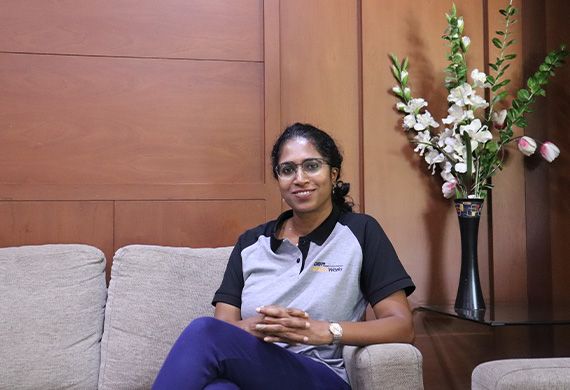
A computer-aided engineering model is magnificent company if you enjoy finite elements, parameterization and the quiet suspense of a load case. For everyone else, it can resemble a thunderstorm of acronyms. Shirin Hameed has built a career in the space between those two reactions. As Chief Marketing Officer of Detroit Engineered Products, she helps explain work that begins in simulation and ends in something decisively physical: a lighter vehicle, a shorter development cycle, a better manufacturing choice, a product that reaches the market sooner.
The interesting part is not that she simplifies technical subjects. Simplification can become a polite word for removing everything that matters. Hameed's method is closer to translation. Preserve the engineering consequence, remove the ceremonial fog, and give the customer a reason to connect the capability with a problem they actually have.
That distinction matters at DEP. The company sells engineering services, product-development work and MeshWorks, its integrated CAE platform. Its conversations range across automotive, aerospace, consumer electronics, energy and other industries. The buyer may care about morphing geometry without returning to CAD; the buyer's boss may care about man-hours, validation risk or the date a new design can ship. Marketing has to let both people recognize the same promise.
“We don't believe in one-size-fits-all marketing.”
The dashboard is not the destination
Hameed is unusually direct about measurement. She looks at impressions, response rates, cost per lead, return on investment, return on engagement and customer lifetime value. But she refuses the comfortable fiction that one number can judge every job. A campaign opening a new geography cannot be read like a program designed to keep existing customers engaged. Context changes the measure because context changes the work.
On LinkedIn, she framed the problem as four questions for marketing leaders: are their teams chasing real outcomes or merely reporting activity, are dashboards measuring what matters, are presentations showing performance or driving progress, and do goals connect to business impact? The questions are brisk, almost impolite. That is their charm. A dashboard can look extremely busy while a strategy sits perfectly still.
Her neatest phrase on the subject contains its own little reversal: “I love data. But really, I love outcomes even more.” It is not an argument against evidence. It is an argument against allowing the evidence display to become the objective. Data should help a team decide, not merely help it decorate Friday's presentation.
Pause the spreadsheet
Once a month, Hameed's team holds what it calls a “voice of the world” session. The premise is refreshingly analog. Pause the spreadsheets. Ask what the market seems to need. Ask who has been left out of the story. Listen especially to people close to the customer experience. Then return to the numbers with better questions.
This ritual reveals her larger idea about diversity. Different perspectives do not sit alongside performance as a separate corporate virtue. They improve the interpretation of what a market is doing and why. Algorithms can detect movement. People supply motives, omissions and the awkward exceptions that a tidy segment tends to erase.
There is a practical humility in pausing before analysis. It concedes that the marketing team may not yet understand the very audience it has quantified. It also guards against the industrial habit of polishing language until every person in it sounds like a procurement category. For a business dealing in optimization, Hameed keeps a pocket of productive inefficiency: time to talk before the dashboard gets the final word.
A career spent near complicated products
Hameed studied at Symbiosis Institute of Media and Communication from 2006 to 2008, with her qualification publicly described as an MBA in Communications Management. Her early career took her to Tata Technologies as a marketing communications executive, then to National Instruments as a marketing communications specialist. Both environments put her near products that punish vague explanation. An engineering audience notices when the copy has wandered away from the capability.
At DEP, she moved through marketing manager and global marketing manager roles before becoming CMO. The progression offers a quiet lesson in professional shape. Communications taught the sentence. Global responsibility supplied geography, channels and competing customer contexts. Executive responsibility added the harder question of whether the sentence produced movement.
Studies at SIMC in communications management.
Marketing communications at Tata Technologies.
Technical marketing communications at National Instruments.
Marketing manager, global marketing manager, then Chief Marketing Officer.
Public conversations on leadership, B2B trust, AI-assisted engineering and software-defined vehicles.
A former DEP colleague, Niju Nair, has described her as creative, tenacious in learning, patient with sales and product owners, and open-minded as a leader. That combination suits the job. Technical marketing is a relay race run by people who disagree about the baton. Engineering protects accuracy. Sales protects urgency. Product protects coherence. Marketing must keep all three without producing a brochure that reads like a committee meeting.
Proof has wheels, wings and deadlines
Hameed's public examples tend to land on concrete outcomes. DEP described helping reduce the mass of a Mahindra SUV model by 12 percent while maintaining performance targets, and reducing the mass of a shipping bulkhead by 28 percent while improving performance and preserving stiffness. The company also built an EV scooter as a technology demonstrator and displayed it at Auto Expo 2020.
For Auto Expo 2023, her marketing team synchronized physical and online activity around DEP's electrification capabilities, including a specialized module integrated with MeshWorks. That is a useful miniature of her role. The object on the floor, the software behind it, the campaign around it and the buyer's problem all had to arrive at the same moment.
Less mass. Fewer man-hours. Faster iteration. A clearer customer decision. Technical marketing becomes credible when the consequence can be inspected.
She has also explained digital twins in deliberately functional terms: converting a physical asset into a numerical one. A numerical counterpart can be analyzed, adjusted and learned from before every change is imposed on expensive matter. Strip away the science-fiction gleam and the appeal is managerial as much as technical. Discover more when mistakes are cheap.
The sale keeps going
In September 2025, Hameed used a podcast conversation to extend her outcomes argument beyond acquisition. In complex B2B markets, she said, the company is selling “a longer relationship with the client.” The post-sale experience creates the evidence for loyalty. Marketing, sales and customer teams cannot each tell an attractive but incompatible version of the truth.
This is particularly apt for engineering software and services. The contract does not instantly transform a workflow. People need implementation, feedback, technical support and time. Trust develops when the operational experience resembles the promise that opened the conversation. A clever campaign may win attention; consistency earns permission to remain.
Her formulation of mutual success also avoids a common B2B pantomime in which the vendor claims victory while the customer is still wrestling with adoption. If the customer becomes more capable, the relationship grows. If the product leaves them with a glossy deck and another disconnected tool, the funnel may report a win that the account remembers differently.
“AI is a tool, not a substitute for thinking.”
Smart machines, stubbornly human judgment
Hameed works at a company investing in AI and machine learning for engineering. She has discussed AI-assisted CAE, predictive engineering and software-defined vehicles. At the ETAuto SDV Summit in June 2026, her public message connected AI with faster development cycles, improved system accuracy and more efficient innovation pipelines. She is plainly interested in what the technology can do.
She is equally clear about what it should not do. In a pointed LinkedIn post, Hameed criticized auto-generated social comments that add volume without insight. Her complaint was not mechanical authorship by itself. It was surrendered individuality. Tools can accelerate a thought; they should not impersonate the presence of one.
That position gives her approach a satisfying symmetry. In engineering, AI can search possibilities, automate modeling and improve prediction. In marketing, it can process and distribute. But judgment still chooses the problem worth solving, the result worth measuring and the sentence worth sending. More output is only a triumph if output was the shortage.
The question beneath the technology
Hameed's subjects keep changing because engineering keeps changing: digital twins, cloud simulation, electrification, advanced driver assistance, AI and software-defined vehicles. Her core questions are steadier. What real outcome does this create? Who is missing from the interpretation? Can the customer trust the promise after the sale? Does the message sound as though a person meant it?
Those questions may look modest beside a glowing vehicle simulation. They are harder to automate. They also explain why her public voice moves so naturally between technical capability and people-first leadership. Both depend on seeing a system whole. A product is not only its feature set. A campaign is not only its dashboard. A customer is not only an account. An organization, like a digital twin, becomes more useful when the relationships between its parts are visible.
The CMO's task in that system is translation with consequences. Keep the engineering intact. Make the outcome legible. Then stay long enough to see whether reality agrees.