Before Nidhi Alexander had a marketing dashboard, she had a newsroom deadline. At Star Television, the work was to find a story, locate its cleanest question and make it legible before the clock won. She contributed to programs including Focus Asia and National Geographic Today, meeting people across cultures and professions. The glamour was incidental. The durable education was curiosity under pressure.
She learned to listen for what had not yet been said. Alexander calls it looking for “the question behind the question.” That phrase could serve as a job description for the rest of her career. In television it opened interviews. In enterprise technology it would open a different kind of conversation - with analysts, buyers, sales leaders and, eventually, an 85-person marketing team.
The change of beat was not planned. A move to Bengaluru early in her career left her far from the media houses that had made journalism feel permanent. She had no technology degree and no background in human resources. She did have English literature, postgraduate training in journalism and an instinct for how brands settle in the mind. So the reporter went looking for a new assignment.
The useful thing about an unexpected door
Infosys gave her one. Alexander joined work around InStep, the company's global internship program, conceived to bring students from leading universities into an Indian technology company. “Global employer brand” was not yet the boardroom phrase it later became. The premise was more concrete: invite talented students into the actual place, give them serious work and let experience carry the story home.
The program demanded equal parts editorial judgment and operations. A promise to students in another country had to survive selection, travel, projects, mentors and the daily reality of an unfamiliar workplace. InStep gained international press attention and became material for business-school case studies. Alexander took from that period a sentence she still repeats: strategy is only as good as its execution.
The story changes desks
Her path then ran through analyst relations, branding and marketing at Infosys, Polaris Financial Technology and Mindtree. The audience changed, but the work still asked: Who needs to understand this? What do they need to believe? What evidence will survive scrutiny? Analyst relations was an especially exacting school. An elegant claim is of little use when an informed outsider can test it against competitors, clients and delivery.
“You can have the most beautiful story in the world, but if data is not backing it up, it's just noise.”Nidhi Alexander
At Mindtree, those relationships became a demand channel as well as a reputation practice. At Hexaware, which she joined in January 2020, Alexander first led analyst and advisor relations and stepped into the CMO role in August 2022. The filing language makes the span clear: brand management, content, digital, social, corporate initiatives, analyst and media relations, market research, field marketing and omnichannel demand generation. This is less a department than a small weather system.
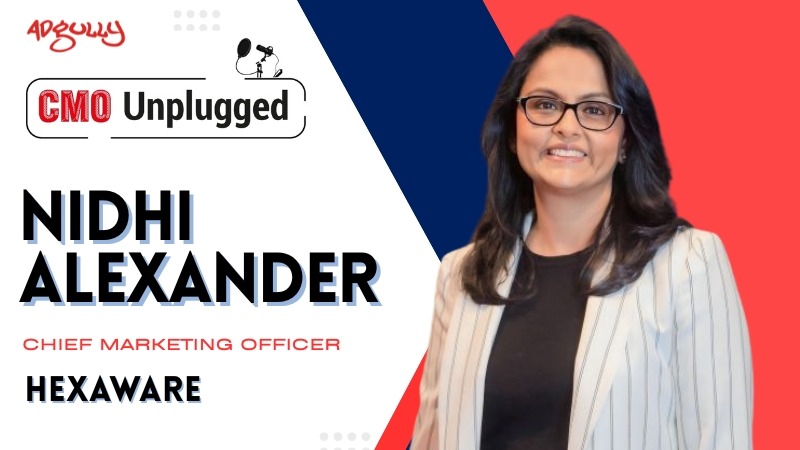
A CMO with a scoreboard
Alexander's distinction is not that she likes stories. Marketing executives are professionally required to like stories. It is that she keeps asking them to show their workings. In her telling, the CMO's remit has moved from running campaigns to improving how the business wins. That means spotting market movement early, raising pipeline quality and making the transfer from marketing to sales less like a ceremonial passing of the baton.
One early portfolio decision illustrates the temperament. She inherited a mix weighted toward content syndication. It produced marketing-qualified leads, but too few became sales-qualified opportunities. Alexander shifted emphasis toward events. Hexaware went from 16 events in 2022 to 45 the next year on the same budget; she reported a greater than 500 percent increase in demand generation through the marketing channel. The important detail is not that events are universally better. It is that a cherished tactic was asked to earn its keep.
By 2026, she described a weekly operating rhythm in which marketing sourced roughly three requests for proposal a week. Her team tracked brand signals alongside demand. Buyers, in her view, should encounter the same story from analysts, advisors, customers and employees. A shared proof library keeps the language consistent; paired measures compare external consideration and references with internal advocacy and enablement.
The approach is commercial without becoming bloodless. Alexander treats the client relationship as the part competitors cannot easily copy. Hexaware's ForeSight summit and Customer Advisory Board are designed to let senior clients shape conversations before a formal buying process appears. Its CEO Tech Live series has put enterprise leaders into public conversations over three seasons. The relationship does work that no product sheet can manage: it makes a company familiar before it asks to be chosen.
The machine gets an editor
Artificial intelligence complicates this tidy argument because it makes competent-looking language abundant. Alexander's answer is to use the machine and retain the editor. At Hexaware, generative AI helps cluster topics, build account briefs, draft complex content, generate controlled creative variants and detect early buying intent. Guardrails sit above the workflow: style checks, disclosure norms and human quality assurance before publication.
This is where her journalism training seems least nostalgic and most current. A newsroom also moves quickly, combines inputs of uneven quality and makes judgment visible through what it chooses to publish. AI changes the speed and volume. It does not cancel the obligation to decide what is true, useful or worthy of a reader's time.
Marketing can rent attention. Alexander's harder brief is to earn belief.
She calls Hexaware's approach AI-led and human-perfected. The phrase risks the smoothness common to corporate language, but the mechanism beneath it is specific: automation for compression and variation, people for context and accountability. Her own career offers the analog version. Each move gave her unfamiliar material. Curiosity compressed the distance; judgment decided what to keep.
Tenacity, properly edited
Alexander's favorite leadership trait may be tenacity, but her early stories keep it human-sized. As a young journalist seeking an internship with Nutan Manmohan, she arrived at the office unannounced. Turned away because the journalist was busy, Alexander waited. Hours later she got the meeting; minutes after that she had the internship.
On another assignment, former Pakistani prime minister Benazir Bhutto cancelled a scheduled interview after travel left her unwilling to continue. Alexander urged the crew to remain, quietly, since the equipment was already there. When Bhutto emerged, the team gave her room rather than applying pressure. The patience worked. They got the interview, and Alexander left with a signed book.
These are charming anecdotes because success arrives before the scene ends. Corporate tenacity is usually duller. It lives in weekly reviews, repeated briefings, revised allocations and the long work of making one external promise agree with thousands of internal actions. Alexander has received awards at Infosys, Polaris and Mindtree; in 2025 she was recognized for marketing leadership by the International Business Awards and for her body of work by the MarCom Awards. The plaques are conclusions. The habit is repetition.
People who have worked with her publicly describe ownership, collaboration and a willingness to help others succeed. Her own advice is similarly practical: keep learning, build relationships, accept failure as instruction and use a moral compass when convenience offers a shortcut. She has argued that companies should behave as citizens of their communities, organizing people around useful local work rather than treating responsibility as decorative philanthropy.
The transferable craft
Alexander's career is often presented as a dramatic pivot from journalism to technology. The more interesting reading is that it was a transfer. Television gave her framing, audience awareness and comfort with deadlines. InStep added systems and employer brand. Analyst relations taught verification. The CMO seat added capital allocation, team design and revenue accountability. Nothing vanished; each layer made the earlier one more useful.
She now lives and works in the New York metropolitan area, far from the Bengaluru move that disrupted her original plan. In a 2026 reflection, she wrote that a meaningful career does not require a straight line. Industries and titles change; mindset shapes the story. It is sound advice, though her own record adds a necessary footnote: mindset must eventually meet a calendar, a budget and somebody willing to do the work.
The reporter is still there, listening for the missing question. The executive has simply given her a larger notebook - one with client relationships, AI workflows, brand health and pipeline in the margins. A story may open the conversation. Proof keeps it open. Execution decides whether anyone remembers it.