There is a small arrow hiding in the Onix logo. It sits between the I and the X, a sliver of negative space aimed toward whatever comes next. Jessica Wesley likes this detail. As chief marketing officer, she has explained the mark as a picture of forward movement, while the rounded O suggests a cloud and a partnership. Even the letters have assignments. The I carries innovation and intelligence; the X gestures toward service and multiplied results. No part gets to loaf.
This is a telling way to approach a brand. In Wesley's hands, a logo is not the bit that arrives after the real work. It is a pocket-sized account of the real work. Onix, a company with more than three decades behind it, was shifting from a history weighted toward licensing into a broader cloud consulting and services business. The identity had to acknowledge both facts at once: the company had history, and the company had changed.
So the familiar red stayed. The typography, illustrations, language, and digital presence moved. The resulting system tried to make a complicated business easy to retell. It is an old marketing problem wearing very current clothes. Cloud migration, data engineering, and agentic AI are consequential subjects, but their vocabulary can make a sensible buyer feel as though someone has swapped the meeting notes for alphabet soup.
“There was a lot of thoughtfulness that went into the creation of the new logo.”Jessica Wesley on the Onix identity
Wesley's public career suggests that translation is the durable part of her craft. Products change. Platforms change. The particular flavor of technological upheaval changes with exhausting reliability. Her work keeps returning to the same question: how can a business make change intelligible without making it bland?
The apprenticeship was in attention
Before hyperscalers and AI platforms entered her professional vocabulary, Wesley worked closer to the consumer. At Euro RSCG, she handled account work tied to Sprint retention communications. A colleague from that period remembered her using consumer insight, competitive research, and the client's commercial priorities to locate the customers most worth keeping. That is less glamorous than unveiling a brand under conference lights. It is also excellent training. Retention work teaches the marketer that people are not obliged to stay merely because a company would find their departure inconvenient.
An integrated marketing communications internship at Motorola Solutions sharpened a related instinct. Her manager recalled a quick learner and good listener who earned favorable responses from colleagues in her first weeks. The recommendation also describes someone comfortable leading projects and bringing strategic suggestions into the room. There is a useful sequence in that description: listen, learn the system, then recommend. Reverse it and one becomes a consultant in search of a problem.
Morningstar appears in the route that followed, then Maven Wave, the Chicago consultancy that became her long professional education in cloud services. By 2014 she was its director of marketing and leading a new visual brand. The occasion was growth: a larger office, more recognition, and a company whose old presentation no longer matched its ambitions. “With our rapid expansion, the brand needed to grow with the company,” she said at the time.
Consumer insight and account work at Euro RSCG, followed by communications experience at Motorola Solutions and work at Morningstar.
Led Maven Wave's visual brand evolution as the cloud consultancy expanded in Chicago.
Moved through global cloud marketing and Americas marketing leadership roles at Atos.
Chief marketing officer at Onix, spanning brand, demand, customer engagement, and the enterprise AI story.
Maven Wave eventually joined Atos, and Wesley's remit widened. She became vice president of global cloud marketing, then vice president of marketing and communications for the Americas. The scale changed from regional consultancy to global systems integrator. The underlying task did not. In a partner ecosystem, every story has several owners: the consultancy, the hyperscaler, the client, and the people expected to make the technology work on Monday morning. Marketing must preserve the relationship between them without producing a sentence only a procurement committee could love.
A rebrand you could use in a meeting
Wesley arrived at Onix in 2023 with roughly a decade spent around systems integrators and Google Cloud partners. The company she joined was in motion. It had new ownership, a new executive team, an expanding services model, and an old reputation that needed to stretch. Her first visible assignment was the rebrand, and its cleverness lay in its practicality. A salesperson could point to the O, the arrow, or the X and recover the corporate story without opening a 74-slide deck.
A brand built as a sequence of signals
The red maintained continuity. The cloud shape located Onix in its partner world. The forward arrow provided direction. The language connected the company to end-to-end delivery rather than a single transaction. This is brand architecture at its least mystical. It gives people common phrases for a company that has become different from the one they remember.
That distinction matters in enterprise technology, where a reputation can lag behind a business model by years. A licensing company can become a consulting company on an organization chart much faster than it can become one in a customer's mind. Wesley's job was partly to close that distance.
The campaign that listened back
The more revealing work came after the launch. Onix created an executive customer advisory board, bringing leaders from important accounts into recurring conversations about the company's direction. Wesley described the commitment as a way to “engage and uplevel” relationships with customer executives. The council was not arranged as a ceremonial audience for finished ideas. Its feedback influenced the product roadmap, research and development priorities, and broader strategic choices.
Within its first year, the program reported full retention among participating customer accounts, consistent executive engagement, and openings for co-innovation and account expansion. The percentage is neat. The mechanism is more interesting. Onix gave customers a view into the workshop, and the customers helped decide what should be built there.
There is a pleasant reversal here. Marketing usually projects a company's voice outward. A good advisory board brings outside voices back through the walls. The signal travels both ways. For a business remaking its identity, this is an unusually honest form of research: strategic accounts can say where the new promise feels real, where it feels thin, and what they would pay to see next.
It also reframes trust. Trust is a word technology companies use so often that it risks becoming atmospheric, present everywhere and visible nowhere. A recurring council is visible. Customers spend the time. Executives respond. Product decisions change. Accounts remain. The abstract value acquires a calendar.
Las Vegas, with the humans left in
By Google Cloud Next in 2025, the revised Onix story had accumulated more moving parts. The company arrived in Las Vegas with a large team, customer meetings, booth demonstrations, speaking sessions, a private event called Bollywood Nights, and Wingspan, its new agentic AI platform. It also came away celebrating two Google Cloud Partner of the Year awards, one in data and analytics and another in telecommunications industry solutions.
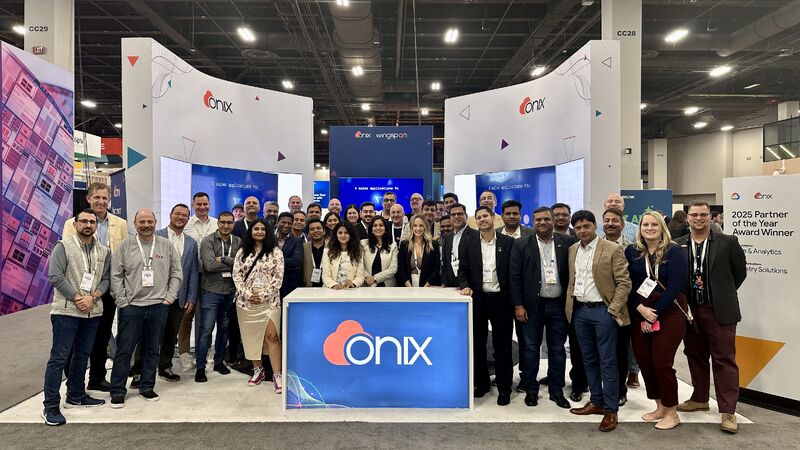
Wesley's own recap called the week electric, but the revealing phrase came when she turned toward the people behind it: “a small and mighty force who brought this all to life.” Then she named them. Marketers, designers, communications colleagues, agency partners, and executives all appeared in the roll call. Public gratitude can become syrupy in corporate posts. Hers was specific enough to function as a record of who did the work.
The team answered in kind. One colleague thanked her for an empowering style and the confidence she placed in others. Another said it mattered that she was always available. Those are modest observations beside an AI platform launch, which is precisely why they are useful. Anyone can claim a culture in a recruitment brochure. Colleagues reveal it in the small verbs: trust, empower, answer.
Wesley has also stepped into the content herself. In March 2025, she hosted a compact session with Onix's data leadership about the unromantic prerequisite for enterprise AI: dependable data. The conversation emphasized governance, curation, consolidation, and the difficulty of building useful systems on scattered information. Later, she joined a webinar about how a workplace AI platform could support marketing, sales, human resources, and executive teams, with change management as the condition for adoption.
This is where her work comes full circle. The subject may be agentic AI, but the practical obstacle is still human comprehension. People need to understand what a tool is for, why the underlying data matters, and how their work will change. The cloud does not become simpler because the brochure says “seamless.” It becomes usable when the company names the hard parts and gives people a route through them.
The durable job inside a changing industry
Wesley's biography is unusually consistent for a career conducted in an industry addicted to novelty. Early consumer work taught her to notice why people stay. Communications work taught her to listen before proposing. Maven Wave gave her a growing company's brand to reshape. Atos expanded the map to global cloud marketing. Onix brought those strands together: identity, partner ecosystems, customer voice, team leadership, and the daily effort to make technical change sound like something a person might choose.
There is one biographical detail that feels almost too tidy. Wesley studied Italian language and culture while living in Verona and traveling through Western Europe. Language study rewards attention to context, cadence, and the small differences that decide whether a phrase lands. Enterprise marketing asks for the same attention, only with worse acronyms and fewer piazzas.
Her current ambition is visible in the work more than in any grand declaration. Onix wants to be trusted as a cloud consulting partner while it moves deeper into data and AI. Wesley's contribution is to make that movement recognizable to customers and repeatable by colleagues. The logo carries the direction. The customer council tests it. The events put it onstage. The team makes it credible.
A marketer cannot make a transformation true by describing it beautifully. She can, however, expose whether the parts agree. Does the product match the promise? Do customers recognize themselves in the roadmap? Can employees explain the strategy without borrowing a thesaurus? Wesley's work treats brand as the place where those answers meet.
The hidden arrow is therefore more than a charming device. It is a small standard for the whole operation. Look closely. Find the direction. Make every element do some work.