Before the cloud, before containers, before security teams began worrying about autonomous agents making decisions from incomplete inventories, Meghan Mitchell-Marks worked at a television station. Oregon Public Broadcasting, Portland's PBS station, was the first line on a career that would eventually fill with increasingly technical nouns. Hardware. SaaS. Digital grids. Cloud-native applications. Asset intelligence. The nouns grew colder and more abstract. Her work remained stubbornly human.
Today, as chief marketing officer at Axonius, Marks sits between people who want the engineering details and people who want to know what those details will do to a business. She calls cybersecurity marketing a constant act of translation. One conversation may demand technical precision; the next may require a clean account of business outcomes. The trick is to make the complex feel simple without making it simplistic.
That distinction is where careers in enterprise marketing are either made or buried under a tasteful avalanche of jargon. Cybersecurity companies sell things that are difficult to photograph, tedious to explain and urgently important only when something has already gone wrong. Fear is the industry's convenient fuel. Marks has chosen another one: confidence.
“The biggest misconception is that cybersecurity marketing is all about fear. For me it's actually about confidence.”Meghan Mitchell-Marks
The long route to a short sentence
Marks moved from public broadcasting into technology, first marketing physical hardware and then software as a service. She has said she has now spent about 20 years in SaaS marketing, moving between smaller startups and large organizations. Her public résumé includes Radisys and Serena Software, followed by senior roles at Siemens. At Puppet, she ran global demand marketing and earned recognition in CRN's 2018 Women of the Channel for expanding indirect revenue programs.
The sequence matters because it trained both halves of the executive brain. At big companies she encountered scale, systems and the inevitable abundance of interested parties. At startups she encountered speed, scarcity and the invigorating possibility that Tuesday's decision might become Friday's campaign. She learned to speak both dialects.
In February 2019, Marks joined container-security company Twistlock as vice president of marketing. The company had just reported that both sales and its customer base had grown more than 250 percent during 2018. Her remit was global go-to-market work. Three months later, Palo Alto Networks announced an agreement to buy Twistlock for approximately $410 million; the deal closed that July. Twistlock's technology was folded into Prisma Cloud, and Marks went on to lead marketing for the Prisma Cloud business.
This was category construction performed while the building was moving. Containers, serverless computing and multi-cloud architecture were changing how software was made. The security language had to catch up. Marks was not merely presenting a finished product; she was helping a market understand why its old mental models no longer fit.
Give the creative people something worth keeping
Marks joined Orca Security as CMO in 2021, when the company extended its Series C financing to $550 million. Orca offered an agentless approach to cloud security, promising broad visibility without installing software on every workload. It was a technical proposition entering a very crowded market. The marketing problem was easy to describe and difficult to solve: sound distinct without becoming louder for the sake of volume.
Her approach to the team was equally direct. She does not regard a large marketing department as a trophy. The accomplishment, she has said, is having the right team, with people who understand their parts in the process. Her model pairs an internal group of writers, creatives, field marketers and digital operators with external specialists who can bring current expertise. The arrangement works only when neither side treats the other as a rival.
There is a small but revealing principle inside that model: in-house creatives deserve the exciting assignments too. If every conspicuous project, from the glossy commercial to the wrapped race car, automatically leaves the building, the internal team becomes a production desk while somebody else gets a portfolio. Marks wants employees to make work they are proud to keep. It is hard to manufacture loyalty while exporting all the fun.
Strong internal craft + outside perspective + clear roles - needless rivalry.
She is candid about the temperamental weather of creative work. Marketing is emotional, she says, because its purpose is to make people react, think, feel and act. Good marketers care, which makes criticism useful and occasionally bruising. The leader's job is not to eliminate the emotion. It is to point it in a productive direction. Thick skin helps, but so does remembering that salespeople are carrying market feedback from what she calls the literal trenches.
That philosophy became visible in Orca's 2022 campaign, “The Cloud is Yours.” Its premise was empowerment and transparency. Marks acknowledged that it might sound unusually emotional for a cloud-security company, then argued that change, uncertainty and the pressure to keep an organization secure are emotional already. The campaign simply declined to pretend otherwise.
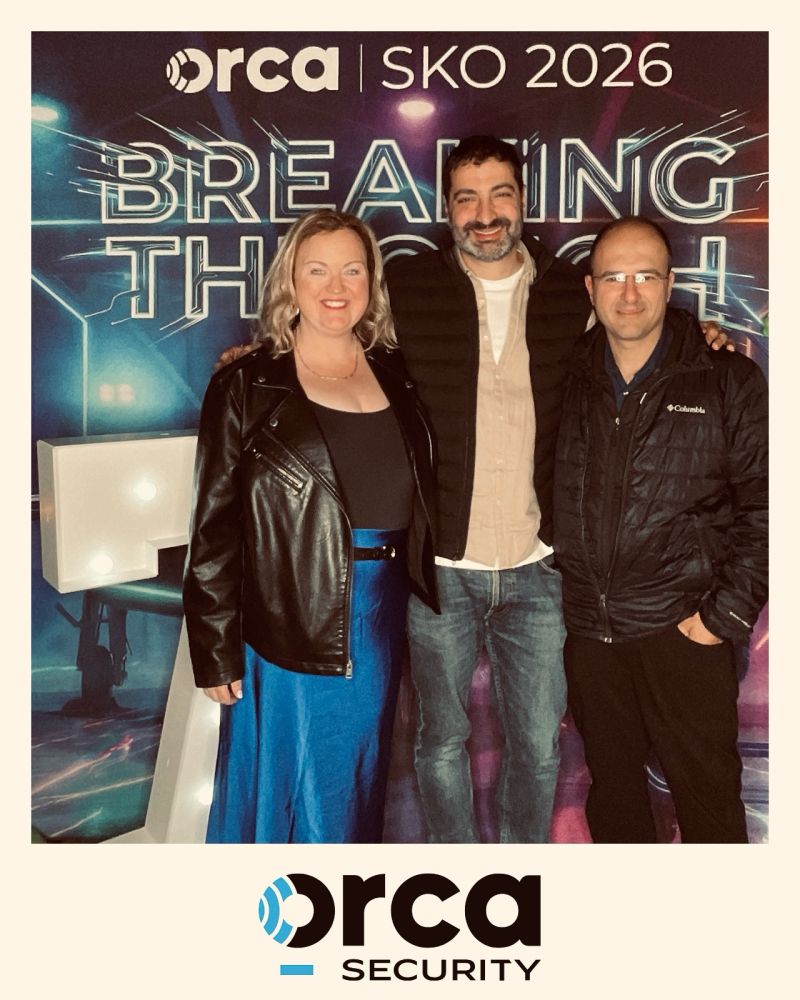
When she left Orca after more than four years, Marks did not publish a victory lap disguised as a farewell. She wrote that she had been dreading the post because it made the departure real. Her list of proud moments included building the cybersecurity marketing team, Forbes Cloud 100 recognition, work with Amazon Web Services and the 2022 AWS Global Security Partner of the Year award. It also included product launches, events, campaigns, websites and puppies. The last item performs useful editorial work. Corporate life is never only the milestones approved for a slide.
An infinite supply of drafts
Artificial intelligence has made Marks's argument for human judgment more urgent. In a 2025 discussion with other marketing leaders, she observed that the scoreboard had not been replaced. Pipeline, customer acquisition cost and lifetime value still matter. AI changes the route to those metrics by helping teams work faster and notice signals earlier. It does not relieve them of taste.
“AI sparks creativity, but humans curate it,” is how she framed the bargain. A machine may produce something usable, or something close enough to provoke a better idea. The marketing team still supplies voice and discernment. Strategy, ethics and critical thinking remain human responsibilities. When producing average material becomes almost free, the value of exceptional work rises. Abundance does not abolish standards. It makes standards busier.
Marks has a household anecdote for this accelerated age. Early in 2025, her eight-year-old asked if she knew what ChatGPT was. Yes, she replied. The child considered the timeline and asked where she could possibly have learned about AI, since it did not exist when she was in school. The joke lands because the premise is perfectly childish and perfectly sensible. Adults are expected to finish their education before the world finishes inventing things. Technology has other plans.
“We can't outsource strategic thinking. That's got to have human curation.”Meghan Mitchell-Marks
From the cloud to everything
In February 2026, Axonius appointed Marks to oversee global brand strategy, product marketing, demand generation and communications. The move broadened her subject. Cloud security had been about understanding risks across fast-changing cloud environments. Asset intelligence asks an even more basic question: what exists across the organization's digital estate, who owns it, how is it connected and where is the exposure?
Marks described Axonius's opportunity as becoming a “platform of platforms” for unified security operations and exposure management. The language contains a large ambition but also a familiar marketing challenge. A source of truth is useful only if people trust it enough to act. At Black Hat USA in August 2026, she pushed the case that AI security begins with asset intelligence. An autonomous system fed an incomplete inventory does not become wise. It merely becomes confidently incomplete at machine speed.
Her career has now traveled from communicating public stories to communicating the shape of invisible technical estates. The distance looks enormous on paper. In practice, both jobs require choices about audience, evidence, emotion and the sentence that survives after everything else has been cut.
There is a temptation in technical marketing to treat clarity as a cosmetic layer, something applied once product strategy is finished. Marks's route suggests the reverse. Clarity is operational. It helps an engineer, a seller, an executive and a customer see enough of the same picture to move together. It gives creative teams a standard beyond mere novelty. It tells an AI-generated draft why it exists.
The technology will keep changing. That is the safe prediction. The more interesting question is whether the people describing it will keep learning fast enough to remain honest. Marks has spent two decades doing that work in public: learning a new system, finding its human consequence and resisting the urge to replace an explanation with a siren. In cybersecurity, confidence is not a mood. It is what becomes possible when the facts can finally be seen.