An engineer changes the curve of a turbine blade, presses run and waits. The computer solves fluid flow across a mesh, sometimes for hours, sometimes for days. Then the engineer changes the blade again. This expensive call-and-response is how aircraft, cars, power systems and semiconductor equipment become real. PhysicsX, a London company with Formula One in its bloodstream, thinks the waiting has become an engineering material in its own right - something to be designed out.
The company trains deep-learning models on the answers produced by conventional simulation software and physical experiments. Once trained, those models can estimate what heat, pressure, stress, noise or airflow will do around a new design in seconds. The point is not a prettier simulation. It is a larger appetite for questions. A team that could afford to compare ten ideas can consider thousands, optimize several objectives at once and carry the model into manufacturing or live operations.
The product is a loop, not a crystal ball
PhysicsX calls its main creations Large Physics Models, or LPMs. The name invites comparison with large language models, but the ingredients are less chatty: CAD geometry, boundary conditions, meshes, numerical simulations, experimental readings and operational data. A model learns the mapping from a proposed object and its environment to useful physical outcomes. In automotive aerodynamics, that can mean drag and lift, surface pressure, wall shear stress and the three-dimensional wake behind a car.
Around the models sits an enterprise platform for creating simulation data, training and fine-tuning, uncertainty quantification, optimization, deployment and integration with CAE tools. Around the platform sits a Delivery team. Its simulation engineers, data scientists, machine-learning engineers and software developers embed beside the customer's specialists. This human layer is not incidental. Physics changes slowly; industrial workflows accumulate quirks at speed.
How a solver becomes a daily tool
One anonymized aerospace project makes the arrangement tangible. Designing a hydraulic manifold for a jet engine required days of computational fluid-dynamics work per iteration. PhysicsX and the customer's engineers adapted the data-generating simulations, chose a model architecture, trained it and built an interface that fitted the existing toolchain. Engineers could explore hundreds of variants. Sharing results went from a two-day PowerPoint ritual to a link. The broader design cycle contracted from months to weeks.
“Will engineers actually use this to make better decisions?”The question PhysicsX says guides every tool and integration
Formula One supplied the impatience
Founder and chairman Robin Tuluie began in theoretical physics, modeling gravitation and cosmology. The validation cycle could take decades. He moved to Formula One, where a wrong theory announces itself by Sunday afternoon. Tuluie led research and development at Renault and Mercedes F1, then vehicle technology at Bentley. Co-founder Nico Haag came through racing and aerospace engineering. CEO and co-founder Jacomo Corbo was Renault's chief race strategist during two championship seasons before building QuantumBlack, the data-science company that became McKinsey's AI arm.
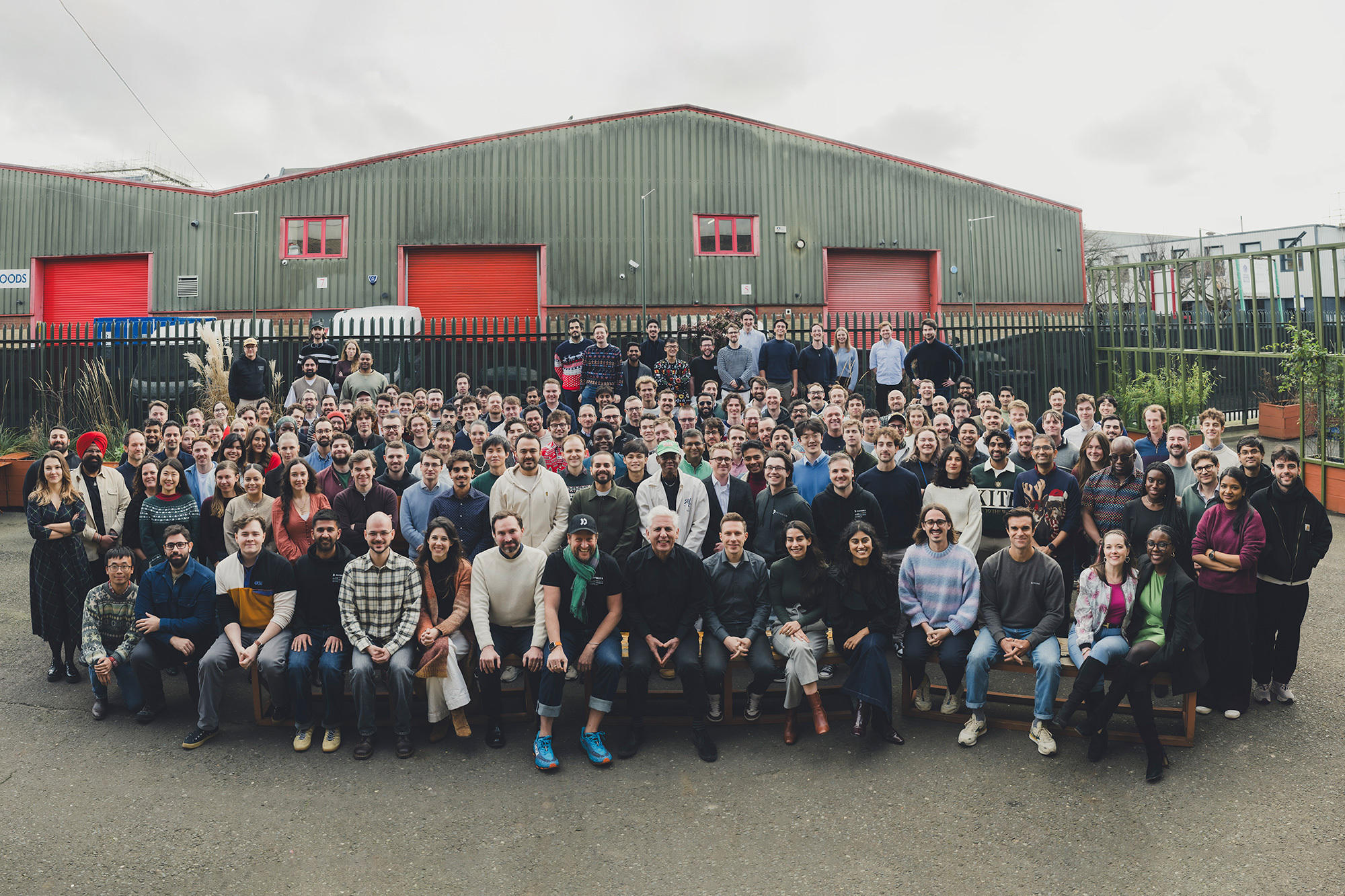
Their shared inheritance is not speed for its own sake. It is the fast learning loop: model, build, measure, correct. PhysicsX was founded in 2019 and launched in 2020. Corbo, who had collaborated from the beginning, formally joined as co-CEO in 2023. That year the company emerged from stealth with a $32 million Series A and a team of more than 50.
The bill moves from compute to data
PhysicsX does not publish a price list. Its disclosed operating model begins with a jointly scoped pilot, usually lasting one to three months, before the customer broadens access. The harder cost is easier to see: training data. High-fidelity simulations remain expensive, and training a narrow surrogate model from scratch for every component can consume much of the saving.
The company's answer is pre-training. Its PX-Car-Aero-v1 model was built from 33,203 simulated car designs derived from 444 baseline vehicles. PhysicsX reports that fine-tuning this model for a new automotive dataset reached the same performance as the same architecture trained from scratch while using about 80 percent less target simulation data. If that result travels across customer geometries and solver setups, the cost of yesterday's simulation becomes reusable capital rather than a one-off bill.
The data economy of a pre-trained model
PhysicsX's reported comparison uses identical post-initialization training procedures. It is a model result, not a universal promise for every geometry, solver or physical regime.
Confidence has borders
The first thing to fail is generalization. A neural surrogate can score handsomely when its test set contains close cousins of the shapes it saw during training, then wobble when a customer supplies a genuinely new vehicle family or another simulator's version of reality. PhysicsX has criticized common automotive datasets for producing exactly this comfort. Different turbulence models, meshes, boundary conditions and solvers all leave fingerprints on the answers.
Its platform therefore treats uncertainty as a routing decision. Training simulations are versioned and traceable. Customer-specific models remain isolated. Predictions are checked against physical constraints. When a model enters a low-confidence region, the system can escalate the case to the trusted numerical solver, add the result to the learning loop and retrain. In high-stakes engineering, “I don't know” is a feature only if it triggers the right next calculation.
Good fit
- A repeated, expensive simulation bottleneck
- Reliable solver, test or sensor data
- Many designs or operating points to explore
- Domain experts available to validate outputs
Poor fit
- A one-off question with no reusable loop
- Sparse, drifting or badly labeled data
- Novel regimes with no trustworthy validation
- A team seeking autonomous approval of critical designs
This is also where PhysicsX differs from both ends of its market. Traditional suites from Siemens, Ansys, Dassault Systemes and Altair own trusted solvers and deep customer workflows. AI-native rivals such as Neural Concept and Luminary, plus cloud platforms such as SimScale and Rescale, also promise faster exploration. An internal team can build with NVIDIA PhysicsNeMo. PhysicsX's pitch is the whole governed loop: pre-trained models, data orchestration, optimization, CAE connections, private deployment and people who help the technology survive contact with a factory.
The airplane toy went to the hangar
Ai.rplane was the charming version of the thesis. The public experiment let anyone generate an aircraft concept and evaluate aerodynamic performance in seconds. It made an abstract technology playful. PhysicsX retired it after its newer geometry models and enterprise platform moved beyond what the demo could show. The decision reads like a change of mind, but it is better understood as a change of audience: from curious visitors making improbable wings to engineering teams making accountable decisions.
The grown-up examples are quieter and more consequential. A casting system predicts aerospace defects as they form and reportedly runs more than 100 times faster than previous methods. Work with Siemens turns data-center busbar thermal analysis from a day-plus simulation into an interactive prediction. A Microsoft Discovery integration lets agents request geometry and physics models while engineers keep control of requirements and approvals. Britain's America's Cup team GB1 uses the platform to chase the last fractions of aerodynamic performance.
What another engineering team can copy
- Start with one valuable decision, not a company-wide AI mandate.
- Measure the current wait, compute bill and handoffs before building.
- Put simulation, ML and end users in the same working team.
- Design uncertainty and solver fallback before chasing speed.
- Expand only after the model earns routine use.
A $2.4 billion wager on the physical economy
The money arrived in steps: $32 million in 2023, $135 million in June 2025, a Series B extension that took that round beyond $155 million, then a $300 million Series C led by Temasek in June 2026. The latest deal valued PhysicsX at about $2.4 billion. Siemens, Applied Materials and NVIDIA sit among the strategic investors, a useful map of where the platform hopes to live.
The valuation assumes that a meaningful slice of engineering will move from repeated numerical solution to learned inference. That does not make the old simulators obsolete. It makes them teachers, validators and emergency services. Siemens can be partner, investor and incumbent competitor at once because this transition is more braid than coup.
PhysicsX's strongest idea is almost modest: stop spending the same expensive physics twice. Record it carefully, teach a model, expose its uncertainty and let more engineers ask more questions. The company will be judged not by how quickly a colorful field appears on screen, but by whether the turbine, chip, casting or cooling fan behaves when somebody finally makes it.