An oilfield is an awkward place to celebrate a local victory. Open a well a little wider and the extra flow changes conditions in the pipes it shares with its neighbours. Improve one part of the system and another may struggle. The organisational chart has separate departments for reservoirs, wells and facilities. The fluids have never read it.
That mismatch is the business opportunity behind PE Limited, better known as PETEX. The company develops software that lets engineers model those connected parts together, test operating choices and forecast their consequences. Its customers include oil and gas operators, engineering specialists and universities. It sells the ability to ask a more useful question: what happens to the whole field?
The idea sounds obvious once stated. Turning it into dependable calculations has occupied the business since 1990. Its Integrated Production Modelling suite, or IPM, links the behaviour of reservoirs, wells and surface networks. Around that core sit tools for live operational workflows and structural geology. Together, they cover decisions from interpreting underground rock to adjusting production above it.
One field, two numbers worth reading together
A case involving Occidental in Oman gives the proposition some teeth. PETEX’s published technical summary describes a workflow that characterised fluids, matched reservoir behaviour, modelled individual wells and then optimised the gas lift distribution network. Gas lift uses injected gas to help fluids rise through a well; distributing that resource effectively is a field-wide problem.
The reported result was an 8% increase in production and a reduction of more than 25% in lift gas consumption. Read together, those figures explain the appeal: the operation produced more while using less of a resource needed to produce it. They describe one implementation, rather than a standard return promised to every purchaser.
Production
Less lift gas consumed
The sequence matters as much as the percentages. Engineers first assembled and checked the physical description, then used the connected model to choose operating changes. Buying optimisation software does not eliminate that preparatory work. The transferable lesson is to map shared constraints before rewarding isolated improvements, whether the resource being allocated is lift gas, processing capacity or an engineer’s time.
The alphabet soup has a job description
PETEX’s product names can make a newcomer feel late to a meeting. PROSPER models wells and pipelines. Engineers use it for nodal analysis, comparing what a reservoir can deliver with what the well can carry. It supports decisions about completions, artificial lift, pressure losses and flow assurance. A prospective change can be investigated on screen before someone changes field equipment.
MBAL handles reservoir analysis and material balance, helping engineers interpret production history and forecast reservoir behaviour. GAP brings the surface network into the calculation, including the constraints that connect one well’s performance to another’s. PVTP handles fluid characterisation; REVEAL adds reservoir simulation and specialised investigations into subjects including thermal effects, production chemistry and solids transport.
RESOLVE connects models and workflows. PVTP supplies fluid characterisation. Changes propagate across the connected system.
RESOLVE provides a way to assemble broader engineering workflows, including scenario studies and economic evaluation. Its visual workflows let engineers organise calculations without writing scripts. Its integration capabilities also connect external process simulators such as UniSim, HYSYS and ProII. That matters for an operator with years of investment in software from several suppliers.
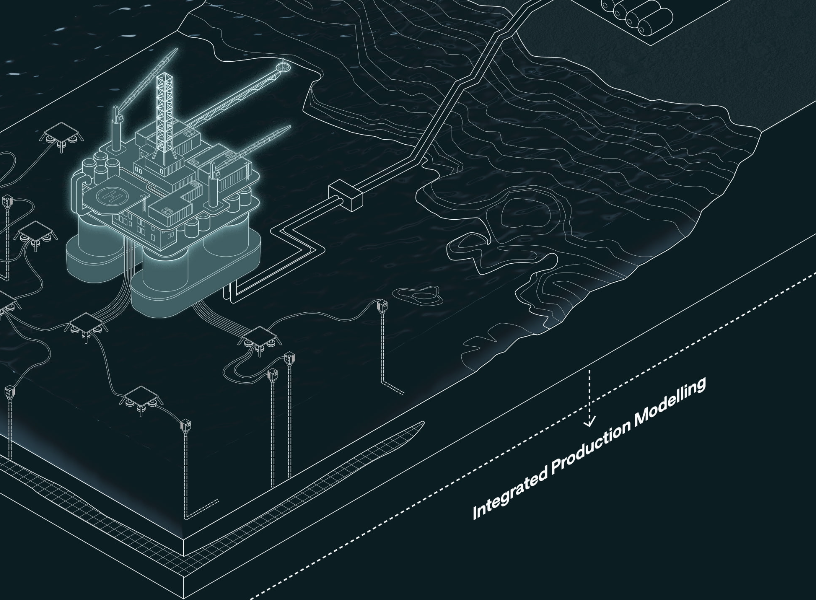
This is a specialist enterprise software market with substantial competition. SLB’s Pipesim also models well and network performance, while Olga addresses transient multiphase flow. PETEX’s pitch rests on the breadth and connection of its own tools, alongside integration with outside applications. The useful comparison is the actual engineering workflow, its supported physics and its fit with existing models.
A digital twin needs someone to mind the files
A production model can be carefully built and still become stale. Wells change, measurements arrive and operating conditions move. PETEX’s DOF suite addresses the work of connecting models to operational information. The current site calls it the Digital Operations Framework; older materials describe the Digital Oil Field. Its purpose is to bring engineering into repeated, live decisions.
Integrated Field Management, commercialised in 2006, links modelling with surveillance, automation and company workflows. PETEX describes screening incoming field data for consistency and accuracy before using it. That is a consequential detail. Automating a calculation makes it repeatable; it does not make an unreliable input reliable. A useful deployment needs both the model and the rules for accepting data.
Then comes the wonderfully unglamorous Model Catalogue. It records versions, changes and ownership, giving teams a repository of approved models and associated files. An engineer can establish which model is current and how it got there. In a discipline built on elaborate mathematics, a familiar office question still matters: are we all using the right document?
“The strength of our suite lies in how each tool seamlessly works together, built on a foundation of consistent data and physics.”
Greg Grimshaw · CEO, PETEX
The June 2026 user meeting added a specific example of this integration strategy: a connection between DOF and Andromeda, the pressure transient analysis platform from Engineering Workflows Ltd. PETEX announced that analysis could run on live data and return results to operational workflows. The development brings a specialist analysis stream closer to daily production decisions.
Build the calculation before the screen
Founder Hamid Guedroudj established Petroleum Experts in 1990. Contemporary reporting on his 2014 Scottish EY entrepreneur award described a business started without outside funding. Today PETEX says all product development is self-funded. Its development process makes that independence more interesting than a routine corporate biography: customers help shape an annual plan, while the company finances its own research.
On its product development page, PETEX describes defining calculation flows and testing logic with basic prototype files before designing the interface. Calculation routines are separated from presentation so components can be tested independently. Corporate researchers can also introduce their own calculations through modules. It is a practical example to copy when the validity of an answer matters more than the first demonstration.
The company frames this method as a lesson from earlier programming experience. The disclosed change is procedural: establish the computational structure first, then build the interface around it. Its annual user meeting gives customers another route to influence priorities through feedback and enhancement requests. These are identifiable mechanisms for changing the product, rather than a vague promise to listen.
The business is sold through commercial software licences, with product pages inviting personalised quotations, alongside training, technical support and engineering services. Buyers are acquiring tools that need domain expertise, suitable data and ongoing model maintenance. The practical budget therefore includes the people who build, validate and use the models, as well as the software agreement.
£4.97 million, with a distinction that matters
Public university announcements offer a view of PETEX’s licensing programme. In February 2025, Lebanese American University announced ten donated IPM licences carrying an equivalent commercial value of £4.97 million. That is the stated value of the donated package. It should not be treated as a cash payment to the university or a universal price list.
Imperial College London reported a ninth consecutive year of software support in December 2024. Its package included ten licences each of IPM and MOVE, valued at more than £4.5 million. The university described uses in teaching, research and postgraduate projects. Students get hands-on experience with tools used by the employers they may eventually join.
For PETEX, the commercial logic is easy to understand, although the announcements do not quantify it: engineers who learn a tool at university arrive in industry already familiar with its methods. For departments, access supports work on difficult subsurface questions without buying the same commercial package. The relationship gives both sides a reason to keep the software in use.
The rocks get a vote
PETEX’s reach into structural geology expanded when Midland Valley joined Petroleum Experts in October 2017. The MOVE suite lets geoscientists construct, restore and test geological models, investigate faults and fractures, and analyse stress. Restoration asks whether a proposed structure makes geological sense when its deformation is worked backwards. A convincing picture alone is insufficient.
The company’s own staff provided a pleasantly literal illustration during a Jurassic Coast field trip reported in June 2026. Colleagues visited Kimmeridge Bay, Lulworth Cove, Durdle Door and Hive Beach. They used FieldMOVE Clino to record observations that could feed into MOVE. Here was software training with sea air, high-visibility jackets and the subject matter towering nearby.
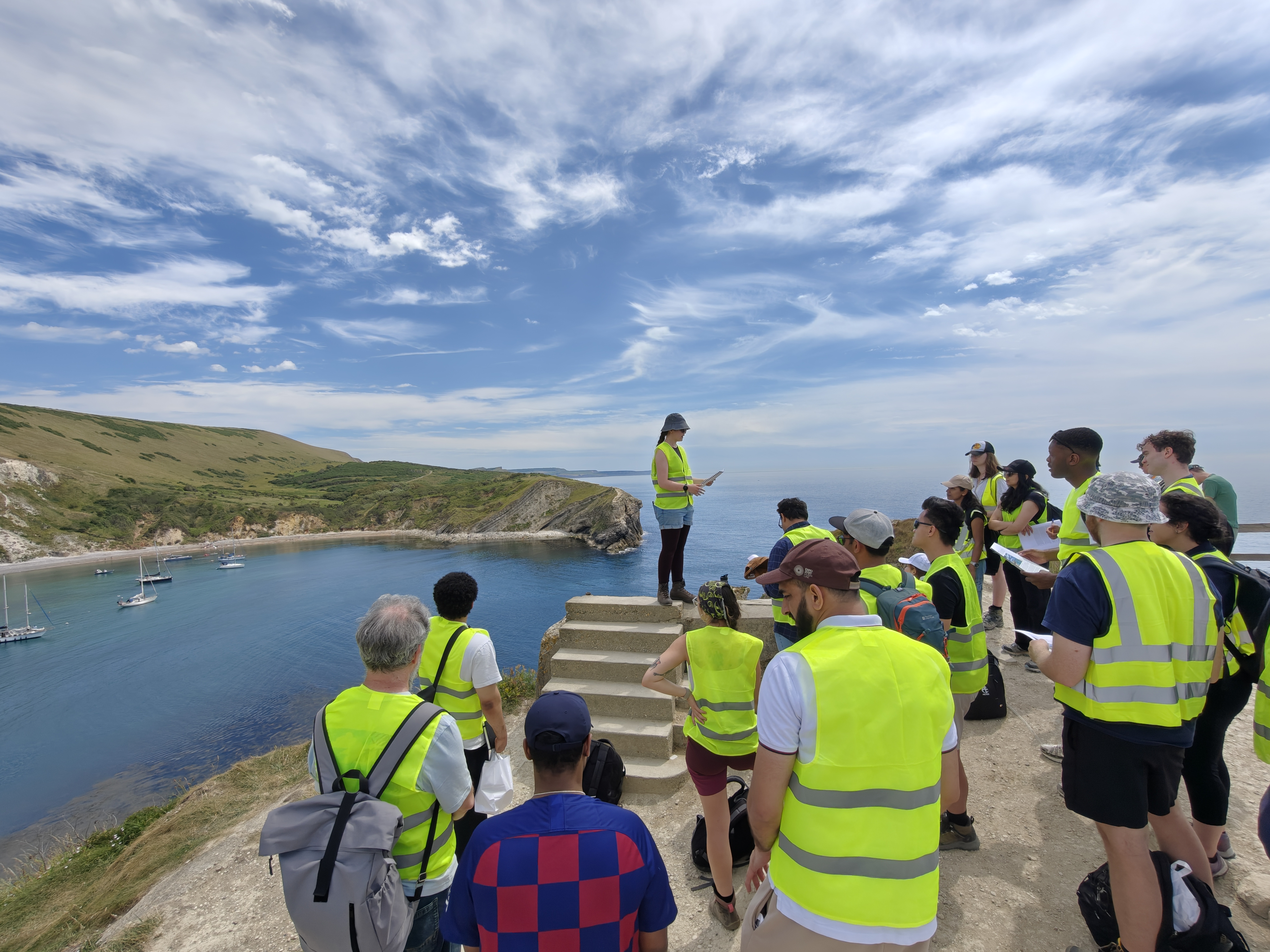
PETEX describes extensive in-house training for staff from scientific backgrounds, and names transparency, predictability and mentoring among its values. The coastal outing gives those statements some observable texture. So does its Guildford headquarters, opened in 2025, with dedicated training facilities and collaboration spaces. Technical knowledge has to move between people as well as between applications.
The next reservoir may hold something else
The company’s June 2026 meeting also demonstrated applications in carbon capture, utilisation and storage, and geothermal systems. Those are credible extensions of its existing work: fluid properties, pressures, temperatures and connected networks remain central engineering questions. PETEX is also advertising expansion into mining and other industries, though the clearest continuity lies in problems its physics already addresses.
The same requirement follows it into those markets. A connected model is useful only when its assumptions, data and scope suit the decision. PETEX supplies ways to test scenarios, reconcile information and preserve model histories; engineers still have to judge the results. Its enduring proposition is concrete enough: before changing one part of a complicated operation, calculate what the rest will do.
PETEX website ↗ Product range ↗ Company news ↗ LinkedIn ↗ Official YouTube videos ↗ Development approach ↗