The trouble with a 3D printer is that it obeys instructions beautifully. Feed it a part that is too heavy, weak along the wrong seam or based on a model that only vaguely resembles the original, and the machine will manufacture your misunderstanding one tidy layer at a time. The invoice arrives in plastic, machine hours and an engineer's afternoon.
Novineer, a small engineering-software company in Daytona Beach, Florida, is built around this awkward truth. Its software sits before the satisfying part where an object appears. The company wants to help an engineer capture a missing shape, redesign it for the load it must carry, and predict how the printed material will behave. The printer is almost the last character in the story.
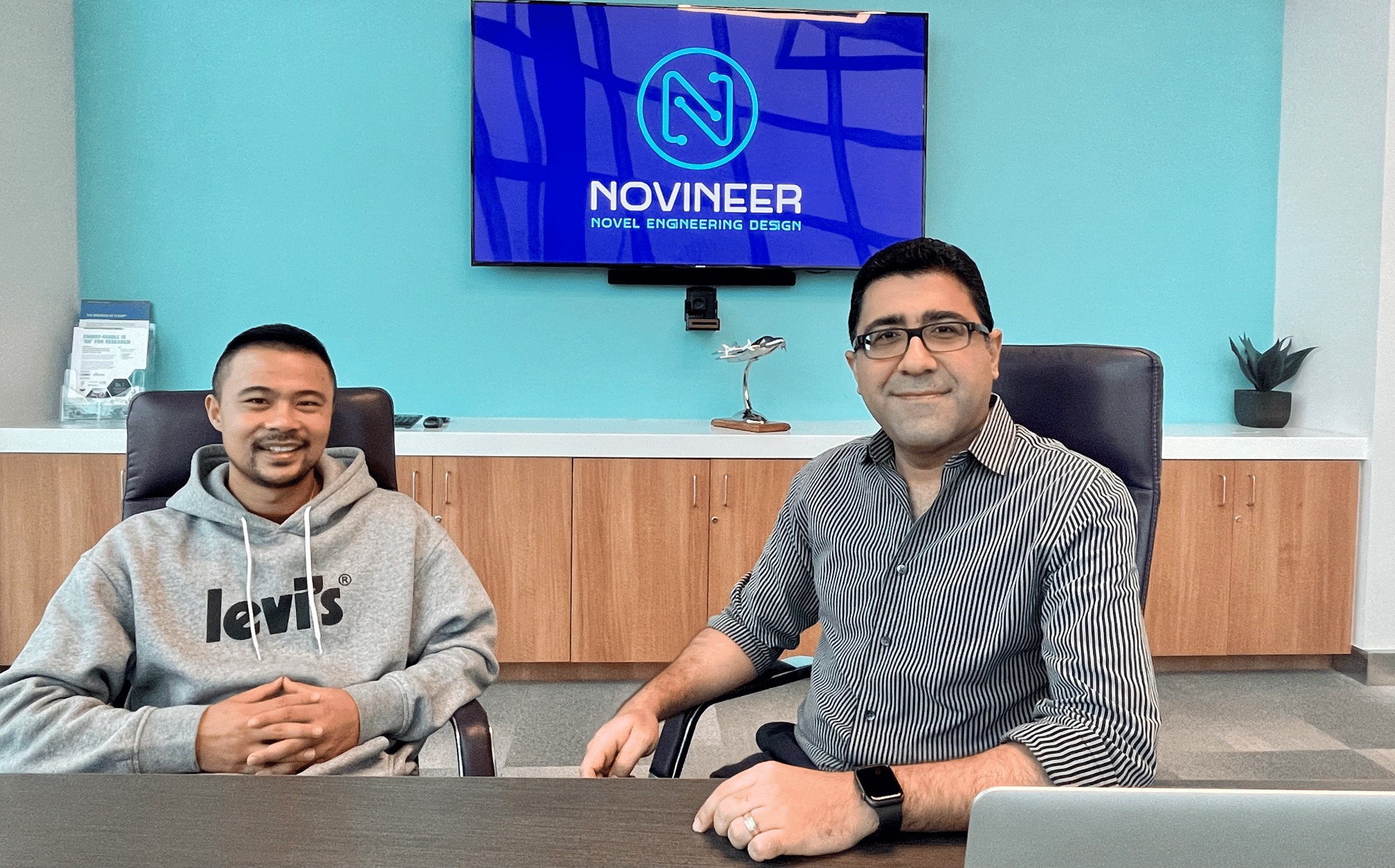
The company was founded in 2022 by Ali Tamijani, an Embry-Riddle Aeronautical University professor, and Zhichao Wang, his former doctoral student. Tamijani had already spent roughly 15 years on design technologies for additive manufacturing. Research projects involving NASA, the U.S. Navy, the Air Force and the National Science Foundation supplied the technical soil. The startup supplied a commercial deadline.
The expensive little loop
Industrial additive manufacturing is often sold as a shortcut from digital file to physical part. The file, however, can be missing. A maintenance team may have an aging aircraft component in hand and no usable CAD model. Reconstructing it can require a specialist, a scanner, travel to the equipment and manual cleanup. Tamijani has described a representative airline-part workflow that can consume about three weeks and $15,000 to $20,000 before the replacement is ready to move forward.
Even when the geometry exists, simulation can tell a comforting lie. General-purpose finite-element analysis commonly treats a printed polymer part as a uniform solid. FDM printing does not create one. It lays down beads in directions, stacks layers with weaker interfaces and fills the interior according to a path. Rotate those choices and the same outer shape may fail differently.
“AI isn't the goal of the entire thing we do. The problem users want to solve is what to do when a CAD model is missing.”Ali Tamijani, CEO and co-founder
This is what failed first: confidence. Teams compensate with conservative geometry, extra material and repeated physical tests. The loop is familiar - simulate, print, break, adjust, print again. Novineer's proposition is not that testing disappears. It is that fewer bad ideas should reach the test machine.
Three products, one handoff
Novineer now packages the workflow into three named products. NoviVision starts with photographs and produces an editable CAD model. NoviDesign uses generative design and topology optimization to shape a part around strength, stiffness, material direction and manufacturing constraints. NoviPath reads actual FDM toolpath data to predict stiffness, strength, failure load and likely failure location.
Phone photos become an editable digital starting point.
Loads, materials and print constraints become manageable CAD geometry.
The real toolpath becomes a prediction of where and when the part fails.
The sequence is the differentiator. A photo-to-mesh novelty is not enough for an aerospace engineer. A generative shape that cannot be edited is a handsome dead end. A simulation that ignores the slicing strategy is judging a part that will never exist. Novineer is trying to make each output useful to the next person in the chain.
That makes the best customers easy to picture: additive-manufacturing service bureaus, product engineers, printer OEMs, aerospace and defense teams, and maintenance organizations handling old equipment. A contract manufacturer may need to quote a replacement before winning the job. The photographs create a fast feasibility model. The design tools refine it. The simulation reduces the number of versions that must be printed and broken. Certification, when required, remains outside the magic trick.
What changed their mind
The startup did not emerge from a founder guessing in isolation. In 2021, Tamijani and Wang took part in the NSF I-Corps program and interviewed engineers, product developers and other people working around 3D printing. They came away convinced that design and simulation were serious adoption bottlenecks. Wang has credited that process with helping turn academic work into a viable business.
The product story kept widening. Early Novineer language centered on generative design: editable optimized geometry, anisotropic material behavior, lattice structures and faster cloud computation. By 2026, the public suite stretched upstream to missing CAD with NoviVision and downstream to production-aware validation with NoviPath. That is less a pivot than an admission that a single clever optimizer cannot repair a broken workflow by itself.
“We didn't want to see them die in journal papers. We wanted to actually help someone because we thought we could.”Ali Tamijani on commercializing the research
The business model follows enterprise engineering software rather than a self-serve consumer app. Public pricing is not listed. Companies request access, enter pilots or buy through a partner workflow. That approach fits a product whose value depends on materials data, machine settings, validation and integration. It also means the sales cycle is probably measured in demonstrations and engineering reviews, not impulsive credit-card swipes.
Distribution hides inside the toolpath
Novineer's most consequential distribution move is its partnership with Stratasys. NoviPath is being integrated with GrabCAD Print Pro, the software already used to prepare jobs for Stratasys industrial FDM systems. Instead of asking users to export an approximation of the print, NoviPath can consume the same toolpath that the machine will follow, including build direction, infill and material choices.
Initial support was announced for the F3300, F900 and Fortus 450mc systems, with Nylon 12CF, Antero 800NA and ULTEM 9085 among the planned validated materials. Stratasys and Novineer scheduled an early-access program for the second quarter of 2026. Public demonstrations have shown predicted failure loads and locations lining up with destructive tests on selected parts. These are case results, not a universal guarantee, but they make the product concrete.
The AM Craft partnership works from the other end. AM Craft manufactures certified aerospace parts and has produced more than 35,000 flight parts. NoviVision gives its teams a faster way to begin reverse engineering when the digital drawing is absent. Stratasys is also an AM Craft investor and partner, so the route from photograph to print is becoming a small, connected ecosystem rather than three unrelated logos.
The honest edge of the map
The most persuasive thing Tamijani says about the software is where it stops. He puts NoviVision's current accuracy at roughly 95 to 97 percent, varying by part. That can be useful for additive-manufacturing feasibility, quoting and a first editable model. It is not enough for precision machining. NoviPath does not abolish physical testing, either. It moves testing toward the end, after software has eliminated weaker iterations.
Where the promise holds - and where it does not
FDM parts made with supported materials and machines, especially when teams have actual toolpath data and need faster feasibility, optimization or validation.
Tight-tolerance machining, unsupported materials, unknown loads, final safety certification and any job where a photograph cannot capture critical hidden geometry.
That boundary also clarifies the market. Novineer competes with broad engineering suites from Ansys, Altair, Autodesk and Hexagon; additive-specific tools such as nTop and Digimat; scanners and reverse-engineering software; and, most stubbornly, the manual print-and-test routine. The company is not trying to out-feature every general-purpose platform. It is betting that an opinionated workflow for material extrusion can be easier and more accurate because it knows exactly how the part will be built.
What another founder can copy
Deep technical work is not a playbook by itself. The transferable pieces are more ordinary and therefore more useful: interview the operator, find the ugly handoff, preserve the data that general tools throw away, and distribute through the system already open on the customer's screen.
Novineer's wedge is not “better simulation” in the abstract. It is the print toolpath that generic FEA simplifies away.
Editable CAD matters because another engineer must change it. A prediction matters because someone must decide whether to print.
Integration with GrabCAD puts NoviPath beside installed machines and existing customers without recreating a printer OEM's channel.
Saying that 97 percent accuracy is not machining accuracy makes the useful application easier to trust.
The conditions matter. This approach will not work when the partner will not expose production data, when material behavior cannot be validated, when users need a generic tool for every manufacturing process, or when regulatory testing is the actual bottleneck. It also demands a team fluent in mechanics, geometry, software and the unglamorous business of cleaning up engineering workflows.
Novineer is still a small private company. Revenue, valuation and customer count are not public. Its support has included a $50,000 StarterStudio investment, a $30,000 Florida Venture Forum prize, a $275,000 NSF Phase I grant and a $1.245 million NSF Phase II award. The team page reads like a compact technical department: optimization, simulation, geometry processing, cloud architecture.
The wager is proportional to that team. Novineer does not need to reinvent manufacturing. It needs to make one costly loop shorter, then repeat the proof across enough parts, materials and machines. If it succeeds, the quiet victory will happen before the printer starts - when an engineer looks at a failure prediction, changes the design and never manufactures the mistake.