A 3D printer is an obedient machine. Give it a flawed design and it will manufacture the flaw with remarkable discipline, laying down each bead as instructed until the mistake has weight, texture and an invoice. Ali Tamijani has spent much of his career in the awkward interval before that moment. His work asks a practical question: how can an engineer know more about a part before the printer makes the argument physical?
Tamijani is a professor of aerospace engineering at Embry-Riddle Aeronautical University and the founder and CEO of Novineer, a Daytona Beach software company. Those two jobs share an intellectual spine. For roughly two decades, he has worked on computational design, structural optimization, composite materials and manufacturing. In the university, that work produced papers, courses, students and research awards. In the company, it has become a set of tools intended for engineers with deadlines.
The distinction matters because additive manufacturing has always carried a hint of magic in its public image. A shape appears on a screen; a machine builds it layer by layer; complexity is supposedly free. The less cinematic reality is filled with missing CAD files, awkward model conversions, conservative guesses, long simulations and physical tests that end with a broken part. Tamijani did not choose the photogenic end of the workflow. He chose the queue of expensive inconveniences before it.
A printed object remembers how it was made
Conventional finite-element simulation often treats a polymer component as a uniform solid. A fused deposition modeling printer creates something more particular. It extrudes material along paths, turns corners, changes direction and stacks one layer upon another. Beads have orientation. Interfaces can be weaker than the material within a bead. Infill patterns and build direction change performance. Two parts with the same outer shape can behave differently because their internal histories differ.
That is the opening for NoviPath, Novineer's performance-simulation product. It uses the actual printing toolpath to account for the way a component will be built, then predicts properties such as stiffness, strength, failure load and likely failure location. The aim is not to abolish the test lab. Tamijani is unusually clear about that boundary.
“Does our approach replace physical testing? No, but not every iteration in your design process needs testing. You can wait until the end.”Ali Tamijani
This is a restrained promise, which makes it more useful. The product is meant to keep weaker ideas from consuming material, machine time and engineering attention. In December 2025, Stratasys announced a partnership with Novineer to integrate NoviPath with GrabCAD Print Pro. The arrangement puts print-aware simulation closer to the software production engineers already use and gives NoviPath access to the toolpath data that ordinary analysis tends to ignore.
Research needed somewhere to go
Tamijani earned his Ph.D. in engineering mechanics from Virginia Tech in 2011, then stayed for two years as a postdoctoral researcher in aerospace and ocean engineering. He joined Embry-Riddle in 2013. His research moved across lightweight structures, load paths, topology optimization, cellular microstructures and fiber-reinforced composites. The applications ranged from aircraft structures and wind-tunnel models to heat exchangers, energy absorbers and acoustic treatments.
The recognition accumulated. Three summers as an Air Force Faculty Fellow were followed by a 2017 Air Force Office of Scientific Research Young Investigator award. A five-year National Science Foundation CAREER award arrived in 2019 for multiscale optimization of additively manufactured cellular structures. Embry-Riddle named him its University Outstanding Researcher of the Year in 2020. In 2023, the American Institute of Aeronautics and Astronautics named him an Associate Fellow.
Awards can finance a method and validate a career. They do not automatically put a tool on an engineer's desktop. In 2021, Tamijani and his team joined the NSF I-Corps program and spent seven weeks interviewing engineers, product developers and others around 3D printing. The conversations exposed recurring trouble in design and simulation. A technical capability had met a commercial brief.
“We didn't want to see them die in journal papers. We wanted to actually help someone because we thought we could.”Ali Tamijani
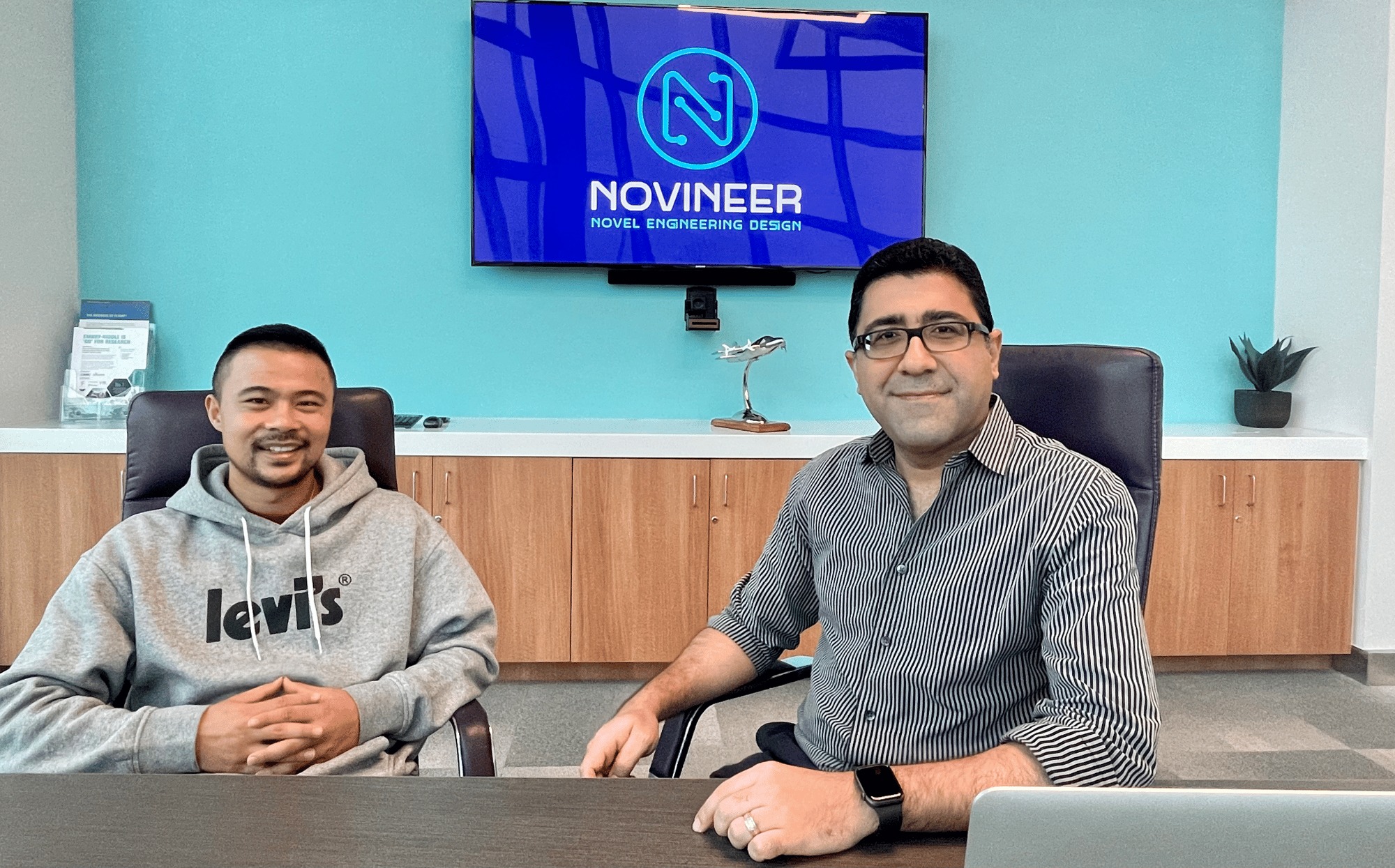
In 2022, he co-founded Novineer with Zhichao Wang, one of his former doctoral students. The professor-student connection is more than a charming origin detail. Wang's doctorate dealt with strength-based optimization of lattice structures, precisely the sort of difficult computational work that underlies the company. Tamijani became CEO; Wang now leads research and development. Their old roles changed, but the subject stayed with them.
The camera arrives before the optimizer
Novineer's product story has widened since its first alpha release. NoviDesign creates optimized, editable geometry around structural loads, material orientation and manufacturing constraints. NoviPath checks how an FDM component should behave using the intended print path. NoviVision, introduced publicly in 2026, moves upstream. From several smartphone photographs of a suitable object, it generates an editable CAD model, sometimes in about two minutes.
NoviVision
A handful of photographs becomes an editable digital starting point.
NoviDesign
Loads, materials and manufacturing rules shape optimized geometry.
NoviPath
The actual print path informs a prediction of real part performance.
Tamijani explains NoviVision with a maintenance problem. An airline needs to replace a seat component, but the original digital model has vanished into the administrative fog that surrounds old equipment. The conventional route may require a specialist with a 3D scanner, travel, manual reconstruction, simulation and repeated testing. He has described a representative process lasting about three weeks and costing $15,000 to $20,000 before a replacement is ready to proceed.
A phone-based model is not the answer for every part. Tamijani has put current reconstruction accuracy around 95 to 97 percent, depending on the object. That may be useful for feasibility, quoting and additive-manufacturing work. It is not a substitute for tight-tolerance metrology or certification. Once again, the boundary is part of the product.
AI gets a job description
NoviVision uses artificial intelligence to infer geometry from images. AI also helps accelerate parts of Novineer's simulation workflow. Yet Tamijani does not present it as a decorative layer sprinkled across the product menu. He starts with the missing model, the expensive iteration or the overlooked print path. The technology gets a specific assignment.
“AI isn't the goal of the entire thing we do. The problem users want to solve is what to do when a CAD model is missing.”Ali Tamijani
That attitude reflects the engineer beneath the founder. Physics remains in charge. Material data still matters. Unknown loads remain unknown. Hidden geometry cannot be photographed through solid walls. Safety-critical work still requires validation. The software is valuable where it shortens a loop without pretending the loop no longer exists.
It also points to Tamijani's operating style. He has built a career around optimization, a discipline that begins by defining objectives and constraints. Novineer follows the same habit. Make a component lighter, but keep it strong. Make reconstruction faster, but keep the output editable. Reduce physical tests, but preserve the final test that earns confidence. Ambition is given a fence, then asked to run.
The work keeps finding its way back to aircraft
In 2026, while waiting for a delayed flight from Florida to Hamburg, Tamijani wrote about the things that keep aircraft on the ground. Weather and strikes were beyond his reach. Maintenance was not. He pictured an engineer facing a component that needed replacement while its digital model was nowhere to be found. The clock was running; the plane was not.
It was an unusually tidy founder anecdote because the inconvenience and the product occupied the same airport. NoviVision was headed to Aircraft Interiors Expo with AM Craft, an aviation additive-manufacturing company. A few weeks later, the broader Novineer suite appeared in a detailed public demonstration of how photographs, simulation and generative design might connect.
The aspiration is larger than any one seat arm or bracket. Tamijani wants advanced engineering methods to become accessible enough that more manufacturers can use additive processes for production, not merely prototypes. That means making software faster and simpler without sanding away the physics that decides whether a part holds.
There is a pleasant symmetry in the path. Research taught Tamijani to see how forces move through structures. Customer interviews taught the company to see how information moves through organizations. NoviVision, NoviDesign and NoviPath now sit at three points along that second load path: capture what exists, shape what should exist, predict what will happen next.
The printer remains obedient. Tamijani's wager is that the instructions can become more observant.