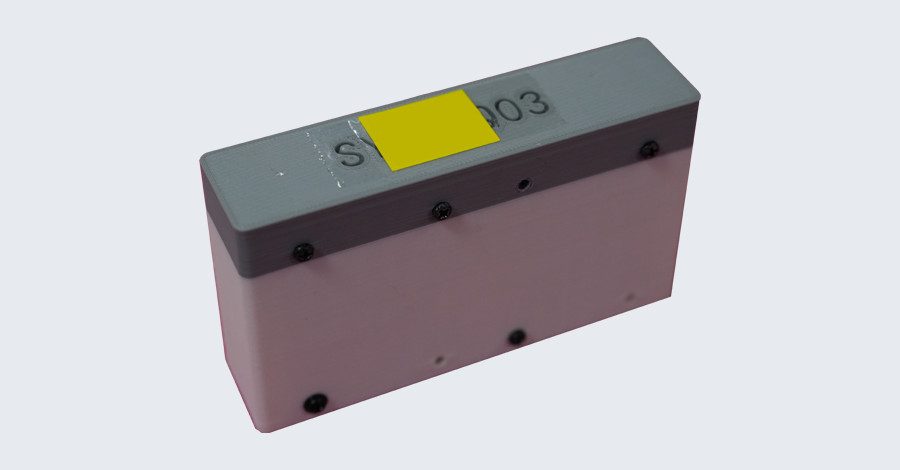
Consider the positioning fixture. It holds a circuit board in place while somebody works on it. It has none of the glamour of the electronics it supports. Yet at Advantech’s Kunshan factory, getting these modest objects made had become an expensive nuisance. Outsourced machining took one to two weeks. Changing a drawing could mean starting again. The little part had acquired a large opinion about the schedule.
- Raise3D sells printers, materials and software for prototypes, tooling and short production runs.
- Its industrial appeal is control over revisions, material settings and production queues.
- The purchase makes sense when the finished part earns back the whole workflow’s cost.
The part that held everything up
Advantech’s response was practical. Its team compared machines and tested samples before buying a Raise3D Pro2 Plus. The printer went inside the engineering workspace. Engineers already comfortable with CAD could make fixtures themselves. The company’s account describes larger components taking about 20 hours and fixture costs falling to roughly 10% of the previous level.
Those are vendor-published results, specific to this application. The interesting detail is the infill: engineers used 30% or 50% internally, making selected regions solid where strength demanded it. They changed how the object was made, rather than simply copying a machined block. Someone reading this can copy that experiment: choose one recurring fixture, test its working surfaces and compare an accepted printed part with the outsourced version.
A cabinet becomes a production system
Raise3D launched in 2015 with its N Series on Kickstarter. Its $50,000 target arrived in 41 minutes, according to the company’s history. That was an encouraging reception for a prosumer printer. The subsequent product sequence tells a more ambitious story: ideaMaker slicing software in 2016, Pro2 and RaiseCloud in 2018, then composite-focused machines, metal processing and resin printing.
The business now sells a collection of linked decisions. Which material? Which settings? Which printer gets the job? Who checks the result? Hardware sales bring customers into a range of filaments, resins, spare parts and support, sold through regional stores and resellers. The commercial appeal of that arrangement is straightforward: the initial machine purchase can be followed by years of supplies and service.
Founder Edward Feng, also identified as Feng Hua, secured backing for that expansion. In February 2022, Raise3D announced RMB 100 million in Series C financing, approximately $15.8 million then. Investor Blue Lake Capital described a Shanghai headquarters and manufacturing bases in Nantong and Suzhou. The announced research priorities included metal, ceramic and fiber-reinforced materials for repeatable industrial production.
Speed has a supporting cast
The Pro3 HS series puts high-speed filament printing into enclosed, dual-extrusion machines. Raise3D specifies speeds up to 300 mm/s with selected materials. Its June 2024 US launch prices were $5,599 for Pro3 HS and $7,599 for the taller Pro3 Plus HS. These are historical launch prices, useful as a scale of investment rather than a current quotation.
Droog Moto supplies the more entertaining illustration. The bespoke motorcycle builder uses the Plus HS for prototypes and composite end-use parts, including a magnetic cover. “We don’t like a lot of down time,” co-owner Max Droog says in Raise3D’s case study. A custom motorcycle is an accumulation of fitted decisions; discovering that one component needs another revision is easier to tolerate when the next attempt is nearby.
“We don’t like a lot of down time.”Max Droog, Droog Moto
The settings are part of the product
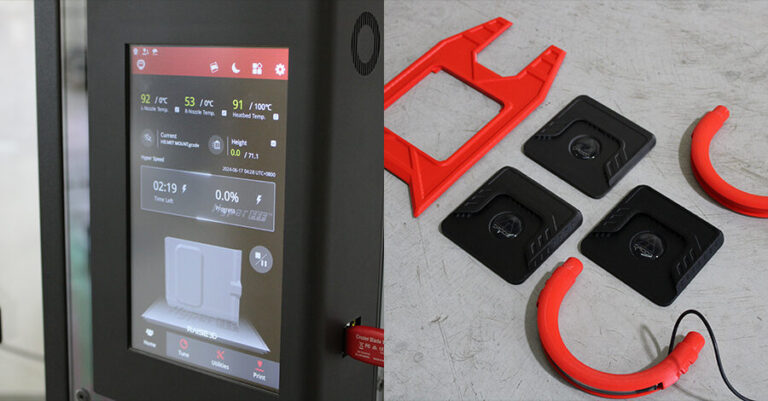
ideaMaker turns a model into printing instructions and supplies material profiles. RaiseCloud handles scheduling, team management and remote monitoring. A machine’s nominal speed says little about a queue nobody has organized. This software pairing addresses the work surrounding the print, where a growing collection of machines can become a growing collection of interruptions.
Raise3D’s Open Filament Program adds third-party material settings. A 2022 E2CF announcement covered 32 industrial filaments from 16 manufacturers, including Polymaker, Covestro and Jabil. That gives buyers alternatives to the printer maker’s own consumables. Compatibility still belongs to a particular material, profile and machine combination; an open program does not make every spool suitable for every part.
Resin remembers what comes next
The DF2 resin system takes workflow control into washing and curing. RFID on the build platform carries process information between stages, with settings prepared in ideaMaker. Purdue University Fort Wayne adopted the DF2 after using Raise3D filament machines. Its published projects include reverse-engineered monitor brackets and a reworked automotive actuator component.
For a teaching lab, handing a student a resin printer also means handing over a finishing procedure. Matching print, wash and cure settings makes that procedure easier to repeat. The DF2+ and RMS220, introduced in 2025, widen the range into updated DLP resin printing and polymer selective laser sintering. MetalFuse goes further: metal-filled filament parts require debinding and furnace sintering before they become finished metal components.
The useful number is the finished part
A 2025 Raise3D case study about CATL reports a battery-cell model moving from a 15-day traditional production cycle to eight hours of printing. The stated part cost fell from $27.80 to $11.10. It is a striking comparison, though the public account does not establish a complete, audited ownership-cost calculation. Material, labor, depreciation, finishing and rejected parts still belong in the buyer’s arithmetic.
CATL example published by Raise3D, July 2025. Specific part comparison; excludes a verified total ownership calculation.
Raise3D sits among professional systems buyers may compare with UltiMaker or Markforged, and now competes across resin and powder workflows too. Its case is strongest where teams need varied geometries, repeated revisions and modest quantities. A stable design made by the thousand may justify molding; tight tolerances may still require machining. The sensible purchase starts with a part and its acceptance criteria.
Its recent releases underline the same direction: a B520 sandblaster for SLS finishing in April 2026 and ideaMaker 5.5.0 in September. The lesson is pleasingly unromantic. Move one suitable job closer to the person changing the drawing. Measure the delay, the labor and the finished result. The fixture may never win applause. It can give an engineer Tuesday back.