A pickup truck is a collection of compromises wearing a confident face. Move the roof, deepen the bed, change the mirrors, and the air finds a new way to argue. An engineer can settle that argument with a detailed computational fluid dynamics simulation. The trouble is that, by the time a long queue of simulations returns its verdict, the design may have acquired a schedule, a budget and several people who would rather not move the roof again.
Luminary, a San Mateo company founded in 2019, is betting on an odd inversion of that process: do more expensive computing before the individual design question arrives, then make each subsequent question cheap to ask. Its software runs or ingests high-fidelity physics simulations, trains AI models on the results, and serves predictions inside engineering workflows. The company calls this Physics AI. The useful translation is simpler: a fast, reusable approximation of a physical system, with the original solver still nearby to check the interesting answers.
- Luminary makes simulation data, AI models and deployment tools for teams designing physical products.
- Its SHIFT models cover SUV and pickup aerodynamics, aircraft wings and vehicle crash response.
- The up-front bill is real: one published SHIFT-Truck simulation used 56.3 H100 GPU-hours.
- The payoff is earlier feedback, when designers can still change the shape.
The answer that arrives too late
Traditional simulation is not deficient because it is slow in every circumstance. It is indispensable precisely because it can resolve difficult physical behavior in detail. But a design studio may want to compare hundreds of possible shapes before sending a handful to a solver. If every variation needs its own mesh, compute allocation and review, the team begins to ration curiosity. A design can become a finalist because it was feasible to test, rather than because it was the best idea.
Luminary first attacked that bottleneck as a cloud-native CFD vendor. Co-founders Jason Lango and Juan J. Alonso built a GPU-driven simulation platform; the company emerged from stealth in March 2024. Pete Schlampp succeeded Lango as CEO that August, while Alonso remained CTO. The change in emphasis since then is telling. Faster solvers still matter, but a solver alone cannot make every future design question instantaneous. A model trained on many reliable answers can.
The pickup project shows the arithmetic. Luminary varied 17 design parameters in a generic truck geometry, including switches for a bed cover and air dam. It generated roughly 1,000 design points. Each detailed simulation in its published setup required 56.3 H100 GPU-hours. That is tens of thousands of GPU-hours for a training campaign of this order before any model can answer in seconds. The technical cost sits before the first fast answer: the team pays for a large, validated library of examples.
That is Luminary’s published compute requirement for one detailed SHIFT-Truck training simulation. The model moves this work ahead of the next design question.
The resulting SHIFT-Truck model was trained from scratch on 613 cases and evaluated on a fixed 57-case set. Luminary reported a median drag-coefficient error of 3.8 counts against its DDES reference. The important caveat sits in the same technical account: high-fidelity CFD remains in the loop to validate selected designs and to improve the training set. A fast prediction is most useful when it tells an engineer which expensive test is worth running next.
A wing is a different sort of question
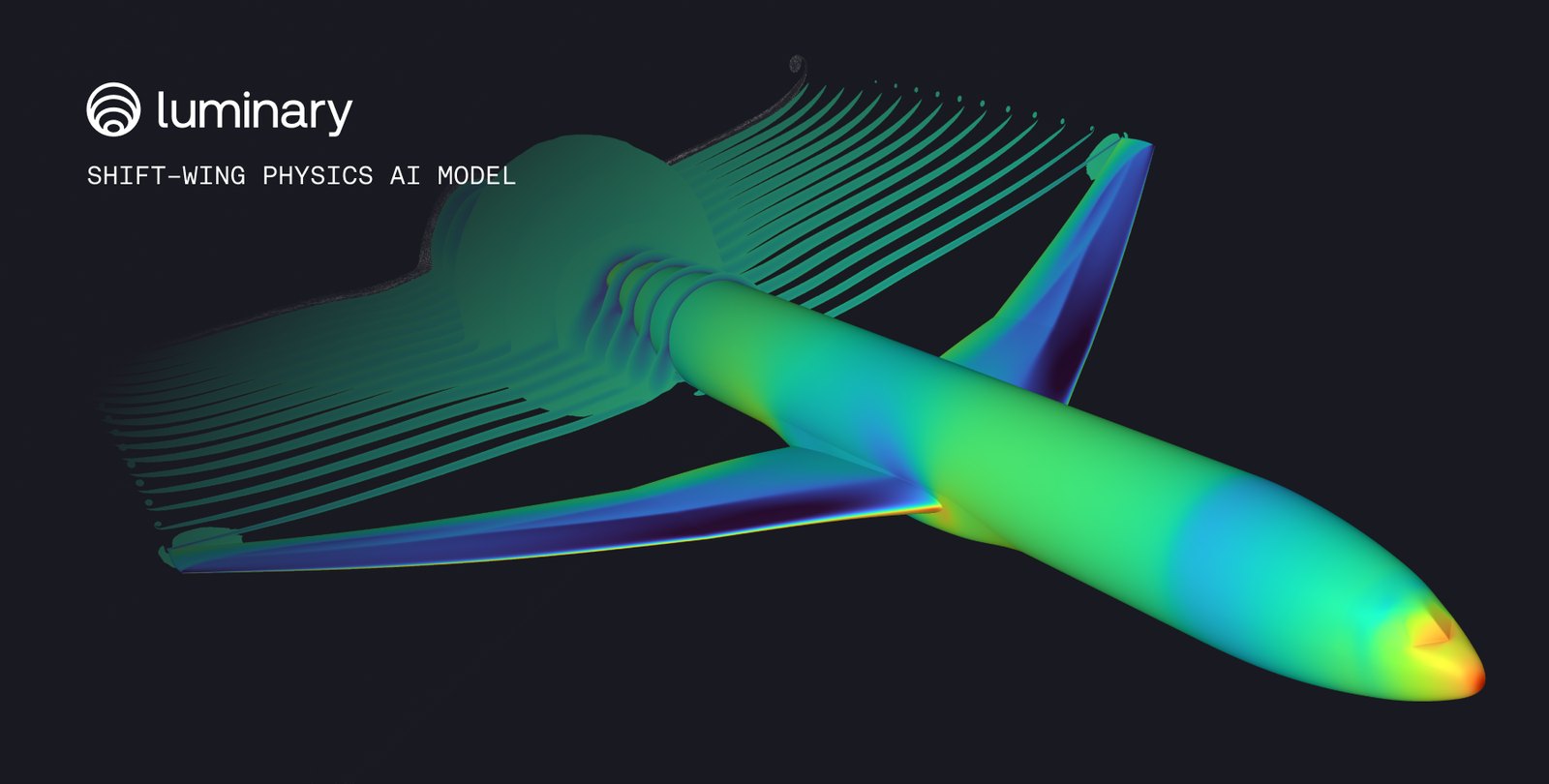
The same pattern appears in the sky. SHIFT-Wing, developed with Otto Aviation using NVIDIA’s PhysicsNeMo framework, learns from simulations of varied transonic wing geometries. It predicts quantities such as lift, drag and surface pressure quickly enough for early concept exploration. Otto contributes real aircraft-design judgment; Luminary supplies the data and model pipeline. The public model and dataset are available for noncommercial use, with commercial licensing offered separately.
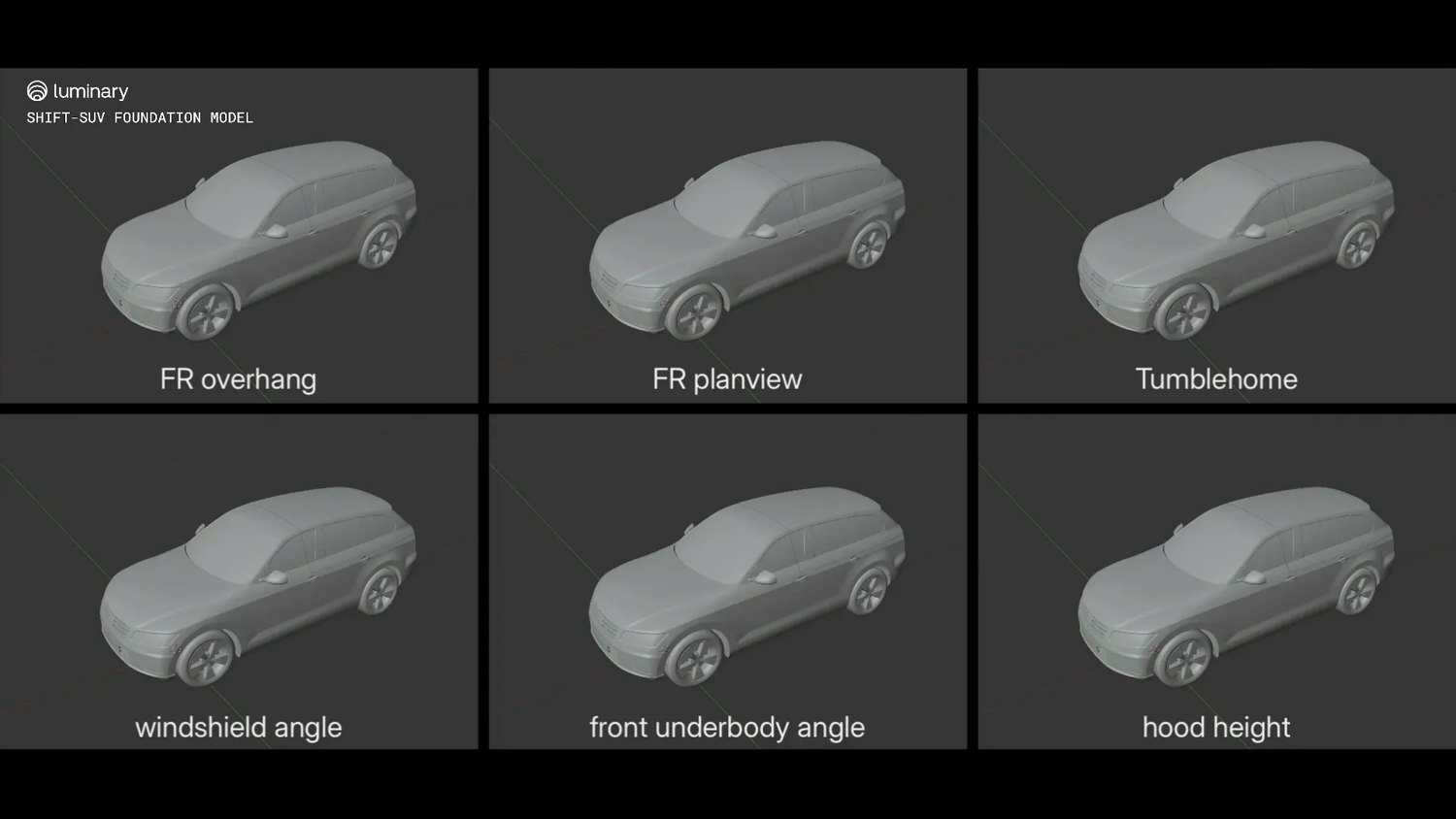
Honda played a comparable role in SHIFT-SUV. That model was developed with Honda and NVIDIA and demonstrated inside Blender, where changing a vehicle’s geometry can trigger aerodynamic feedback in the designer’s own tool. Luminary reported an average drag prediction error of about 3.45% on its published test set. Such figures describe a particular dataset and test, not every SUV a designer might invent. The point of the Blender integration is less glamorous than the AI label and more consequential: put the answer where a design decision is actually made.
“The hardest part of physics AI is not building the models. It is getting them to travel the last mile inside a real engineering organization.”Pete Schlampp, Luminary CEO
That last mile helps explain Luminary’s product shape. Its Physics AI Factory connects data generation, model development, deployment and governance. The platform supports Luminary’s own SHIFT models, proprietary customer models and third-party architectures. It tracks versions and approval context so a prediction has a history, rather than arriving as an immaculate number from a black box. APIs and integrations are meant to carry predictions into existing design tools. For aerospace and defense programs that cannot send sensitive work to a public cloud, the company introduced a private-cloud deployment in February 2026.
When the shortcut guesses
There is a catch in any learned shortcut: a neural network will generally produce an answer even when a proposed design lies beyond the cases it has seen. That answer can look just as polished as a trustworthy one. Luminary’s recent work on out-of-distribution detection and uncertainty quantification addresses precisely this problem. The company’s own technical writing also describes simplified propulsion assumptions in an early combat-aircraft model after poorly constrained boundary conditions made the training data noisy. The response was to narrow the initial model’s scope, not pretend the physics had become easy.
SHIFT-Crash makes the stakes plain. Announced in April 2026, it predicts time-dependent fields for a full-vehicle frontal crash in seconds, trained on 5,000 simulated crashes based on a 2010 Toyota Yaris reference vehicle. That can move crash insight earlier, when structural choices are still negotiable. It does not turn an AI output into a certified crash test. The lesson travels well beyond automotive work: the model must match the design range, and important decisions still need physical or high-fidelity validation.
The customers make the strategy legible. Luminary names Northrop Grumman, Joby Aviation and Otto Aviation among its users, and its earlier CFD business included Sceye, Trek, Cobra Golf, Mueller Co. and Welbilt. These are organizations for which a few weeks of design delay or a missed performance target has a tangible price. A hobby project with only a handful of designs may never earn back the training effort. A team that repeatedly evaluates related shapes might.
Luminary’s commercial arrangement follows that split. The managed platform is sold to engineering organizations, with SaaS, hybrid and private deployments. Its published cloud consumption terms describe prepaid or on-demand credits for compute and storage; the company also offers commercial SHIFT model licensing. A $72 million Series B in September 2025, led by N47 with Sutter Hill Ventures and NVentures participating, funded further research and a larger go-to-market team. The round gave Luminary more room to pursue the costly data and deployment work behind its models.
Established CAE packages and internal HPC teams remain credible alternatives. Luminary’s distinction is its attempt to own the full path from expensive simulation to reusable model to governed prediction. That is a useful bet where design questions repeat, the source physics can be validated, and engineers have enough freedom to act on fast feedback. The old engineering question was often, “Can we afford to simulate this?” Luminary would like the next one to be, “Which of these ideas deserves the real test?”