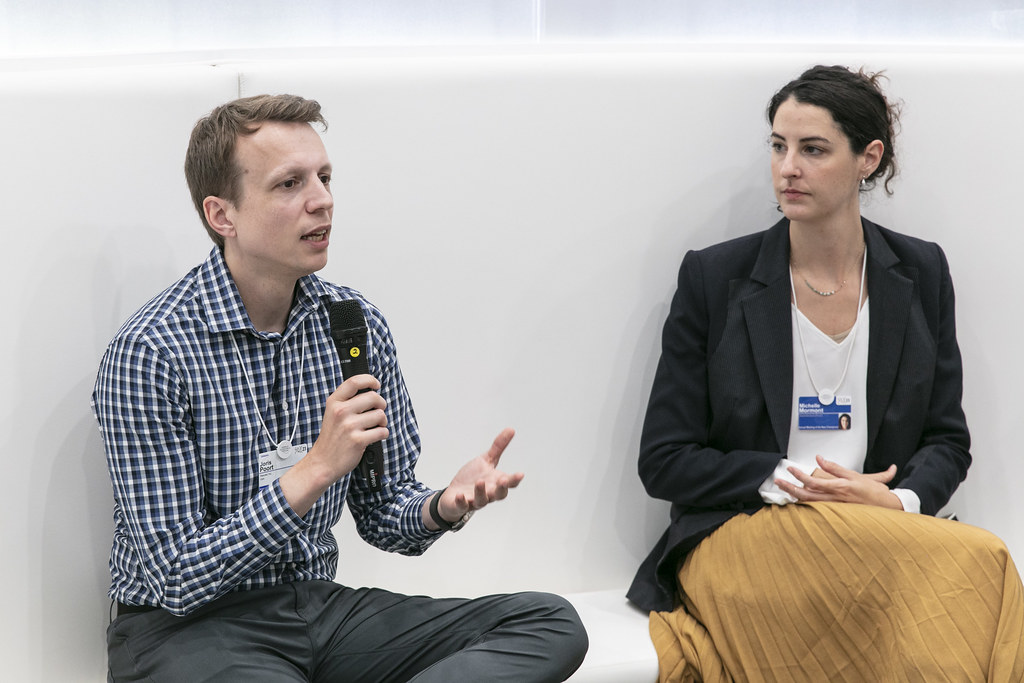
The Engineer Who Democratized the Supercomputer
In 2007, Joris Poort was a structural engineer at Boeing working on the tail section of the 787 Dreamliner. He had the algorithms. He had the optimization models. What he did not have was access to the supercomputer that could actually run them. The machines existed. They were down the hall. But compute time was rationed by seniority and project priority, and a relatively junior engineer working on a secondary component did not make the cut.
He ran his simulations anyway, on whatever sliver of capacity he could beg for, and eventually produced a wing design that saved Boeing hundreds of millions of dollars. But the frustration of that rationing never left him. Why should the world's most capable computational tools be locked behind institutional permission structures? Every engineer on the planet faced the same wall.
That specific frustration - not an MBA thesis, not a market analysis - is what became Rescale.
From Nijmegen to the Cloud
Poort was born in 1983 in Nijmegen, the Netherlands, one of the oldest cities in Europe - a Roman settlement that has been continuously inhabited for over two millennia. His family moved when he was young, taking him through Australia and eventually to Minneapolis before settling in Michigan. His father, an academic, steered him deliberately away from computers. "Computers are just a tool to get a job done," the elder Poort told him. "Go study a real subject."
He studied mechanical engineering at the University of Michigan, graduating magna cum laude, and then aerospace engineering at the University of Washington, again magna cum laude. The irony of his father's advice is that Poort learned object-oriented programming as a child in Australia, on a NeXTcube - the machine Steve Jobs built between his two stints at Apple. The instinct was always there.
After Boeing, he applied the minimum regret framework - a decision methodology that asks what you would regret least when looking back - and chose Harvard Business School. Not because he wanted to become a manager, but because he wanted to understand how to take a technical insight and make it a real company. He graduated with distinction in 2010, then spent a short period at McKinsey's Amsterdam office working on product development for semiconductor companies, before returning to the United States with Adam McKenzie, his Boeing colleague, to build what neither of them had been able to find in the aerospace industry.
"Our future breakthroughs are limited not by imagination, but by the speed at which engineers and scientists can turn ideas into reality."
- Joris Poort, CEO of RescaleY Combinator, 2012
Rescale was accepted into Y Combinator's Winter 2012 batch. At the time, cloud computing for enterprise software was still early - Amazon Web Services had launched only six years earlier, and most engineers still assumed that serious simulation work required on-premise hardware and institutional HPC clusters. The YC network was skeptical but curious. Sam Altman, then becoming a prominent figure at the firm, backed it. So did Paul Graham, Peter Thiel, Jeff Bezos, and Richard Branson.
The pitch was simple: every major industrial engineering challenge - designing safer aircraft, more efficient engines, better pharmaceutical compounds - requires massive computation. That computation is currently locked behind institutional gatekeepers and fragmented across proprietary systems. Put it in the cloud, make it elastic, make it accessible to any engineer anywhere, and the pace of physical-world innovation accelerates dramatically.
It was a thesis that took years to prove. The market was real but slow-moving. Industrial enterprises do not adopt new software the way consumer apps spread. The sales cycles are long. The compliance requirements are stringent. The stakes - when your software is helping design a jet engine - are existential.
Rescale Builds the Infrastructure Layer
By 2021, Rescale had crossed $100 million in funding and was being described by industry analysts as the dominant company in cloud HPC. By 2022, it crossed $200 million with a valuation above $1 billion - the first unicorn in the cloud high-performance computing category. The milestone was notable not just for its size but for what it represented: industrial-scale simulation had finally found its cloud moment.
The platform today is a different scale than its 2012 origins. Over 1,250 engineering simulation applications. More than 500 cloud datacenters worldwide. Clients across aerospace, automotive, energy, life sciences, and semiconductors. The architecture handles what Poort calls "big compute" - tightly coupled physics-based problems that cannot be decomposed the way digital workloads can. Computational fluid dynamics, finite element analysis, multi-disciplinary optimization: these are not workloads that scale by spinning up more web servers. They require synchronized processors communicating in real time, and the infrastructure to run them must be purpose-built.
Rescale has also moved deliberately into the AI era, positioning its platform not just as a simulation runtime but as an AI physics layer - tools that use machine learning to accelerate and augment the underlying physics models. Poort's stated target is a 1000x improvement in design validation speed, which would compress months-long product development cycles into overnight runs.
"Today's leading innovators face bottlenecks in limited compute, siloed data, and complexity of AI deployment. Rescale removes these barriers."
- Joris Poort, Series D announcement, April 2025Davos, Goldman Sachs, and the Recognition Circuit
In 2023, Goldman Sachs named Poort one of the most exceptional entrepreneurs of the year at its Builders and Innovators Summit. That same year, Rescale was selected for the World Economic Forum's Global Innovators Community as part of the Unicorn Track, recognized for its work in sustainable computing and advanced manufacturing.
At Davos in January 2024, Poort took the stage to speak on "Prosperity Through Data Infrastructure." He ran into Sam Altman on the sidelines - the same Sam Altman who had written a check to Rescale through YC over a decade earlier, who was now running the most-discussed AI company on the planet. Poort described the reunion as a reflection on a shared mission that had grown considerably since a San Francisco accelerator batch in 2012.
He writes occasionally for the World Economic Forum, advocating for the intersection of AI and physical-world engineering. His WEF pieces tend to argue a consistent thesis: the AI revolution has so far been concentrated in digital domains - content, conversation, code generation. The larger economic prize is in physical-world innovation, where AI-accelerated simulation can compress the timelines for developing new materials, drugs, aircraft, and energy systems.
The $115 Million Bet on AI Physics
In April 2025, Rescale closed its Series D: $115 million, bringing total funding to over $284 million. The investor list reads like a who's-who of the intersection of industrial computing and AI: NVIDIA, Foxconn, Hanwha Asset Management, Hitachi Ventures, NEC's future fund, Applied Ventures, and - notably - the University of Michigan, the same institution where Poort earned his undergraduate degree magna cum laude two decades earlier.
The round is specifically targeted at expanding the AI Physics product line, building out the unified data fabric that lets simulation data flow between tools without the manual extraction and translation that currently consumes enormous engineering time, and growing the application library beyond its current 1,250 titles. Poort's framing for the raise was direct: the bottleneck to the next generation of physical-world breakthroughs is not imagination but execution speed, and Rescale is the infrastructure that removes that bottleneck.
The Quiet Genius Pattern
Silicon Valley insiders have described Poort as "a silent genius." The characterization is earned. In a founder ecosystem saturated with proclamations, Poort's public statements tend to be specific and technical. He talks about processor coupling constraints. He distinguishes between hyperscale compute architectures and big compute requirements. He argues from first principles - the kind of reasoning that comes from having actually run simulations on insufficient hardware at a major aerospace company and felt the specific pain of the problem he later built a company to solve.
He has said of his own approach: "I've always been relentlessly curious and always eager to learn new things." It is the kind of line that reads as a cliche until you trace the path from a NeXTcube in Australia to a Boeing HPC queue to a YC batch to Davos. The curiosity was not decorative. It was navigational.