BREAKING
Paul Graham co-founded Y Combinator in 2005 YC alumni companies valued at $600B+ Viaweb sold to Yahoo for $49.6M in 1998 Founder Mode essay sparked industry-wide debate in 2024 Hacker News: 10M+ monthly visitors Essays at paulgraham.com: read by millions of founders Airbnb, Stripe, Dropbox, Reddit, OpenAI - all YC-funded Paul Graham co-founded Y Combinator in 2005 YC alumni companies valued at $600B+ Viaweb sold to Yahoo for $49.6M in 1998 Founder Mode essay sparked industry-wide debate in 2024 Hacker News: 10M+ monthly visitors Essays at paulgraham.com: read by millions of founders Airbnb, Stripe, Dropbox, Reddit, OpenAI - all YC-funded
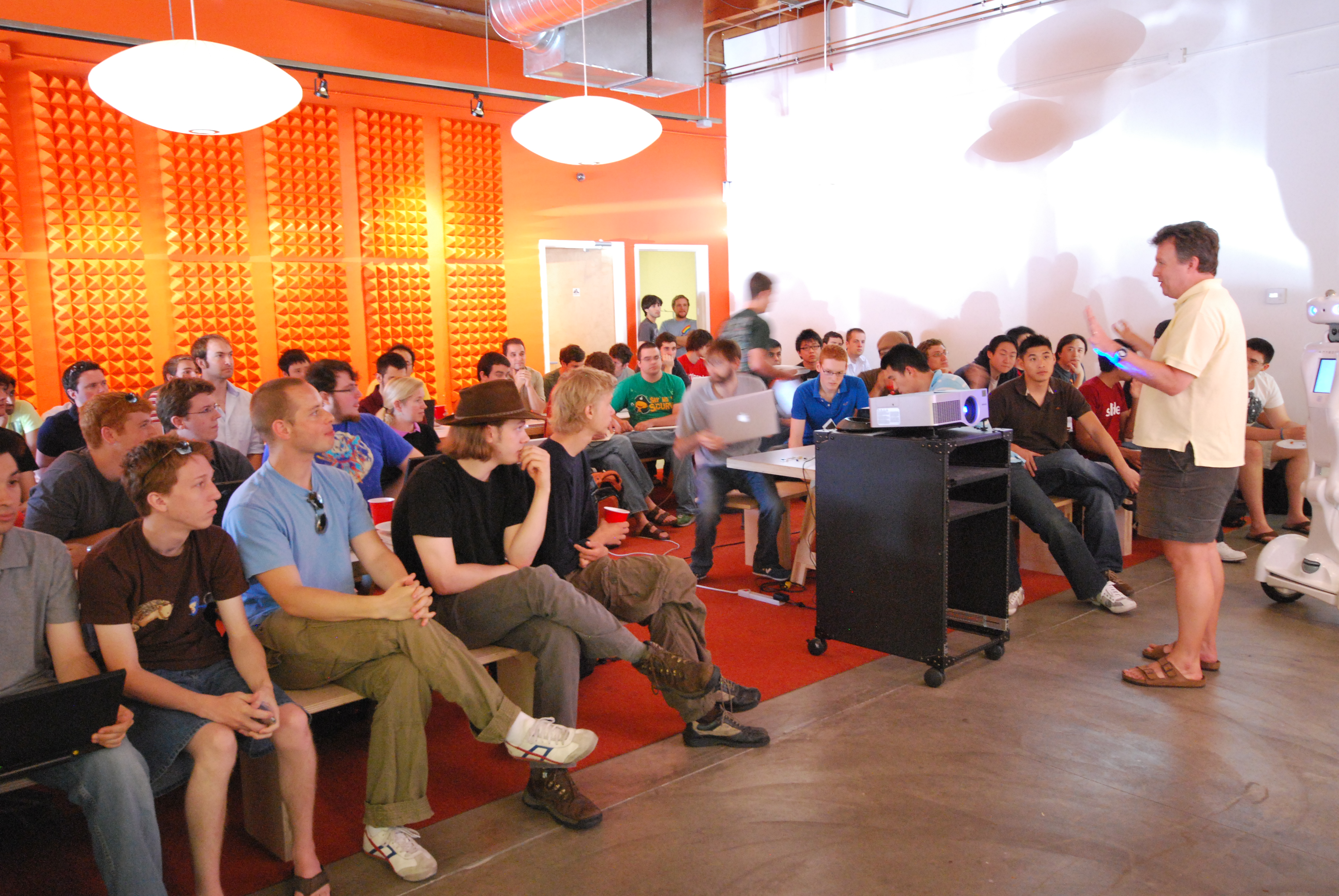
Paul Graham speaking at Y Combinator Prototype Day, Summer 2009
Programmer • Essayist • Seed Investor

Paul
Graham

"The man who made seed funding a philosophy - and got away with it."

Co-founder of Y Combinator. The programmer who sold his startup to Yahoo, then used the proceeds to build the most influential idea-factory in Silicon Valley history. When Paul Graham writes, founders read. When he invests, empires get started.

Y Combinator Viaweb Founder Lisp Evangelist Hacker News
1,300+ YC Startups Funded
$600B+ YC Portfolio Value
$49.6M Viaweb Exit (1998)
200+ Essays Published
2005 YC Founded

The Programmer Who Changed
How Startups Get Born


Most people in Silicon Valley claim to have funded the future. Paul Graham actually did it - twice. First by building Viaweb, one of the internet's earliest web applications, in a Cambridge apartment using a language almost nobody else was writing commercial software in. Then by co-founding Y Combinator in 2005 and quietly incubating a list of companies that reads like the table of contents of modern tech: Airbnb, Stripe, Dropbox, Reddit, Twitch, OpenAI.

He was born in Weymouth, Dorset, England in November 1964. He studied philosophy at Cornell before drifting into computer science at Harvard, where he earned a PhD in 1990. The resume is respectable. But what makes Graham unusual isn't the credentials - it's the trajectory. After Harvard, he didn't take the obvious path. He painted. Seriously. He studied fine arts at RISD and spent time at the Accademia di Belle Arti in Florence. This is a man who, when he had every reason to go straight into tech, went to Italy to learn to paint.

"Don't ignore your dreams; don't work too much; say what you think; cultivate friendships; be happy."

- Paul Graham

The origin story of Viaweb involves a dream - literally. Graham dreamed about clicking on links to control server-side software. He woke up with the idea for a web application: a store-builder that lived on the internet rather than on a personal computer. He co-founded Viaweb with Robert Morris and Trevor Blackwell in 1995 and wrote most of it in Lisp, the programming language practically nobody used for commercial software. Three years later, Yahoo bought it for $49.6 million.

The Yahoo exit gave Graham money, reputation, and something more valuable: a platform. He began writing essays. Not blog posts. Essays - the kind that build arguments, surprise the reader, and end somewhere the reader didn't expect to go. Essays on wealth creation, on what makes a great hacker, on startup ideas, on inequality, on how to live. Hundreds of them, all free, all unadorned at paulgraham.com. No ads. No newsletter. No paid tier. Just the thinking.

"The Viaweb idea came to me in a dream. I realized I could control server software by clicking on links. That was the whole thing."

Y Combinator was born in 2005 after Graham gave a talk at the Harvard Computer Society that drew an unexpectedly large crowd of would-be founders. He realized the demand was real. He co-founded YC with Jessica Livingston (later his wife), Trevor Blackwell, and Robert Morris. The structure was simple and strange: give small amounts of money to very early startups, work intensely with them for three months, and end with a Demo Day. It looked nothing like traditional venture capital. That was the point.

The early batches funded Reddit, which changed how the internet talked to itself. Later batches funded Airbnb - the founders presented a nearly dead company, Graham saw something nobody else did, and invested. Then Stripe, the payments infrastructure that now powers a significant portion of global internet commerce. Then Dropbox, which launched from a three-minute demo video Graham encouraged its founder Drew Houston to make. The pattern repeated, batch after batch.

Dispatches from the Essay Canon

Graham stepped back from day-to-day YC operations in 2014, handing the reins to Sam Altman. But he never really left the conversation. His 2009 essay "Maker's Schedule, Manager's Schedule" remains required reading for anyone running a company - or trying to do creative work inside one. His argument: programmers and managers operate on fundamentally incompatible time structures, and scheduling a meeting in the middle of a maker's afternoon is like throwing a brick through a window.

In September 2024, he published "Founder Mode" - an essay arguing that the conventional advice to delegate and hire good managers and then get out of the way is actively harmful for founders. The reaction was seismic. Every major tech publication ran a piece. Founders who had felt something was wrong with the standard management playbook finally had a name for it. Critics pushed back. Graham responded by pointing at the evidence: Airbnb, Apple, and a dozen other companies whose best years came when founders stayed deeply involved.

"The best way to get startup ideas is not to try to think of startup ideas."

- Paul Graham, "How to Get Startup Ideas"

He's also been paying close attention to AI. In "Writes and Write-Nots" (2024), he argued that AI will split society into two kinds of people: those who write and those who increasingly won't. His view on AI startups is characteristically concrete: AI isn't a solution looking for problems - it's the missing piece in a large number of important puzzles that were almost complete. The founders who win will be the ones who know which puzzles those are.

Graham lives in the UK with Jessica Livingston and their two sons. He works in the mornings after the school drop-off and stops in the afternoon for the pickup - a self-imposed maker's schedule, lived rather than just theorized. He walks when he needs to think. He writes between school runs. He invests by reading people. He has said that his test for a great founder is whether you could describe them as an animal - someone who is relentless, specific, and will not be deflected by a polite no.

There is a version of Paul Graham that is purely an institutional figure - the man who built the machine that built the tech industry. But the more interesting version is the one who studied philosophy, learned to paint in Florence, wrote his PhD on Bayesian inference, chose Lisp when nobody else did, and built a career around the belief that the most important work happens at the edges of what's considered sensible. Not at the center. At the edge.


Quotable Graham

"A programming language is for thinking about programs, not for expressing programs you've already thought of."

"In business, there is nothing more valuable than a technical advantage your competitors don't understand."

"There are few sources of energy so powerful as a procrastinating college student."

"Startups don't win by attacking. They win by transcending."

"What you're afraid of is usually what you should do."

"AI is turning out to be the missing piece in a large number of important, almost-completed puzzles."

"Write like you talk. Doesn't sound literary, but that's a feature, not a bug."

"The best way to get startup ideas is not to try to think of startup ideas."

The Timeline


1986
Graduated Cornell University with BA in Philosophy
1990
Completed PhD in Computer Science at Harvard. PhD thesis on Bayesian inference in AI.
1993
Published "On Lisp" - a foundational text in functional programming and Lisp macros
1995
Co-founded Viaweb with Robert Morris and Trevor Blackwell. Wrote it in Lisp. One of the first web applications.
1995
Published "ANSI Common Lisp" - the comprehensive reference
1998
Sold Viaweb to Yahoo! for $49.6 million (455,000 Yahoo shares). Rebranded as Yahoo! Store.
2004
Published "Hackers & Painters: Big Ideas from the Computer Age"
2005
Co-founded Y Combinator with Jessica Livingston, Trevor Blackwell, and Robert Morris. First batch included Reddit.
2007
Launched Hacker News (originally "Startup News") - built in Arc programming language
2008
Released Arc programming language publicly on January 29
2009
Published "Maker's Schedule, Manager's Schedule" - the essay that changed how knowledge workers think about time
2014
Stepped down from day-to-day YC role. Sam Altman took over as president.
2016
Moved to the United Kingdom with family
2024
Published "Founder Mode" - sparked industry-wide debate about how founders should lead growing companies
2026
Continues active angel investing; recent investment in Orange Slice (Feb 2026)

Achievements

Co-founded Y Combinator - the accelerator that funded over 1,300 startups with a combined valuation exceeding $600 billion
Built and sold Viaweb to Yahoo for $49.6 million in 1998 - one of the first commercial web applications
Created Hacker News, the premier tech news community with millions of monthly visitors and a uniquely civil discourse
Developed Arc - a minimalist Lisp dialect that served as a real-world test of his programming language philosophy
Published "Hackers & Painters" - a seminal book bridging programming and creative thinking, read by generations of engineers
His essay "Maker's Schedule, Manager's Schedule" fundamentally reshaped how tech companies structure time and meetings
Pioneered the seed accelerator model - transforming early-stage startup funding globally and spawning hundreds of YC-inspired programs
"Founder Mode" essay (2024) sparked a major cultural reset in how startup CEOs think about involvement vs. delegation
YC's first batch funded Reddit, which launched the modern social news format used by hundreds of millions today
Wrote "On Lisp" in 1993 - still considered a foundational text in functional programming and macro-based language design

Education


Cornell University
BA, Philosophy
1982 - 1986
Harvard University
MSc, Computer Science
1986 - 1988
Harvard University
PhD, Computer Science
1988 - 1990
RISD
Fine Arts / Painting
1990s
Accademia di Belle Arti
Painting (Florence, Italy)
1990s

10 Facts About Paul Graham

01
Studied philosophy at Cornell before switching to computer science - he believes humanities training makes better programmers.
02
Painted seriously in his 20s, studying in Florence and at RISD. He periodically quit tech consulting gigs to focus on art.
03
Viaweb was written almost entirely in Lisp at a time when no serious commercial software used Lisp. Yahoo's engineers were reportedly baffled.
04
The spark for Viaweb came from a dream about clicking links to control server software. He built a billion-dollar idea from a dream.
05
Hacker News was built in Arc to prove Arc could handle real production workloads. It now serves millions of users monthly.
06
His wife Jessica Livingston wrote "Founders at Work" - interviews with the original teams at Google, Apple, and Yahoo.
07
Has lived in the UK since 2016 - an unusual move for someone at his level of Silicon Valley credibility.
08
His writing routine: mornings after school drop-off until afternoon pickup. A textbook maker's schedule, followed strictly.
09
Founder selection test: "Could you describe this person as an animal?" Meaning - driven to the point of being unstoppable.
10
paulgraham.com has no ads, no newsletter, no paywall. Just free essays. He has never monetized his most widely read writing.

Recent Updates