The suspicious reading in an industrial plant rarely arrives wearing a disguise. It is just a number: a pressure, a temperature, a flow rate. It sits beside thousands of other numbers in a historian, looking sufficiently ordinary to become a chart, an alarm setting, or a training example for an AI model. That is the trouble. A broken sensor can be spectacular; a plausible one can be persuasive.
- APERIO's DataWise watches industrial signals for faults, scores their quality, and ranks issues for investigation.
- It checks whether data copied from plant historians still matches what lands in cloud systems.
- Its newer remediation tools make corrected, labeled copies while preserving the original record.
- Enterprise pricing depends on monitored tags, sites, and modules; APERIO does not publish a list price.
Consider a chemical plant with half a million PI tags, the scale cited by Covestro digitalization lead Rich Guhl. A tag is a named stream of measurements, each with its own habits and failure modes. You can inspect a handful by eye. Half a million require a system. Guhl's point is wonderfully blunt: manual checks cannot cover that scale. A chart can tell an engineer what a sensor reported. It cannot, by itself, certify that the sensor deserved belief.
First, a lie detector for machines
APERIO's opening act was narrower and more dramatic than its present business. When it emerged from stealth in 2016, the company described software for detecting forged readings in industrial control systems. The imagined adversary was a hacker who made a dangerous process look normal to an operator. An executive called the product a “lie detector for machines.” The phrase had the virtue of being memorable and the inconvenience of describing only one way a machine can lie.
Readings also become untrustworthy without an attacker. Instruments drift. A transmitter freezes and repeats its last value. A network drops samples. A historian compresses a series, or a cloud pipeline quietly loses part of it. APERIO's present platform, DataWise, treats these mundane failures as a general data-quality problem. The change in positioning is visible across its public releases: from data forgery protection to continuous scoring and repair of operational data. The company has not publicly supplied a tidy conversion story, and the untidy version is more useful. Security, analytics, and AI all inherit the same fundamental question: is the measurement sound?
A diagnosis is useful. A diagnosis with a defensible next step is useful to the person on shift.
What the software actually does
DataWise connects to industrial historians and data platforms. Its self-supervised models learn a baseline for each signal, then look for failures such as missing values, flat lines, out-of-range readings, outliers, abrupt changes, and unusual sampling. A Data Quality Index, or DQI, turns those findings into scores that can be viewed by tag, asset, or site. The point of the score is practical: if a maintenance forecast relies on bad vibration data, someone should know before a work order is raised.
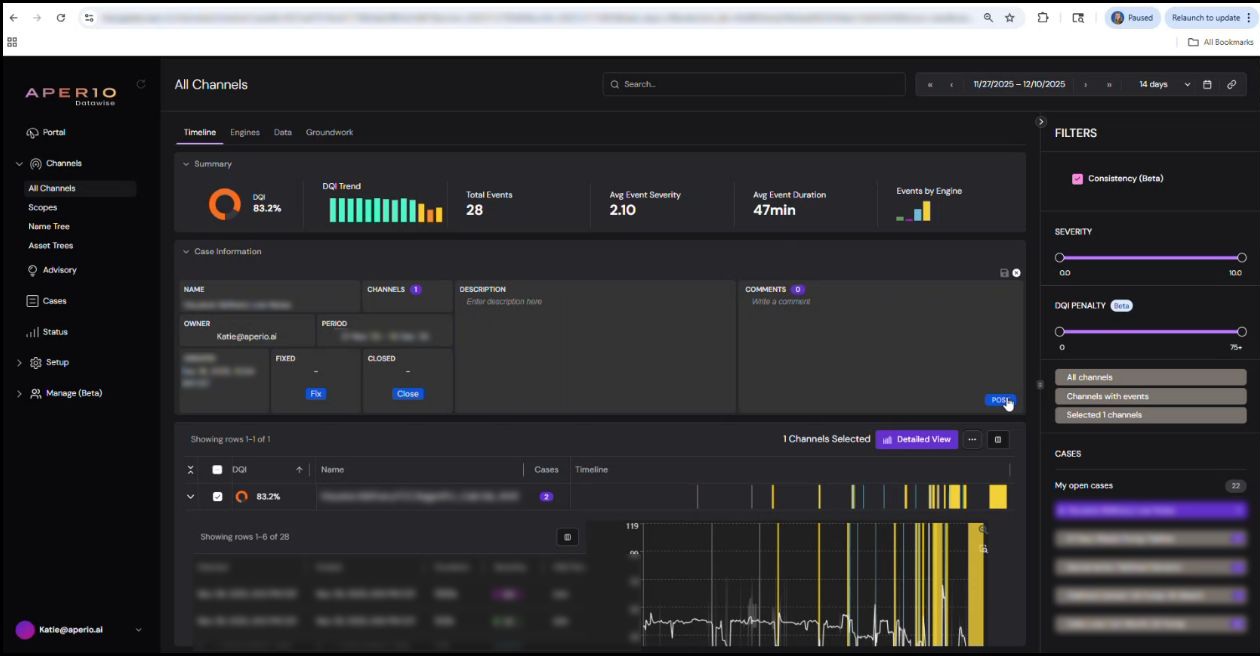
The platform's Consistency Monitor checks a different failure point: the journey from historian to cloud. APERIO says it compares source streams with data landing in Snowflake, Databricks, or Azure to catch dropouts, latency, and sampling differences. This matters because a healthy sensor can still produce a misleading dashboard if its records are altered or lost on the way. APERIO joined the Snowflake Partner Network in 2026, an integration that puts this source-to-cloud question directly in the path of industrial AI projects.
DataWise 4.5, announced in July 2026, moved the product beyond flagging and scoring. Its Albert assistant answers plain-language questions about urgent issues and possible causes, using the platform's own quality data. Configurable DQI views let different teams emphasize different failure types. A process engineer may care about a reading that changes an operating decision; a data scientist may care more about gaps that ruin a training window. Those are different definitions of “good enough,” and forcing them into one universal score would be a small bureaucratic comedy.
“With half a million PI tags, manually checking everything is just not scalable.”
Rich Guhl / Digitalization Lead, CovestroThe difference between clean and invented
Remediation is where the work becomes delicate. If a sensor went silent yesterday, the missing readings cannot be recovered by wishing harder. They can sometimes be estimated from nearby measurements or replaced according to an explicit rule. DataWise offers substitution, interpolation, synthesis, and removal. APERIO's published workflow keeps the original historian data intact, labels changed points, and stores the rule behind each alteration. That distinction is essential: a reconstructed value may be useful to a model, but it is still an inference, not a measurement.
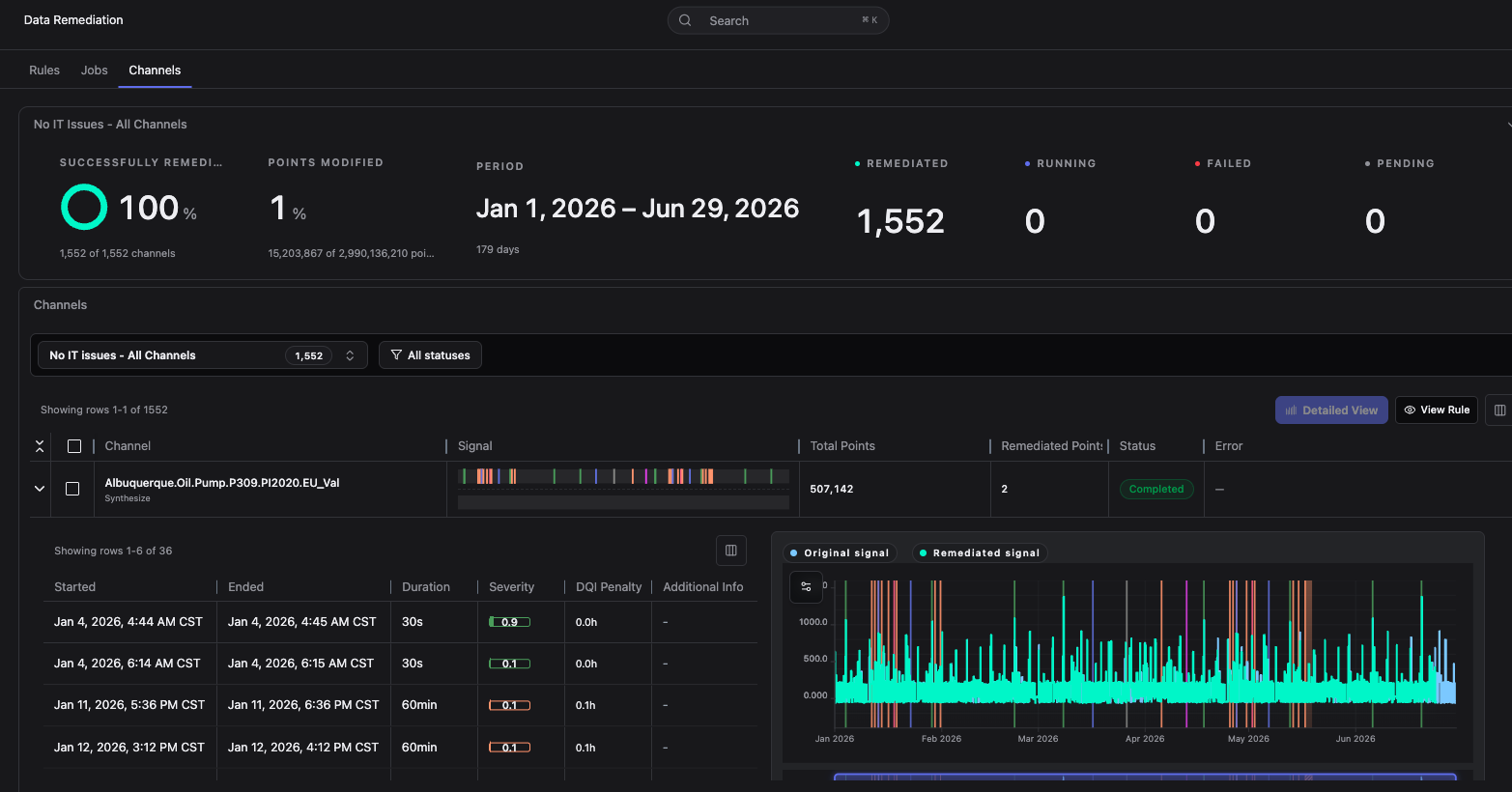
That example is revealing because the changed share was about one percent. A crude cleaning job could flatten valuable variation along with the faults. APERIO's argument is that each alteration should be selected, visible, and reversible at the dataset level. It is an argument anyone preparing AI training data can borrow: keep the source, mark the estimate, preserve the rule, and let the consumer decide whether the result is fit for purpose. For a brief gap in a slowly moving temperature series, interpolation may be reasonable. For a long gap in a volatile process, a neat line may be an elegant falsehood.
Deployment outcomes are reported by APERIO; funding is the sum of its announced $4.5m, $8.5m, and $9m rounds.
Who buys confidence?
APERIO sells enterprise software to people whose decisions depend on plant data: operations and maintenance engineers, OT and IT teams, data engineers, and AI groups. Its public customer references span chemicals, oil and gas, utilities, mining, and manufacturing, including Covestro, Devon Energy, Newmont, Enbridge, Ormat, and Bazan. A company-reported pulp-and-paper case study describes more than 60,000 tags monitored on recovery-boiler operations, 60 percent faster troubleshooting, and 15 percent fewer unplanned outages over six months. Those are useful case-study figures, though they are not an independent controlled trial.
The sales model follows the size of the problem. APERIO says its license price depends on how many tags and sites a customer monitors and which capabilities it needs. It usually starts with a focused pilot, then expands if the case works. There is no public list price. On the financing side, it announced a $4.5 million seed round in 2018, an $8.5 million Series A in 2020, and a $9 million Series A1 in 2023, led by Momenta. The latter included investors with industrial stakes of their own, among them Chevron Technology Ventures and National Grid Partners. Their money is evidence of interest, not proof that every deployment pays back.
The alternative is familiar: hand checks, static thresholds, one-off scripts, or a general data-observability tool. Timeseer also addresses industrial data quality. APERIO's specific pitch is per-signal models for industrial time series, a common quality score across equipment and sites, checks on cloud copies, and a documented route from finding bad values to producing usable data. It sits between instruments and applications rather than replacing either a historian or an analytics platform.
There are edges to this idea. Software cannot recalibrate a failed instrument or make a plant digitize equipment it has never connected. A quality score has little economic value if no one owns the repair queue. And a synthesized reading should never be mistaken for the value a sensor actually measured. APERIO can make these limits visible and can prepare a labeled working copy; the operator still has to decide which gaps are safe to fill and which require a technician, a new sensor, or a postponed model.
The question worth copying
A factory can buy sensors, a historian, a cloud warehouse, and an AI model, then discover that the most consequential component is the least glamorous one: the test of whether the readings survived reality. APERIO's progression from cyber deception to routine data quality makes a practical point. The useful question is not “How much data do we have?” It is “Which data could change a decision, and how would we know if it were wrong?” Ask that before the forecast is built. The answer may be a sensor to recalibrate, a pipeline to repair, a record to label, or simply a model that should wait.