At a Koppers facility in Huntington, West Virginia, a safety professional watched someone handle a heavy drum. The work had to be done; the awkwardness did not. With TuMeke's phone-based assessment, the team could see the risk in the movement, test another way to roll the drum, and compare the scores. The revised task reduced the measured risk and could be performed by one worker instead of two. Koppers later circulated the idea through its internal innovation system.
It is a small story about a big industrial habit. Safety programs are good at counting injuries after they happen. They are less often equipped to examine the thousands of ordinary reaches, lifts, and twists that come before an injury. TuMeke Ergonomics sells a way to examine those moments while the task is still routine.
The short version
- What it does: turns a phone recording of physical work into ergonomic risk analysis and practical recommendations.
- Who buys it: industrial safety teams, ergonomists, operations groups, and insurance risk advisers.
- What it costs: an annual subscription quoted by users, sites, or assessment volume; a 14-day trial is available.
- What matters: a score becomes useful when someone changes the job and measures it again.
The clipboard has a speed limit
Traditional ergonomic assessments ask a trained person to observe a task, record joint positions and load details, apply a method such as REBA or RULA, and write up the result. That expertise matters. It also takes time, especially across a plant where the same task changes by shift, workstation, and worker. Koppers said its earlier use of outside assessments was slow and expensive, with too little actionable output. A separate software trial, it said, lacked the flexibility and engagement it wanted. Those were the first failures its TuMeke pilot was meant to address.
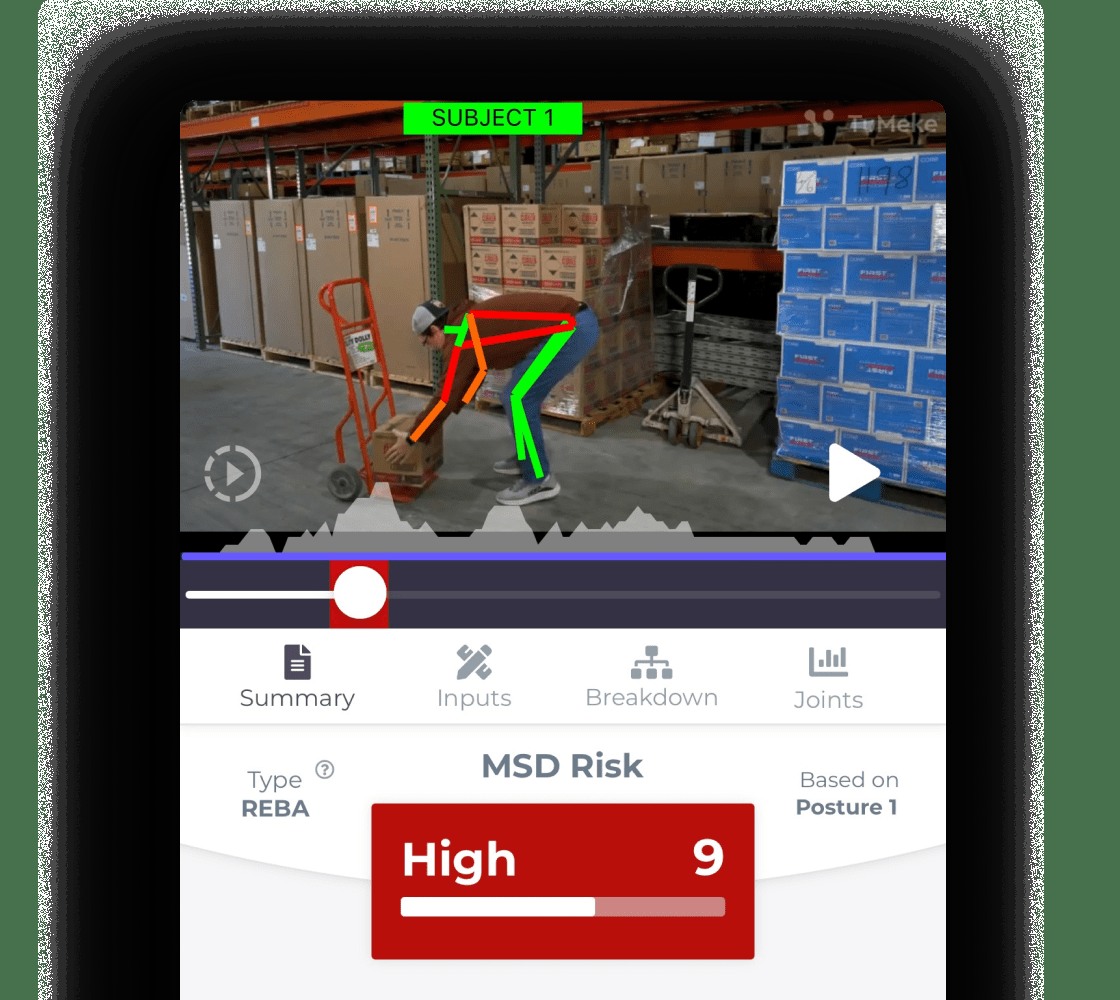
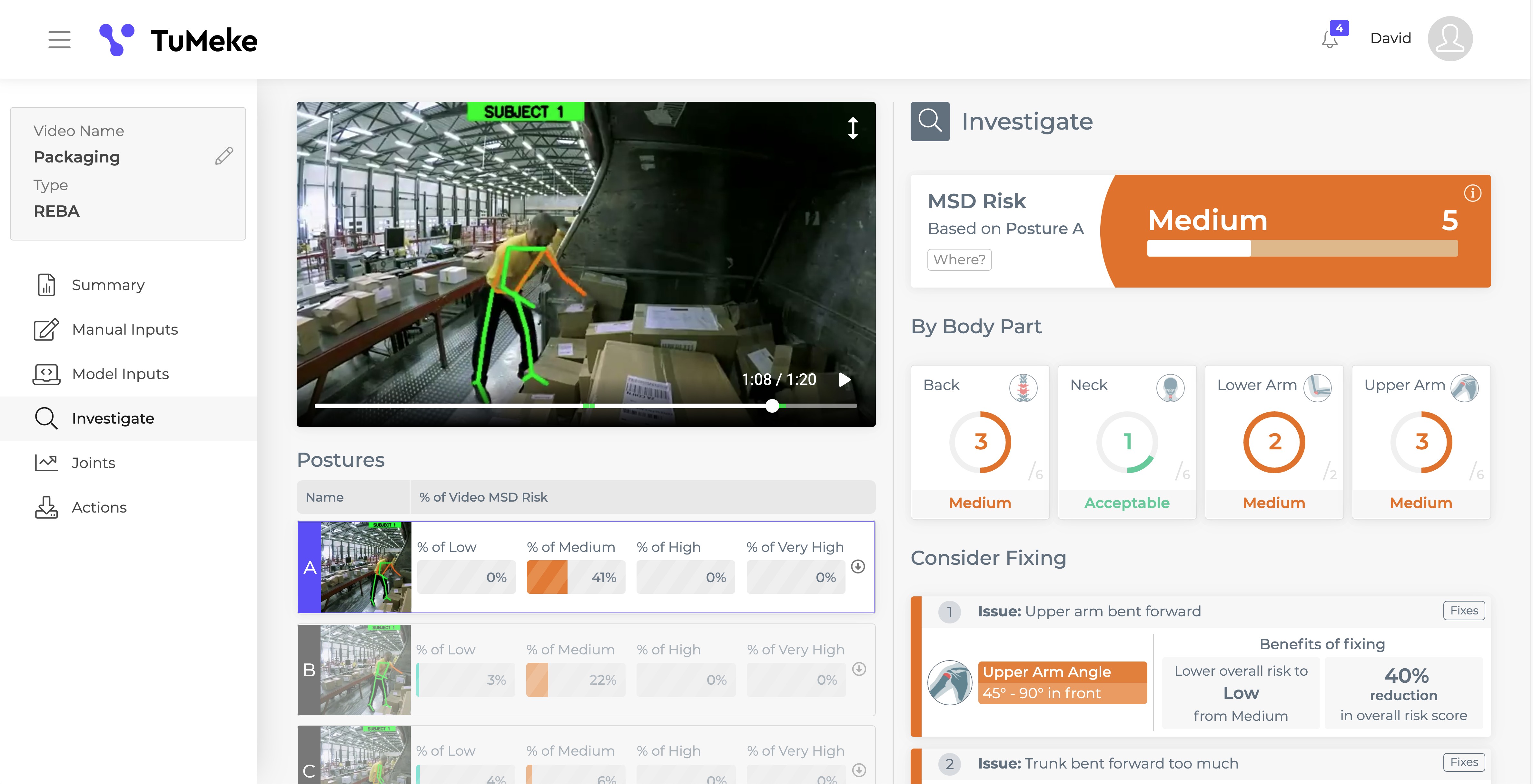
TuMeke began with a simpler piece of equipment: the phone already in a supervisor's pocket. A user records a worker doing a task or uploads existing footage. Computer vision traces movement; Risk Suite scores the job, highlights risky postures, and offers recommendations. The current platform also examines repetition, duration, grip, force, balance, and job context. There are dashboards for comparing tasks and sites, reports for documenting findings, and a mobile app for reviewing the result at the work area. It is software for the person trying to make a decision on Tuesday, not merely a chart for the annual safety review.
A pilot that escaped the pilot
Koppers started at six sites - five in the United States and one in Australia - and expanded to twelve, including four Australian locations. Its safety team used visible before-and-after risk comparisons to persuade colleagues that a change was worth trying. Facial blurring helped address privacy concerns. The company reported a downward trend in strains and sprains, though its public case study did not assign a percentage to that trend. The drum example is more instructive than an invented company-wide number: find a stubborn task, test a change, show the difference, then let other sites copy the fix.
“Certain operations simply can’t be engineered to remove the human factor.”Blayne Darnell, corporate safety and health manager, Koppers
Pacific Southwest Container offers a second version of the same argument. Manual scoring had left its safety team moving slowly through a long list of jobs. With TuMeke, it reported completing more than 300 assessments. Safety specialist Nicole Maxwell said she would have been only a quarter of the way through that work without the software. That is a claim about capacity, not proof that every assessment led to a safer workstation. It does explain why speed can matter: an unexamined task has no chance to enter the improvement queue.
Latham Pools reported the sharpest public outcome: at its Brantford and Scotia sites, sprains and strains fell from 23 cases in 2022 to two in 2024. TuMeke calls that a 91% reduction. It is a customer-reported result at two locations over that period, rather than a promise about what another factory will achieve. The useful detail is that Latham treated the video assessment as a way to address root causes and make a case for changes, including where a task's apparent risk needed to be checked.
What the subscription buys
TuMeke is a business-to-business software company. Its Base package includes industrial and office 3D assessments, quick processing, coaching guidance, AI recommendations, reports, and an executive dashboard. Enterprise adds single sign-on, customized reporting, and dedicated customer-success and ergonomist support. The company prices annual subscriptions according to user count, sites, or assessment volume. It publishes no fixed dollar price. There is a 14-day trial with no credit card, while custom enterprise onboarding can carry a scoped fee. So the answer to “what did it cost?” is a quote, not a tidy number.
Its buyers do not all wear the same badge. A manufacturer wants fewer strains at a production line; a logistics operator wants to compare lifting jobs across warehouses; an insurer's loss-control adviser wants a clearer way to show a client where risk sits. M3 Insurance says TuMeke cut its on-site assessment time in half. The common purchase is a faster route from observation to evidence, and from evidence to a decision. The alternatives are a specialist's manual assessment, an outside consultant, a sensor or wearable system, or another computer-vision product. TuMeke's advantage is the low equipment burden and the workflow around the result.
The uncomfortable question for any clever score
A computer can be consistent without being right. In a 2025 study of REBA assessments, TuMeke's repeated scores were perfectly consistent, while agreement with human raters varied by body region and by which frame of a video was selected. The authors did not test whether the software was more accurate than human raters. That distinction matters to anyone tempted to treat the number as a verdict. A risk score is a tool for finding and comparing possible hazards; the real-world task and the person doing it remain the test.
TuMeke seems to have taken a related lesson into its 2026 product updates. Risk Suite now automates more of the inputs and analyzes factors beyond posture. Its Coaching Cues show the exact video moment that triggered a flag, alongside an illustration and a short explanation a supervisor can use while the worker is still there. The company itself cautions that technique alone cannot solve every ergonomic problem. Workstation design, tools, load, pace, and process may be the cause. Telling a worker to lift differently while leaving an impossible shelf height in place would be an impressively efficient way to change nothing.
The business has grown alongside those product choices. Founded in 2019 by Riley Noland, Zach Noland, and Diwakar Ganesan, TuMeke launched its offering in 2021, announced a $2.5 million seed round in 2022, and a $10 million Series A led by Intel Capital in December 2023. In 2025 it announced SOC 2 Type II compliance and more than 200 industry customers; its current customer page says over 300. The names there include Siemens, Sika, Cargill, and Hitachi Astemo. The scale is interesting because the product has to work far from the original team, in plants and warehouses with different tasks, languages, and habits.
The copyable part
A plant does not need to buy TuMeke to borrow the best idea in its case studies. Pick one repetitive, awkward task; record how it is actually done; score or review the movement with someone who understands ergonomics; change the equipment or workflow; record it again; and let workers see the comparison. Start where the risk is visible and where a local team has the authority to make a change. Koppers' drum was a useful first case because the task was specific, the fix was practical, and other sites could repeat it.
The method is weaker when the camera misses the meaningful part of a job, when no one can alter the workstation, or when a score becomes a substitute for listening to workers. It also asks for trust: filming people at work can feel like surveillance if the purpose, consent, and handling of the footage are vague. TuMeke talks about consent and human oversight, and Koppers' case study mentions facial blurring. Those details belong in the operating plan, not in a footnote after the rollout.
The most persuasive frame in TuMeke's story is not the one with the brightest skeleton overlay. It is the second recording, after someone has moved a pallet, changed a tool, or found a better way to roll a drum. The software makes the old problem easier to see. The safer job is still made by people.