Heat is a talented liar. A car cabin can hit its temperature target while the driver's hands remain cold. A battery pack can look calm on an average-temperature chart while one cell edges toward trouble. A military vehicle can be physically cool enough and still blaze against its background in an infrared sensor. ThermoAnalytics has spent 30 years turning those awkward distinctions into engineering software.
From Calumet, in Michigan's Upper Peninsula, the company builds tools for engineers who would prefer to discover the bad news before a prototype exists. Its customers model conduction, convection and radiation; run long drive cycles; predict skin temperature and sweating; estimate an exhaust plume's effect on nearby components; and ask what a sensor will see at a particular hour, in particular weather, from a particular angle. The common product is not a colorful temperature plot. It is an earlier decision.
“Thermal management is one of the most important and least understood aspects of great design.”ThermoAnalytics' own diagnosis of the market
The contract shop that productized its homework
ThermoAnalytics says Keith Johnson and Allen “Al” Curran founded the business in 1996. The early company developed thermal software for Ford Motor Company and the U.S. Army. Government contracts made the services business profitable; commercial customers arrived more gradually. By 2002, original equipment manufacturers around the world were using its software for thermal analysis, vehicle design and infrared-signature prediction.
That demand changed the company's mind about what it was. It added sales and marketing, expanded engineering and development, and shifted its weight from bespoke services toward repeatable software. This is the origin story worth copying: do difficult work for demanding early customers, notice which internal tool keeps solving the same class of problem, then make the tool the product. ThermoAnalytics kept the services arm, which matters because its engineers still use the software on client models and feed real annoyances back to developers.
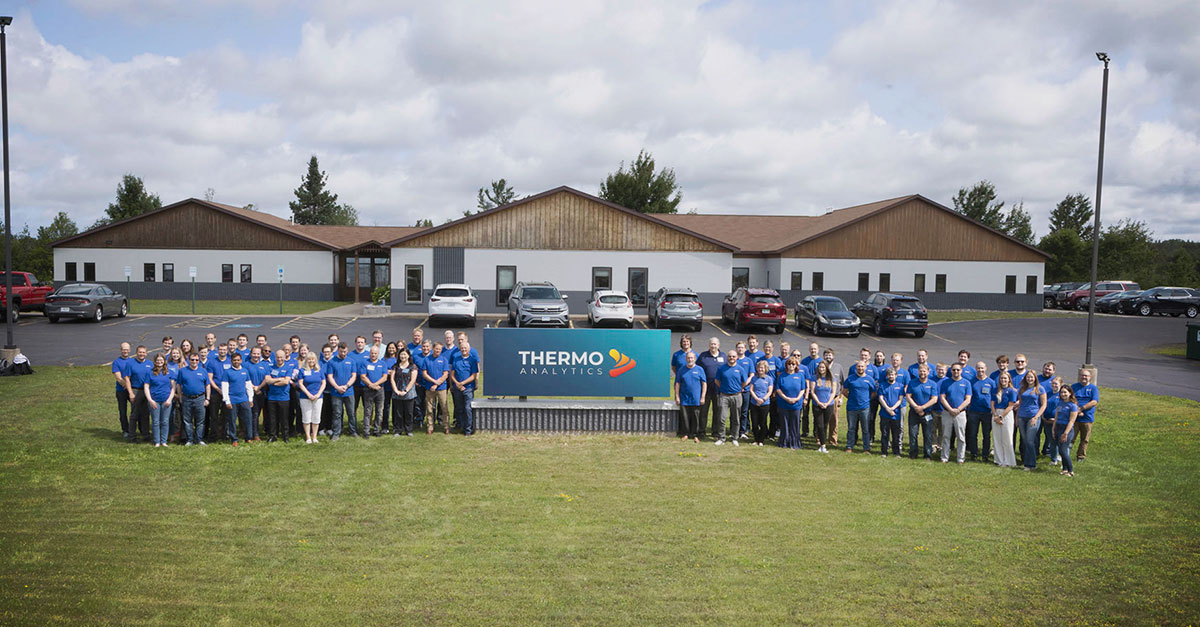
The ownership model followed a similarly patient path. ThermoAnalytics created an Employee Stock Ownership Plan in 2001 and is now fully employee-owned. It describes open-book monthly meetings where employees see financial and performance information, offer input, and participate through bonuses and profit sharing. That does not prove better code. It does create a neat alignment for a niche company whose products improve through long relationships, validation data and accumulated engineering judgment rather than fashionable feature sprints.
Three products divide the argument with physics
TAITherm is the foundation. It solves 3D heat transfer in steady-state and, more importantly for the company's pitch, over time. Conduction through materials, convection to fluids and radiation between surfaces are solved together. Engineers can study the hot soak after a vehicle shuts down, a cold-start cabin, a battery under fast charge or a satellite passing into eclipse. Those transitions are often where limits are crossed.
MuSES takes the physical temperatures and asks a stranger question: what does an electro-optical or infrared sensor see? A painted panel does not merely emit heat. It reflects sun, sky and terrain; atmosphere changes the signal; viewing angle and wavelength matter. MuSES combines thermal behavior with material reflectance, environmental conditions and sensor effects to predict signatures across visible and infrared bands. Defense teams use that work for concealment and survivability. The same machinery can generate labeled synthetic images for detection algorithms when real imagery is rare, sensitive or expensive.
CoTherm is the conductor. Engineering organizations rarely live in one solver, so it automates studies and moves data among thermal, CFD, system, optimization and controls tools. The distinction is practical: TAITherm handles temperature, MuSES handles visibility, and CoTherm handles the workflow. Extensions cover battery behavior, human physiology, exhaust, drive cycles and RapidFlow, a lighter-weight airflow solver introduced with TAITherm 2024.2.
TAITherm
Find the temperature through time, with conduction, convection and radiation interacting.
MuSES
Translate temperature, surfaces and weather into the radiance an infrared sensor receives.
CoTherm
Automate the handoffs among models, tools, design studies and teams.
What fails first is the average
The first casualty of serious thermal work is usually a reassuring average. Average cabin air temperature misses a cold steering wheel and a draft at the ankle. Average pack temperature misses cell-to-cell gradients. A steady-state underhood model misses the moment airflow stops but stored heat keeps moving after key-off. ThermoAnalytics' software is built around transient, local and coupled behavior because products fail at particulars.
Human comfort makes the point almost comically literal. A passenger is not a static heat load. The Human Thermal Extension models metabolism, blood flow, respiration, perspiration, shivering, clothing and localized sensation. Gentherm partnered with ThermoAnalytics in 2019 to deepen personalized comfort prediction, including moisture effects. Volvo Cars has presented cabin heat-up and cool-down work using TAITherm, the human model and GT-SUITE coupling. A thermostat gets one vote; the body gets several hundred.
The company published one automotive comparison that makes its economic case unusually concrete. A conventional transient CFD methodology used 512 processors, took 30 days and ran one driving profile. The advanced coupled transient method in the comparison used 100 processors, took seven days and ran five profiles. ThermoAnalytics calculated an 83 percent reduction in both time and computing resources. It is a company-published comparison, not a universal benchmark, but it explains the offer: reserve expensive, general-purpose computation for the physics that need it and use a faster thermal model for long cycles and repeated design studies.
The price is private. The public receipts are not.
ThermoAnalytics does not post a standard U.S. license price. Enterprise buyers request a quote, and the final bill can reasonably depend on products, extensions, users, compute arrangements and services. Its former Japanese distributor has advertised floating licenses and a 30-day demo. Publicly listed virtual classes provide a smaller clue: a three-day TAITherm course in 2025 and a two-day MuSES course in 2024 were each priced at $299.
The company also sells engineering services: model construction, thermal and signature analysis, on-site testing, validation, workflow development, onboarding and training. This hybrid model lets a small engineering team buy expertise when it cannot justify building a permanent simulation group. Larger teams can license the tools and call in specialists for a difficult first model or a coupling workflow.
A narrow specialist inside a broad CAE market
ThermoAnalytics competes with broad platforms from Ansys, Siemens, Dassault Systèmes and Altair, plus CFD packages such as STAR-CCM+ and OpenFOAM and specialist thermal tools. Yet “competitor” is a slippery label here. Many of those companies appear on ThermoAnalytics' partner list because CoTherm is designed to connect tools rather than demand a one-solver monoculture. The firm occupies the thermal center of a larger computer-aided engineering stack.
Its customer map is equally mixed. Automotive remains visible in cabin comfort, batteries, brakes, exhaust and underhood work. Defense uses include target signatures, synthetic data and human heat stress. Aerospace introduces vacuum and radiation-dominant problems. Buildings, electronics, wearables, performance clothing and protective equipment bring different geometries but the same question: where does energy go, and what happens to the person or component next?
Geography has widened without erasing the Keweenaw base. ThermoAnalytics lists locations in Calumet, Novi, Munich and Tokyo. In 2023 it acquired EThermo, its exclusive Japanese distributor founded by Xubin Zhou, to support customers directly as the automotive market moved toward electrification. The Michigan Economic Development Corporation later described helping with grants, talent needs and the Japanese subsidiary setup. It was expansion by absorbing an experienced channel, not planting a lonely sales flag.
The clever part is not replacing every engineering tool. It is making the expensive ones talk, then asking them fewer, better questions.The ThermoAnalytics position in one sentence
The part any engineering team can steal
Most readers will not write a heat-transfer solver. They can copy the sequence. Start with the operational moment most likely to hurt - fast charge, shutdown soak, cold start, solar exposure, a particular sensor view - instead of the tidy equilibrium case. Couple only the physics that materially change the answer. Automate parameter sweeps so the team explores a design space rather than defending one favorite design. Use a physical test to validate the model and the finalists, not to discover every bad idea at full price.
- Define the failure in a local, time-specific way: a cell, a hand, a hose, a pixel.
- Separate core physics from expensive detail; add full CFD where flow structure truly changes the answer.
- Preserve the workflow, assumptions and data handoffs so a good analysis becomes repeatable.
- Give software engineers access to consulting failures and give analysts access to product developers.
- Keep a final physical validation step for safety, regulation and model credibility.
There are conditions where this approach disappoints. Poor material properties, boundary conditions or weather data can produce precise nonsense. An unvalidated human or battery model can turn software confidence into organizational confidence without physical evidence. A simple, cheap part may not justify specialist licenses and training. Flow-dominated problems may still demand full CFD. Certification programs and safety-critical designs will still require hardware tests. Simulation is not an escape from reality; it is a way to arrive there with fewer doomed prototypes.
That restraint is what makes ThermoAnalytics interesting. It is not selling a world without testing. It is selling a better queue for testing - bad ideas first meet physics in software, good ideas earn the wind tunnel, chamber or field campaign. From cold fingers to glowing ships, the product is the same small luxury: finding out earlier.