At a Pennsylvania distribution center serving a global coffee company, the batteries had become a second job. There were 110 forklifts to keep moving. Their flooded lead-acid batteries needed watering, washing and long equalizing charges. A rented battery-washing machine damaged the floor. Eventually, a technical assistant spent an entire shift each week washing batteries. Before the coffee could reach the customer, somebody had to look after the things moving the coffee.
- EnerSys sells industrial batteries, chargers, power systems and the services that keep them working.
- Its advantage is matching the whole system to the job, across lead and lithium technologies.
- A smaller, defense-focused lithium factory reveals where it now wants to place its capital.
That episode, described in an EnerSys case study, makes an unusually good introduction to the company. The product looks like a battery. The purchase decision reaches into staffing, floor space, charging schedules and the price of a stopped forklift. Getting those details right can matter as much as the chemistry inside the box.

The expensive part is the interruption
EnerSys designs, manufactures and distributes stored-energy equipment for customers in more than 100 countries. Its May 2026 reorganization describes three distinct jobs: keeping networks and infrastructure powered, moving industrial vehicles, and supplying precise power for aerospace, defense and specialized applications. A telecommunications operator and a warehouse manager buy different equipment. Both want fewer unwelcome surprises.
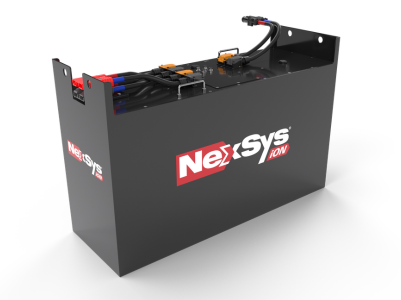
The catalog reflects that variety. NexSys TPPL batteries use thin plate pure lead technology for light-to-medium-duty material handling. NexSys iON provides lithium-ion options for heavier applications, with integrated battery management controls. DataSafe serves backup-power requirements. Alpha supplies power electronics and systems. Bren-Tronics makes portable batteries and charging equipment for military users. Installation, commissioning, monitoring and maintenance extend the relationship beyond delivery.
Storage02
Charging03
Controls04
Service
Four connected decisions. One operating schedule.
The business earns money from equipment and services through direct sales and distribution channels. Buyers can compare batteries by purchase price. EnerSys makes the case for comparing an operating system by lifetime cost. That argument has particular force when maintaining yesterday’s equipment is consuming tomorrow’s labor.
A battery decision made with a stopwatch
At the coffee distributor, EnerSys used its EnSite modeling software to compare alternatives against the actual operation. It recommended NexSys TPPL. The company projected more than 300,000 gallons of water saved over the batteries’ service life and 9% less energy per charge. These are supplier projections for that application, rather than a universal savings promise.
There is a practical lesson here for buyers: measure before choosing. Record energy consumption, shifts, breaks, maintenance hours and the charging opportunities operators really have. A sealed battery removes watering from the schedule. It does not create charging time where none exists. An operation with insufficient charging windows or different energy demands needs a different calculation, potentially a different battery and charger.
That breadth is part of EnerSys’s positioning. Its competitors include East Penn, Stryten and Hoppecke in industrial batteries, Vertiv in infrastructure power, and Saft and EaglePicher in aerospace and defense. Customers have alternatives. EnerSys’s proposition combines chemistry choices, power electronics, application engineering and service. The useful comparison is how well each supplier fits the particular site.
For a small fleet with modest usage, expensive new equipment may be difficult to justify through labor savings alone. For a busy site, the same calculation can change quickly. That is an inference from the ownership-cost approach, rather than a promised payback period. Buyers should insist on their own assumptions and check the result against their actual bills.
Buying the pieces that surround the cell
The modern company emerged from a management-backed acquisition of Yuasa’s Americas industrial battery businesses in 2000, supported by Morgan Stanley Capital Partners. It adopted the EnerSys name in January 2001 and went public in 2004. Its history is easier to understand as a sequence of capability purchases than as a lone inventor’s breakthrough.
Alpha, acquired in 2018 in a transaction announced at $750 million, brought power conversion and a larger broadband and telecommunications presence. In July 2024, EnerSys bought Bren-Tronics for $208 million in cash. That business had approximately $100 million in 2023 sales and roughly 280 employees. The acquisition expanded portable lithium power for defense customers.
“Powering the Future - Everywhere for Everyone”EnerSys’s stated mission
The corporate culture it describes emphasizes employee development, collaboration and internal opportunity. The acquisitions suggest an equally practical organizational challenge: making different engineering teams, brands and service operations behave like one supplier when a customer calls.
The factory that got smaller
In 2023, EnerSys signed a nonbinding agreement with France’s Verkor to explore a U.S. lithium cell factory. The eventual plan called for approximately four to five gigawatt-hours of capacity. In July 2026, the company narrowed it to about one, centered on aerospace, defense and specialized industrial customers requiring a secure domestic supply chain.
EnerSys estimated approximately $500 million in net investment, alongside a revised, conditional DOE grant of approximately $150 million and a state and local incentive package valued at approximately $200 million. Those figures are different funding measures, not three amounts to casually add together. Construction was expected in the first half of fiscal 2028, with full production roughly three years later.
It also said it intended to move away from Verkor as technology partner. Management explained the change through specialized defense requirements and domestic supply security. The lesson is a narrower one than “build your own factory”: owning production makes more sense when customers specifically need what that production location guarantees.
The next load is less predictable
EnerSys reported $3.75 billion in fiscal 2026 sales. In its following first quarter, management said strength in data centers, communications and aerospace and defense offset delayed recovery in material handling. Diversification helps, but it does not make a warehouse investment cycle disappear.
DataSafe Noir, introduced in June 2026, addresses lithium-based UPS storage under variable loads, including AI workloads. By October 22, an unnamed U.S. event-power rental provider had bought the system after evaluation for mobile UPS trailers. The setting changes; the engineering question persists. How does the whole system behave when the customer actually needs it?