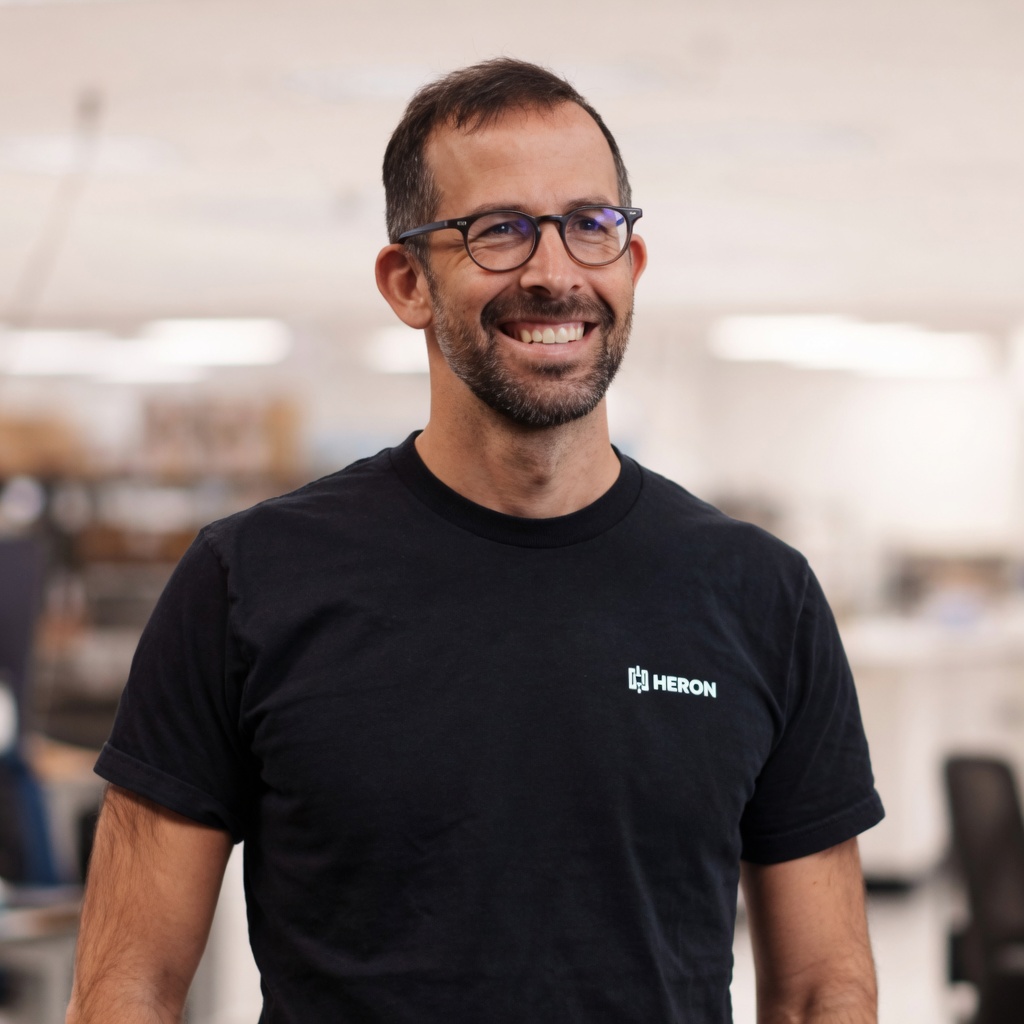
Start with the gray box. There is one humming on a pole near your house and another buried in every substation between you and the nearest power plant. It is the electrical transformer, and it has done its job, more or less unchanged, for about a century. Drew Baglino looked at that box and saw the most boring, most overlooked, most valuable thing on the grid. So he built a company to replace it.
That company is Heron Power, headquartered in Scotts Valley, California, and it makes solid-state transformers - silicon-and-software versions of that gray box that can sense voltage, switch power sources in milliseconds, and be managed remotely like any other piece of modern infrastructure. In February 2026 Heron raised a $140 million Series B co-led by Andreessen Horowitz's American Dynamism fund and Breakthrough Energy Ventures, the climate fund backed by Bill Gates. The plan: build a U.S. factory that can produce 40 gigawatts of the gear every year - roughly half the peak power demand of Texas.
Here is the part that explains the man. Heron says it did not really need the money. Customers had already lined up more than 40 gigawatts of orders, with over a dozen of them deep in technical collaboration. The demand pulled the capital in. "If our customers are leaning in," Baglino told TechCrunch, "we need to lean in as well. We gotta go faster."
The Tesla Years
Baglino joined Tesla in 2006, as an electrical engineer in San Carlos, two years before Elon Musk became CEO. His first work was unglamorous and foundational: digital test equipment and motor-controller firmware that improved the original Roadster. He kept moving up the stack. By 2012 he was the powertrain architect for the Model S and the designer of its dual-motor system.
Then he changed lanes. In 2014 he formed Tesla's energy engineering organization and started shipping the products that turned Tesla from a carmaker into an energy company - Powerwall for homes, Powerpack and later Megapack for the grid. By 2019 he was Senior Vice President of Powertrain and Energy Engineering and one of a small handful of corporate officers. In that seat he led the development of the 4680 battery cell, the dry-electrode manufacturing process, and a clean-sheet 50 GWh battery factory and materials refineries in Texas.
On April 15, 2024, after 18 years, he resigned. He announced it himself on X just after midnight. No drawn-out goodbye tour - he was already thinking about the next box.
Where The Demand Comes From
Three forces - AI compute, cheap solar, and stationary storage - all converge on the same piece of hardware. That is the bet.
Why The Transformer
The conventional transformer is a marvel of indifference. It steps voltage up or down using copper, iron and physics, asks for nothing, and reports nothing. Most are now made overseas and treated as a commodity. That is exactly what drew Baglino in: a critical, century-old component sitting right where renewables, batteries and data centers all need to plug in - and almost no one had tried to make it smart.
A solid-state transformer does the same job with power electronics. It can smooth the voltage dips that come from solar panels and wind turbines, fit in a far smaller footprint, flip between power sources almost instantly, and be actively managed to keep the grid stable. For a data center, Baglino says, stripping out the cascade of conventional gear can mean savings of an order of magnitude.
The technology is not brand new - solid-state transformers have been in development for more than a decade. What changed is that the semiconductors finally got good enough and cheap enough to deploy at scale, right as AI data centers created a desperate, immediate need for them.
Two Companies, One Garage
Most founders find one company a full life. In the two years after leaving Tesla, Baglino started two. Alongside Heron Power he quietly founded Sadi Thermal Machines in June 2025, a startup aimed at residential heat pumps. The two companies share the same Scotts Valley address. One rethinks the gray box on the grid; the other rethinks the way houses make heat. Both point at the same target - take the carbon out of everyday energy and make the hardware cheaper while you do it.
He is not doing it alone, and the names around him are familiar. Heron's advisors include Tesla co-founder JB Straubel and former Tesla CFO Zach Kirkhorn - a quiet reassembling of the brain trust that built Tesla's energy business, now pointed at the wires between the power plant and the plug.
In His Words
Five Things
He did hydrogen-fuel research in New Zealand as a Stanford student - the energy obsession started early.
He joined Tesla in 2006, two years before Elon Musk took the CEO chair.
A single planned Heron factory would output 40 GW a year - about half the peak power demand of Texas.
His full name is Andrew, but everyone has always called him Drew.
His Tesla advisors-turned-backers include co-founder JB Straubel and ex-CFO Zach Kirkhorn.