Tom Hogan sells events that do not happen. The battery pack does not run too hot. The passenger does not wait too long to feel warm. The electronic enclosure does not cook its contents. The military vehicle does not present the infrared contrast its designers hoped to avoid. When thermal simulation works, its reward is often an absence: no late redesign, no avoidable prototype, no puzzled meeting around a failed test.
This is a curious commercial assignment. Hogan is Chief Marketing and Sales Officer at ThermoAnalytics, an employee-owned software company born in Michigan's Upper Peninsula. Its programs calculate the ways heat travels through conduction, convection and radiation. They model human comfort, battery behavior and the signatures that objects present to infrared sensors. The physics is visible to specialists. The value must become visible to everybody else.
Hogan's public career makes that translation look less like a detour than a theme. Long before he was marketing virtual heat, he was president of Parvus, a Salt Lake City maker of rugged embedded computers. There, too, the product lived beneath the obvious product. A PC/104 board could sit inside an aircraft, a factory machine, a medical device or a transportation system. Customers did not buy a little rectangle of circuitry for the pleasure of owning one. They bought what it allowed a larger system to do.
The commercial adult in the engineering room
A recommendation from former colleague Mike Southworth provides the sharpest account of the Parvus chapter. Southworth says Hogan arrived when the engineering-driven organization was facing flat sales and its founders wanted an exit. Hogan's brief was not cosmetic. Southworth credits him with reshaping the business model, improving processes, growing revenue, expanding headcount and ultimately helping facilitate the company's acquisition.
It is tempting to describe such work with the usual vocabulary of transformation, a word so thoroughly sanded by business writing that it now catches on nothing. The more revealing detail is the setting. Hogan had to add commercial structure to a company whose reason for being was technical. Too much sales theater and the engineers stop listening. Too much reverence for the technology and the market never understands why it should care. The operator in the middle must hold both truths without making either one feel patronized.
Hogan's recurring commercial bridge
In 2002, Parvus announced a collaboration with speech-technology company Fonix. The idea was to put voice recognition into embedded control systems. Hogan framed it plainly: voice could create a natural interface for a customer's system, interest existing customers and distinguish Parvus in new bids. He did not sell the feature as a small miracle. He attached it to use and advantage.
A year later came the larger move. Parvus merged with Italy's EuroTech in August 2003. The combination brought together companies serving aviation, industrial, medical, military and transportation customers, with offices in the United States, Italy, China and Germany and distribution in roughly 16 additional countries. Parvus had already moved into a larger headquarters that April in anticipation of growth.
Hogan's public statement about the merger concentrated on fit. The product lines were complementary, he said, with little market overlap. Parvus could use EuroTech's processor-board offerings in its systems work; EuroTech could use Parvus's experience in systems integration, peripherals and rugged enclosures. It was the same bridge in a grander form: capability, consequence, decision. Two catalogs became a strategic argument.
From boxes that compute to heat that predicts
Hogan joined ThermoAnalytics in January 2018. The company had already spent more than two decades turning research into engineering software. Founded in 1996 by Keith Johnson and Al Curran after work at Michigan Technological University's Keweenaw Research Center, it began by developing thermal software for Ford Motor Company and the U.S. Army. Government contracts and research grants supported the early years. In the early 2000s, the business moved into employee ownership and put more emphasis on commercial software.
The setting seems almost designed to interest Hogan: a deeply technical company with roots in public research, government programs and major manufacturers, now carrying specialized tools into broader global markets. ThermoAnalytics says it is fully employee-owned. Its headquarters remains in Calumet, Michigan, while its footprint includes Novi, Munich and Tokyo. Hogan is based in Manitowish Waters, Wisconsin, a Northwoods community on the other side of the state line.
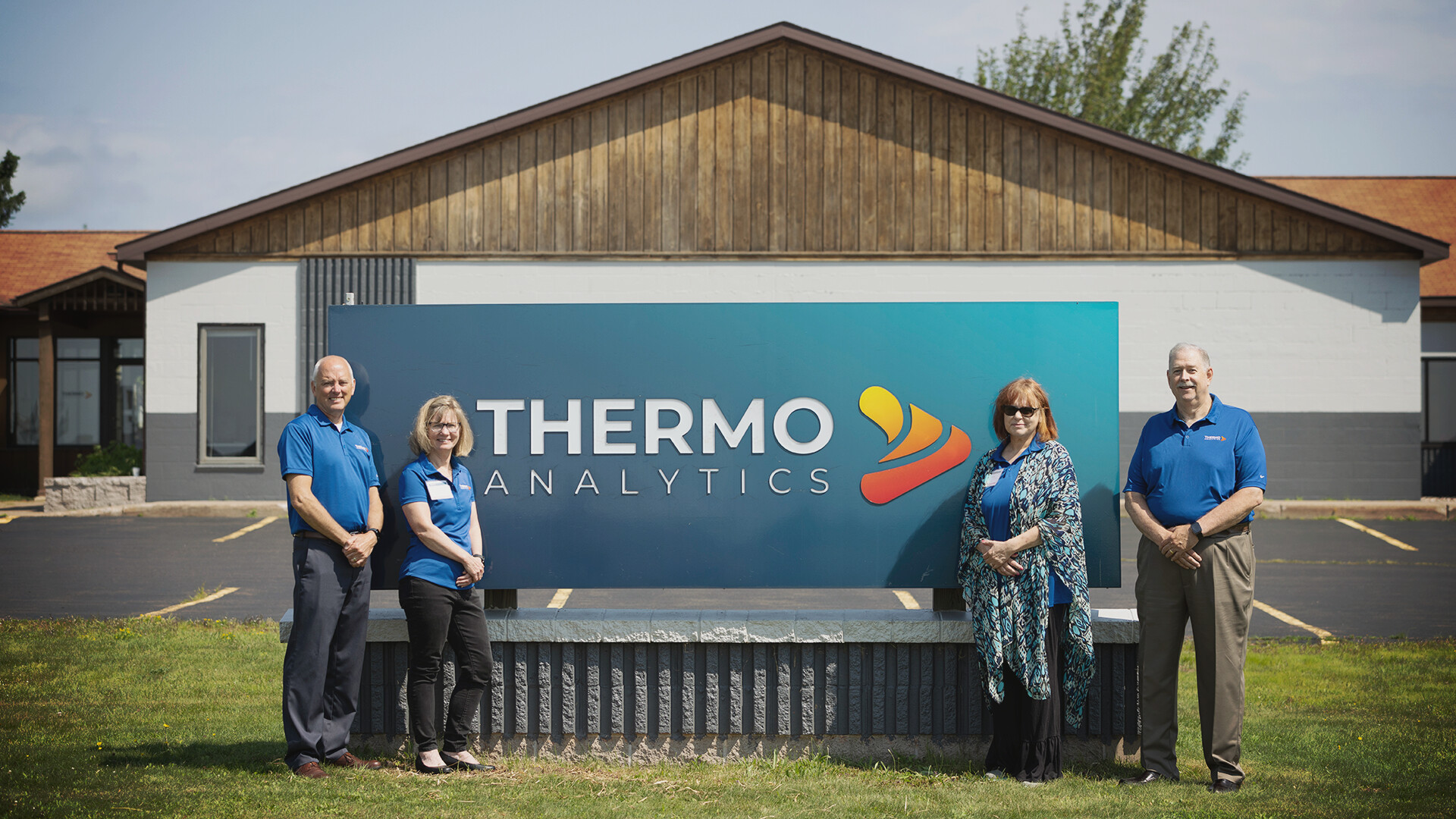
The flagship product, TAITherm, models steady-state and transient heat transfer across complex systems. MuSES focuses on infrared signature prediction. CoTherm coordinates simulation processes across multiple tools. The applications sound diverse because heat is promiscuous. It turns up in the battery, the cabin, the building, the garment, the exhaust and the image seen by a sensor. ThermoAnalytics sells into automotive, aerospace, defense, architecture, electronics, and materials and textiles.
The sales story, then, cannot be one-size-fits-all. Cabin comfort asks how a person feels, not merely what a thermometer reads. Battery analysis asks how cells, cooling systems and operating cycles interact. Infrared work asks what a sensor sees against a particular environment. A commercial leader must preserve enough specificity to be credible while finding a shared promise: discover consequential thermal behavior while a design is still cheap enough to change.
A three-tool glimpse of the job
Hogan's public LinkedIn activity is sparse, but one 2023 post is revealing. He shared ThermoAnalytics work on a three-tool coupling workflow for automotive cabins. The analysis combines the vehicle's thermal state, the climate-control system's response and the occupant's thermal state. No single view is enough. A comfortable passenger is the result of several systems negotiating with one another in motion.
That example also serves as a miniature of Hogan's own job. Engineering software rarely enters an organization alone. It must connect with existing tools, established methods and people who answer to different measures. The technical buyer may care about solver fidelity. A program manager may care about timing. An executive may care about reducing prototype expense and design risk. Marketing cannot merely repeat the engineer's noun. Sales must connect it to the customer's verb.
People who worked with Hogan describe the human mechanics behind that translation. Southworth recalls a leader who considered the input of those around him and communicated a clear path. Richard Geasey, who knew Hogan from the era of major PC accounts and government procurement contracts, calls him creative and results-oriented. Both mention humor. Geasey's account has the better ending: they opened accounts, won large contracts and, improbable as it sounds in procurement, had a blast.
Those remarks are not proof of a management theory. They are more useful than that. They suggest what it felt like to do the work. Hogan appears in them as the person imposing shape without draining the room of oxygen. Engineering sales can become terribly solemn, partly because the consequences are real and partly because acronyms are natural enemies of gaiety. A sense of humor does not reduce the stakes. It may simply make a complicated team more willing to stay at the table.
The value of the unseen result
By 2026, ThermoAnalytics is celebrating its thirtieth year and still lists Thomas Hogan on its executive team. The company's founding proposition has widened but not wandered. Software first developed around Ford and Army needs now supports work on electric vehicles, human comfort, aerospace systems, buildings and textiles. Its commercial case remains an elegant paradox: spend money to see a problem before the problem becomes expensive enough for everyone to see.
Hogan's two publicly documented chapters share that logic. At Parvus, the small embedded computer disappeared into a larger machine but determined what the machine could do. At ThermoAnalytics, the model disappears into the development process but can determine what gets built. In both cases, the sale depends on helping a customer notice the importance of something physically unobtrusive.
There is no public grand philosophy from Hogan, and none is required. His record offers a practical one. Find the complementary parts. Respect the engineers who made them. Translate capability into consequence. Invite the room into the path forward. Then, if the former colleagues are to be believed, leave enough space for a joke. The future may arrive in degrees, but there is no rule saying it must arrive grimly.