The most revealing word in Kevin Maddock's title is not chief. It is recurring. A first sale can be won with timing, appetite and a persuasive demonstration. Revenue that returns requires a customer to wake up months later, consider the relationship again and decide it remains worthwhile. Maddock has arranged almost his entire career around that second decision.
He is executive vice president, chief recurring revenue officer and general manager for North America at Rimini Street, the enterprise-software support company. The title places him across worldwide recurring-revenue sales while adding a regional brief spanning sales, field marketing and customer success. It is a job description full of modern corporate nouns, but its central question is plain: are customers receiving enough value to stay?
Maddock arrived here by a route that began closer to the machinery. In August 1987 he joined Andersen Consulting, now Accenture, and worked on large software-development and implementation projects. Those assignments belong to enterprise computing's physical world: complicated systems, exacting clients and consequences that continue long after a contract celebration. He later moved to KPMG Consulting, holding several roles from 1995 to 1998 in financial-services strategy and operations.
The formative yearsFirst, learn what happens after installation
The consulting years matter because they placed Maddock near the part of technology that glossy launch campaigns politely ignore. Software has to be implemented. It has to coexist with processes, customizations and people. It eventually needs repair. By May 1998, when Maddock became vice president of worldwide support-service sales at PeopleSoft, he had crossed from helping put systems in place to helping preserve their working lives.
PeopleSoft gave him a global sales organization and responsibility for support-renewal systems and processes, along with participation in pricing models and release-support policies. During his tenure, annual support-services revenue for PeopleSoft and JD Edwards products rose from $250 million to more than $1.2 billion. The increase was not presented as his solitary creation, and it should not be read that way. It does establish the scale of the operation around him: billions of dollars riding on the orderly repetition of service, communication and renewal.
Annual revenue for support services covering PeopleSoft and JD Edwards products. The comparison describes the span of his 1998-2004 tenure, not a single-year jump.
Support revenue looks beautifully predictable when viewed in a financial model. Up close, it is stubbornly human. A client remembers the unresolved case, the late call and the person who understood an old customization. Forecast accuracy depends on thousands of such memories accumulating in the right direction. Maddock's work at PeopleSoft placed commercial leadership beside the systems that organize those relationships.
Scale without theatreA billion dollars, five times over
In October 2004 he joined ServiceSource as executive vice president of worldwide inside sales and operations. The company specialized in outsourced maintenance renewals and sales for technology businesses. Maddock became a member of its executive team, with global leadership and profit-and-loss responsibility for building, scaling and operating a 500-person sales organization.
The organization delivered more than $1 billion in service sales and a five-fold increase in revenue growth. Those figures are impressive partly because the underlying act is so repetitive. Five hundred people must perform variations of the same difficult conversation: remind a customer what has been useful, understand what has not and make the economics of continuing feel sensible.
A longtime colleague later described Maddock as a strategist who could preserve company objectives while finding answers to difficult transactions. The same colleague recalled an opening line Maddock used when mentoring: “Have I ever told you that your job is becoming just like mine at PeopleSoft or ServiceSource?” It is a charmingly economical teaching device. Instead of inventing a parable, he apparently kept a small library of operating precedents close at hand.
“It takes a village.”Kevin Maddock, writing about his sales team's 2022 results
Another former colleague wrote publicly that Maddock built a close-knit sales team, inspired loyalty and created room for people to applaud one another's successes. These are testimonials, not neutral measurements, but they line up with Maddock's own rare bit of public narration. After a five-day Rimini Street Sales Club trip in Phuket, his organization received a Team Impact Award for its contribution to the company's 2022 results. Maddock wrote that the award was the highlight and directed his thanks to his sales organization, Global Service Delivery and Global Client Engagement.
The choice of emphasis is revealing. A sales leader could have treated the award as proof of sales. Maddock treated it as evidence of interdependence. The client does not renew because an org chart has assigned credit neatly. The client renews because a collection of people, some visible and many not, kept the experience coherent.
A long tenure in stagesRimini Street, one expanding brief at a time
Maddock joined Rimini Street in December 2008 as senior vice president of global sales. He held that job for more than nine years, a long interval in a technology industry that often promotes motion for its own sake. In January 2018, the words “recurring revenue” formally entered his title. He became executive vice president for global recurring-revenue sales in March 2020 and chief recurring revenue officer in March 2021. In May 2024, he added general manager responsibility for North America.
The sequence traces a shift from winning business to protecting and extending it, then from a specialist revenue remit to a broader operating one. The final addition matters. Sales, field marketing and customer success often inhabit adjacent departments with different calendars. Sales thinks about the close. Marketing thinks about attention and pipeline. Customer success thinks about adoption, satisfaction and risk. A recurring-revenue leader has to make those clocks tell roughly the same time.
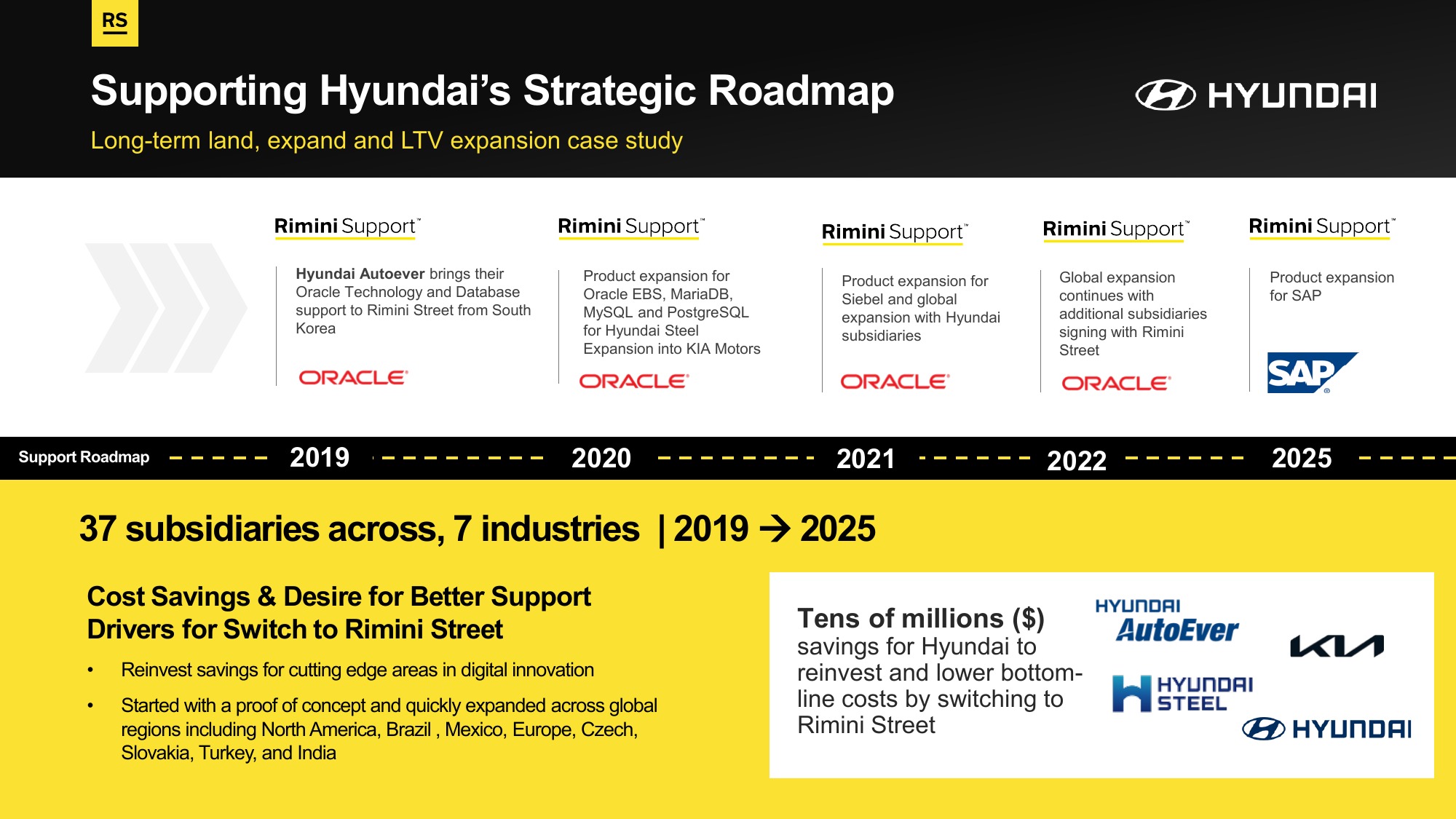
At Rimini Street's 2021 Investor Day, Maddock's session was titled “Renewals and Growing Long-Term Client Value.” Four years later, his presentation concerned protecting and extending annual recurring revenue and growing lifetime value through value realization. The vocabulary became denser; the thesis remained steady. Retention is strongest when the customer can point to something useful, not merely when a renewal team can point to a date.
The operator's grammarARR and LTV, translated into ordinary English
Annual recurring revenue and lifetime value are clean abstractions. Maddock's professional subject is the untidy conduct beneath them. Which accounts are receiving value? Where is a relationship weakening? Can a service problem be recognized before it becomes commercial risk? Does the customer-success team possess the context that sales already learned? The number arrives at quarter-end, but the reason for it accumulates daily.
This is why his early project work belongs in the same story as his present title. Implementation teaches that enterprise systems are not disposable accessories. They are embedded in finance, supply chains, human resources and other operations that dislike surprises. PeopleSoft taught him the scale of support economics. ServiceSource taught him how to industrialize the renewal motion. Rimini Street has given him a long platform on which to connect renewal, support and account expansion.
His education supplies another useful pairing. Maddock earned a bachelor of business administration in finance, with honors, from the University of Notre Dame, then an MBA from UCLA's Anderson School of Management. Finance offers the language for recurring revenue. Operations supplies the verbs. Track, solve, coordinate, renew. A spreadsheet can describe loyalty beautifully, but it cannot create any.
There is also restraint in the available public persona. Maddock has no obvious personal media apparatus orbiting his work. The appearances that stand out are company briefings, a leadership biography and occasional professional posts. Even the anecdote most associated with him is a thank-you note after a team award. For an executive responsible for revenue, he has left a public trail more interested in mechanisms and colleagues than personal mythology.
That makes him well matched to his specialty. Recurring revenue is a business of modest proofs. A case closed. A system kept running. A customer who expands from one product to several. A relationship that survives the calendar and asks to be continued. The most important event is often the absence of an event: no forced disruption, no unresolved crisis, no reason to leave.
Maddock's career has moved through several corporate logos and ever larger mandates, yet its plot is unusually consistent. He learned the systems, then sold the support, then built the renewal organization, then took responsibility for the revenue returning. The first sale may still get the applause. He built his working life around earning the next yes.