Before he announced his retirement, Doug Winter went down to the beach. A full moon was sinking toward the Pacific; daylight was coming up behind it. He had woken early before Seismic’s 2025 customer conference and driven over to sit with the view. For a founder preparing to leave the CEO’s chair, it offered a rather convenient piece of stagecraft: an ending and a beginning, visible at once, with no presentation deck required.
Winter’s departure became public on October 1, 2025. Rob Tarkoff would take over two days later. Winter would remain a board member and advisor. In his farewell, he put Seismic’s journey in concrete terms: five founders, an Encinitas basement, nearly 1,500 teammates and $400 million in revenue. He also remembered the first customer gathering, with 20 attendees. The recent one had drawn more than 1,200. Somewhere along the way, the room had become a conference.
The engineer learns to sell
Winter’s working life began a considerable distance from sales software. After studying electrical engineering at Virginia Tech, he worked at Westinghouse as an instructor in the US Navy’s nuclear training program. He was proud of being an engineer. He also wanted more room to grow. Graduate school offered a way to change direction without abandoning the technical education he had already acquired.
At MIT, he earned both an MBA and a master’s in electrical engineering. His public LinkedIn profile dates his MIT studies to 1994-1996. The combination would suit a career spent moving between what software could do and what a company could persuade someone to buy. The technical problem and the commercial problem were going to share an office.
His résumé includes work on Qualcomm’s CDMA base stations and phone testing, followed by software services leadership. He co-founded Objectiva Software Solutions and later served as chief operating officer and general manager at EMC Document Sciences. By the time Seismic began in 2010, he had worked inside complicated technology businesses rather than merely studied their diagrams.
The path also brought him into contact with Ed Calnan. They had led sales for different teams at an earlier startup and stayed in touch through the dot-com years and afterward. That surviving relationship became part of Seismic’s foundation. Winter’s advice to entrepreneurs would later include a modest, easily neglected task: keep up with the people you meet early. A former colleague can become a future co-founder long after the old company disappears from conversation.
A three-ring binder with a business inside
The irritation that helped give Seismic its shape was thoroughly unglamorous. Winter remembered sitting with financial advisors whose pitchbooks had been assembled in three-ring binders. There were copied pages, stale charts and, on occasion, somebody else’s personal data. He wondered what their chief marketing officer would think of the material reaching a prospective client.
It was an awkward encounter with a familiar corporate gap. Marketing could create carefully approved material, yet a salesperson still had to assemble something useful for the particular person across the table. Every act of copying introduced another opportunity for yesterday’s numbers or the wrong client’s details to join the meeting.
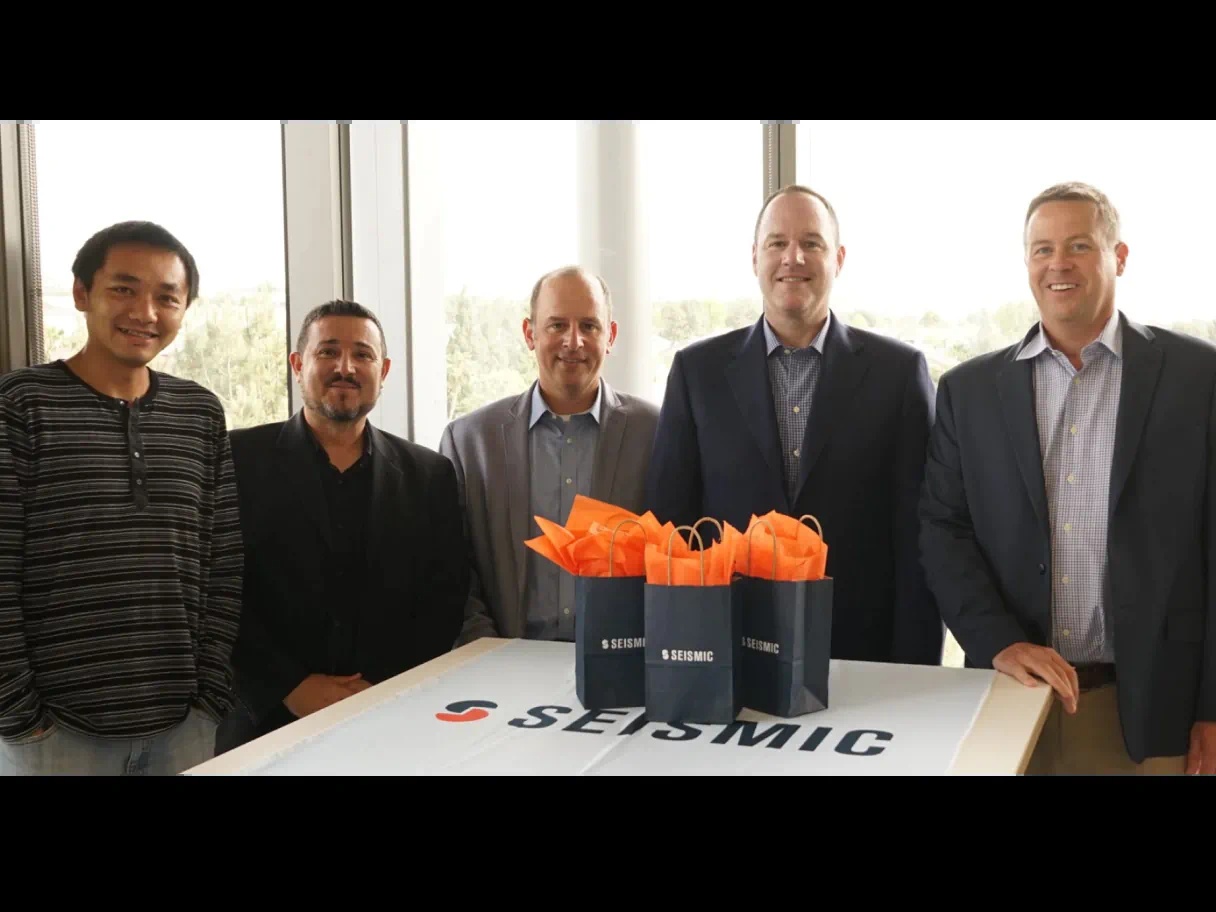
Winter, Calnan, Fred Xie, Nasser Barghouti and Marc Romano founded Seismic together in 2010. Their early work addressed the production and personalization of sales content, including pitchbooks. Cloud software made a different delivery model possible. A team could maintain material centrally while helping sellers prepare something relevant to an individual customer. The binder was a small object with a surprising amount of administrative trouble tucked into its rings.
The first version took more than a year to reach a point where they could show it to people. Even the label for the business needed to catch up. Winter has said he had not initially heard the term sales enablement. The founders had a problem to solve before they had a convenient category to put on the door.
Ten refusals still leave room for a yes
Winter’s account of fundraising contains little of the inevitability that gets added to successful companies afterward. He recalled questioning his own ability to execute and hearing ten refusals before a yes. The difficulty belonged to the work of scaling and raising capital, rather than to some neatly bounded episode that a founder could finish and forget.
That matters when reading the later numbers. A company can look obvious once customers, investors and a category have gathered around it. In the beginning, those groups are being asked to imagine something that does not yet have their collective endorsement. Persistence, in Winter’s telling, involved continuing through doubts about himself as well as objections from other people.
By August 2021, Seismic was announcing a $170 million Series G led by Permira at an approximately $3 billion valuation. It also acquired Lessonly, a training and coaching business. The combination broadened the proposition: a seller needed useful content and the skills to use it. A polished pitchbook could only carry a conversation so far.
Goldman Sachs recognized Winter among its Most Exceptional Entrepreneurs of 2023. Yet the more revealing evidence of how he thought about the business often appeared in smaller observations about customers, colleagues and the cost of losing either.
The arithmetic of keeping people
Winter’s advice in a 2025 interview about customer retention began with an instruction to avoid shrinking. It sounds suspiciously like advice that could fit inside a fortune cookie. His explanation gave it teeth: Seismic had chosen large enterprises, with mature processes and precise requirements. Winning their signatures was only the beginning of serving them.
Those customers needed help getting started, continuing support and evidence that the software was producing value. Their needs also had to travel back into the product team. A subscription business makes the relationship renewable. A customer’s next decision can undo the celebration of the previous sale.
“The best way to grow is never to shrink.”
Doug Winter, on retaining customers
This way of looking at growth puts attention on work that rarely photographs well. Onboarding, listening and follow-through occupy less space in a founder’s public mythology than a funding announcement. They also determine whether the announcement eventually has anything durable underneath it. Winter’s formula asks an expanding company to keep an eye on the people already inside the tent.
Who gets copied on the victory email?
Inside Seismic, a ritual called pushpin made that question unusually literal. After a deal closed, a sales representative sent an email explaining the new customer and why the customer had chosen Seismic. The message also named the colleagues who had helped make the sale happen. Replies from around the company extended the congratulations.
It was a small redistribution of attention. The person attached to the revenue number had a way to recognize the people behind it. An internal email could make teamwork visible without convening another meeting, which is a kindness of its own.
As the company grew, informal habits needed more support. In 2022, Winter wrote about revisiting Seismic’s mission, vision and values as its headcount and geographic reach expanded. He wanted alignment to survive the company’s spread across locations. A culture that depends on everyone knowing the founders personally has an obvious limit: eventually, there are too many people.
He also acknowledged a personal preference that complicates the standard image of a technology founder. Being publicly showy or high profile had never particularly suited him. In a 2022 podcast conversation, he described the satisfaction of seeing early employees advance into more senior roles as the business grew. Other people’s careers were part of what made the project rewarding.
By the FY2025 belonging and impact report, he was explicitly defending inclusion as part of how Seismic operated. He connected different backgrounds and experiences with better work, and placed responsibility for belonging on every member of the team. The statement tied an operating principle to a daily obligation: the environment had to be made by the people working in it.
A founder’s job includes changing the job
In a 2025 conversation with Lindsay Pedersen, Winter described a leader’s need to steady a team through emotional extremes. A big win deserved celebration, but the next day still required work. A loss could feel overwhelming without determining the company’s future. The leader had to help colleagues recover perspective in both directions.
That outlook fits a career in which the task kept changing. Building an early product, earning an enterprise customer’s trust and running a mature organization demand different kinds of attention. Remaining attached to the first version of the founder’s job would have been a peculiar way to manage a company built around helping people improve their work.
When the succession arrived, Seismic reported eight consecutive profitable quarters and 85 customers spending $1 million a year. Winter described the timing as right for retirement and new leadership. Tarkoff brought experience at Oracle and Adobe. Their relationship went back roughly two decades, giving the handover a history beyond the recruitment process.
The business carries on past the farewell
On August 18, 2026, Seismic completed its merger with Highspot. The combined business operated under the Seismic name with Tarkoff as CEO, serving 2,500 customers and 3.5 million users. Those figures belong to the combined organization after Winter’s CEO tenure. They mark the company’s continuing story rather than a retrospective addition to his personal scorecard.
The original question remained recognizable beneath the larger platform and newer language about AI: how does a customer-facing team bring the right information into the right conversation? Winter had first encountered one version of that problem in a badly assembled binder. He spent fifteen years as CEO helping build an organization around it.
His farewell returned to the beach, where the sky had supplied a change of scene before the company announced its own. After years of preparing for the next meeting, next customer and next stage of growth, he could watch something happen without being responsible for running it. The Pacific, fortunately, had its succession arrangements in hand.