A paper portfolio helped Adam Markowitz get an engineering job. A résumé could list his classes; the portfolio could show what he had actually made. It helped him land work on NASA’s Space Shuttle program. Years later, he would build businesses around a familiar frustration: capable people and capable companies being asked to produce something more convincing than their own assurances.
There is a pleasing inconvenience in that idea. Almost everyone enjoys being trusted. Being asked to demonstrate why is considerably less flattering. Markowitz has spent much of his career making that second part easier, first for students, then for software companies. Along the way, the paperwork became a business with more than $100 million in annual recurring revenue.
“Trust is kind of the theme of my career,” he has said. It is a large word for a founder whose original example could fit inside an interview folder. That small beginning makes the larger ambition easier to understand.
A résumé with the work attached
Markowitz arrived at UC San Diego in 2004, the year Facebook launched. Watching students accumulate an online record of their social lives prompted an obvious question: where was the equivalent record of the things they were proud of learning and building? The internet was very good at remembering the party. It could spare a little space for the project.
He studied structural engineering with an emphasis on aerospace structures, and later earned a master’s in astronautical engineering at USC. His engineering career included designing and testing liquid rocket engines. These were systems for which an appealing description had limited persuasive power. The parts had to work together.
The portfolio lesson followed him into recruiting. Back on campus, now judging candidates himself, he found the same classes and similar grades on one résumé after another. Seeing the hiring problem from both sides gave him a product idea with a particularly personal origin.
To build it, he taught himself to code with YouTube and Stack Overflow. That is a rather direct answer to the question of what an aspiring software founder should do without a software background: acquire enough of one to make the first version.
Student → portfolio → employer
Company → evidence → customer
AI agent → activity record → reviewer
The second time, the customer was him
By August 2013, Markowitz was appearing on Entrepreneurs on Fire as founder and CEO of thePortfolium. The early interview captures a company young enough to retain the definite article in its name. His recommended book was Venture Deals; his recommended tool was IFTTT. Even then, automation had made the reading list’s practical companion.
Portfolium gave students a place to display projects and skills that a conventional résumé compressed into claims. Building the network and finding a business model took time. In later interviews, Markowitz described the university market as difficult to enter: institutions wanted evidence that the product worked elsewhere before committing themselves. A company devoted to proof needed proof of its own.
Instructure acquired Portfolium in 2019 for $43 million. Markowitz subsequently served as a vice president and general manager there. The transaction also left him with an education in a problem the original student portfolio had never been intended to solve.
As Portfolium grew, prospective customers wanted evidence that their data would be protected. Security reviews brought requests for a SOC 2 report and the work behind it. The founders were now on the other side of another credibility test. Their confidence in their company’s security was useful. The customer still needed documentation.
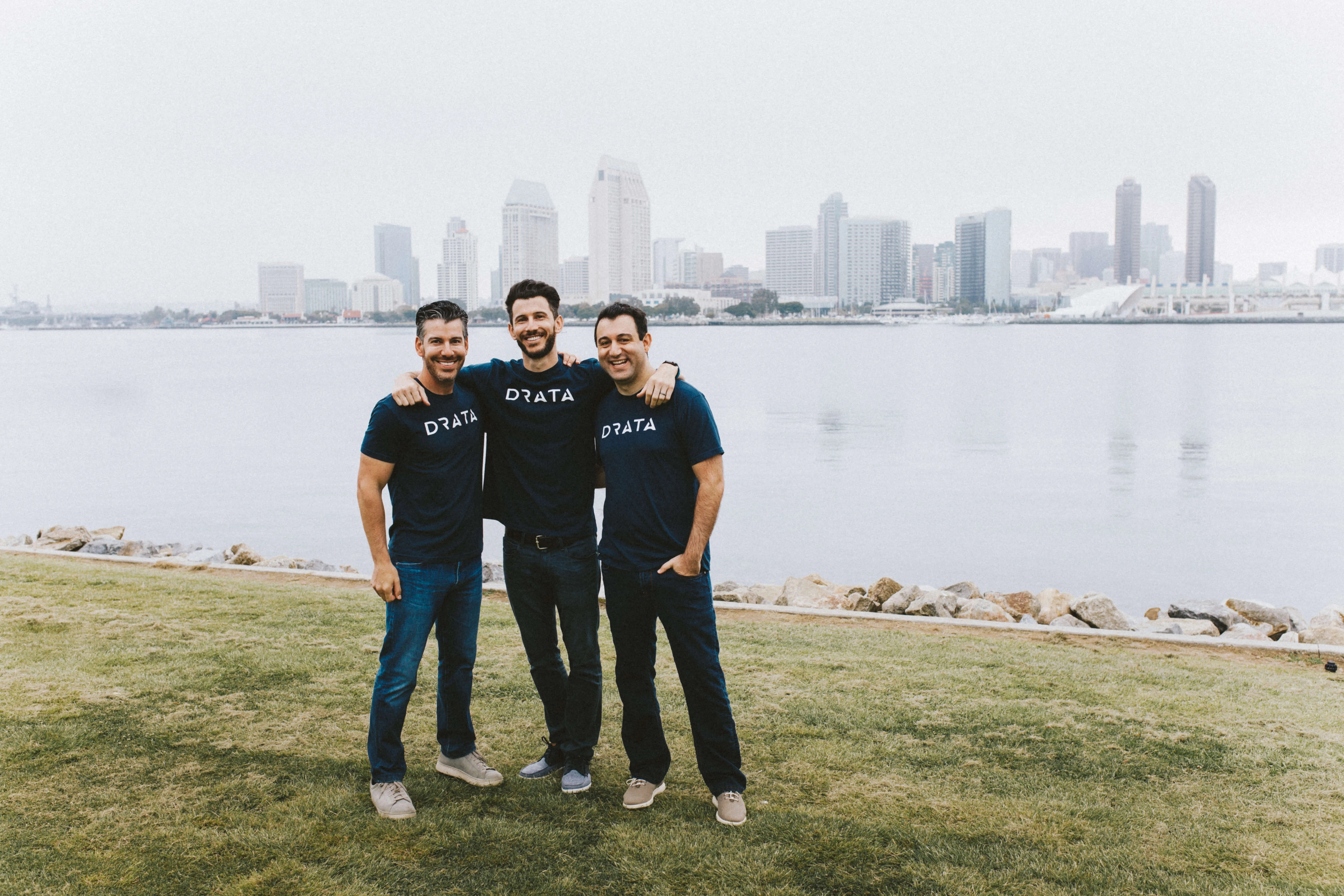
Markowitz, his brother Troy and Daniel Marashlian founded Drata in 2020. They had worked together before. This time, their own experience supplied a concrete problem to investigate before building the answer. The unglamorous hours spent assembling evidence had become a product brief.
Before the first invoice, their own audit
The early Drata team made a decision that gave the pitch some weight: use the product to prepare its own compliance evidence before opening it to paying customers. For a company selling assurance, asking everyone else to go first would have been an awkward opening move.
Drata publicly launched in January 2021. Markowitz says the founders financed its earliest version with proceeds from their previous exit. He also reported $10 million in annual recurring revenue by the end of the first year, ten times their original projection. A problem they had lived with turned out to be widely shared.
His account of the launch includes 100 customers within roughly six weeks and 1,000 in the first year. The contrast with the slower work of selling into universities mattered to him. Buyers already understood the cost of their problem. Drata could spend more of its conversation showing a way to address it.
Customers, not revenue. These are two milestones, not a continuous growth curve.
The product’s practical appeal is easy to describe without borrowing its sales language. Evidence collection is repetitive. A control needs checking; the result needs recording; a reviewer needs to find it. Automating that work gives the people responsible for security fewer administrative errands. An independent audit still has its own purpose and judgment.
Distribution also required relationships. Markowitz has described working with auditors and cloud partners rather than treating each sale as an isolated transaction. His account of those partnerships stresses giving partners a reason to participate. Even evidence software needs someone to introduce it.
Competitive fire, with company
Markowitz’s extracurricular interests are less sedate than audit preparation. He built a backyard obstacle course while preparing to apply for American Ninja Warrior. The detail is entertaining because it belongs to the same practical temperament: if the test requires an unfamiliar apparatus, build something you can practise on.
He has also interviewed Jerry Rice at Drataverse, Drata’s customer conference, discussing leadership, teamwork and the values behind performance. His public response to the conversation singled out Rice’s humility and competitive drive. Evidently there is room at a compliance conference for someone whose best-known controls involved a football.
Yet Markowitz’s description of leadership gives other people substantial space. He has spoken about learning what motivates each individual rather than trying to motivate everyone identically. The manager’s job, in that account, is to connect someone’s particular interests to the company’s purpose.
“I never face a problem alone.”
Adam Markowitz
That observation supplies a useful counterweight to the founder mythology. His emphasis is on complementary skills, advisers who ask difficult questions and colleagues who can do things he cannot. The repeat founding team gives the principle a visible form. Nobody has to pretend that one person contains an entire company.
Growth brings less photogenic decisions, too. In September 2024, Drata cut 40 jobs, 9% of its workforce. A revenue milestone cannot tell the whole story of running an organisation. The decisions affecting the people inside it belong beside the figures used to describe its progress.
A conversation under a tent
In 2021, Markowitz met SafeBase co-founder Al Yang at SaaStr. They talked in an outdoor tent about their companies, customers and culture. Both businesses were young. They stayed in touch as their products developed along adjacent paths.
Drata announced its agreement to acquire SafeBase in February 2025. The fit extended the original idea: collect evidence inside a company, then make it easier to communicate that evidence outside it. SafeBase’s trust centers and security questionnaire tools addressed the conversations that happen when a prospective customer is deciding whether to buy.
In March 2026, Markowitz announced that the SafeBase company brand would be unified under Drata. The early audit problem had expanded into a broader ambition around how businesses establish confidence in one another. The tent conversation had acquired a fairly substantial follow-up.
By February 2026, Drata was reporting more than 8,000 customers across over 80 countries and had opened a San Francisco headquarters. Its international business was already meaningful: Markowitz had described EMEA as nearly a fifth of revenue in December 2025, while still seeing room to expand there.
Now the software needs a chaperone
The next version of his evidence problem involves AI agents. Software that can take actions introduces questions about permissions, ownership and what actually happened. Markowitz’s public writing in 2026 places those questions inside his ambition for Drata. The company using an agent needs a way to account for its behaviour.
In August 2026, Drata made AI Agent Governance available on a limited basis, initially focused on enterprises using Anthropic. Its stated purpose includes discovering agents, monitoring activity, enforcing policy and retaining a traceable record. The qualification matters: this was a staged product release with specific initial coverage.
September brought a standalone third-party risk product, intended to assess vendors against a customer’s standards and preserve the reasoning behind the result. The recurring concern is recognisable. When someone asks why a decision was made, the answer ought to include something they can examine.
Markowitz is now hosting When Trust Meets AI, talking with security leaders about the same shifting responsibilities. The engineer who once brought his own work into an interview is asking other people how their organisations will show theirs.
He has retained another early ambition, too. Asked in a 2026 podcast whether he had wanted to be an astronaut as a child, he answered, “Still do.” For now, his work remains on Earth, where the evidence tends to arrive in less dramatic packaging. There are no launch windows for a security questionnaire. There is, however, someone waiting for an answer.