Somewhere inside a large marketing department, an approved image is waiting to be found. A campaign has a launch date, three regional variations and a colleague who remembers a different launch date. The creative idea may be excellent. Getting everyone to act on the same version of it is another matter. That ordinary predicament is the territory Percolate came to occupy.
- Started with social content; expanded into enterprise campaign coordination.
- Connected plans, workflows, approvals and assets across teams.
- Joined Seismic in November 2019, bringing marketing production closer to sales enablement.
Its story is interesting because the apparently dull parts of marketing turned out to be a product. Calendars. Requests. Permissions. The whereabouts of the final file. Percolate offered a shared place for these details, giving marketers a way to see work moving from strategy to execution. The attraction was less paperwork by surprise.
01 / The brand that needed something to say
Noah Brier and James Gross founded Percolate in 2011. Brier’s background was in agencies; Gross had worked in Federated Media’s publishing business. They understood a change facing brands: social channels required an ongoing supply of material, rather than an occasional grand production followed by a long silence.
In a 2012 AdExchanger interview, Brier framed the starting question as “What does your brand consume?” The premise was that a brand’s interests could help determine what it should publish. Percolate helped find relevant material and turn it into content. That put the company near the point where an organization’s personality became a daily obligation.
But producing another post exposed another problem. Someone had to plan it, make it, check it and distribute it. By 2015, Brier was describing the opportunity as a central system of record for marketing. The company’s ambition had widened from inspiration to the machinery that made inspiration usable.
02 / Fifty teams, one view of the work
Consider Land O’Lakes. Its published case study describes Percolate adoption reaching more than 600 users across 50 teams. The reported benefits were visibility into campaign plans, coordination between brand and agency teams, and more consistent ways of working. Those are practical gains for an organization whose marketing cannot fit into one room.
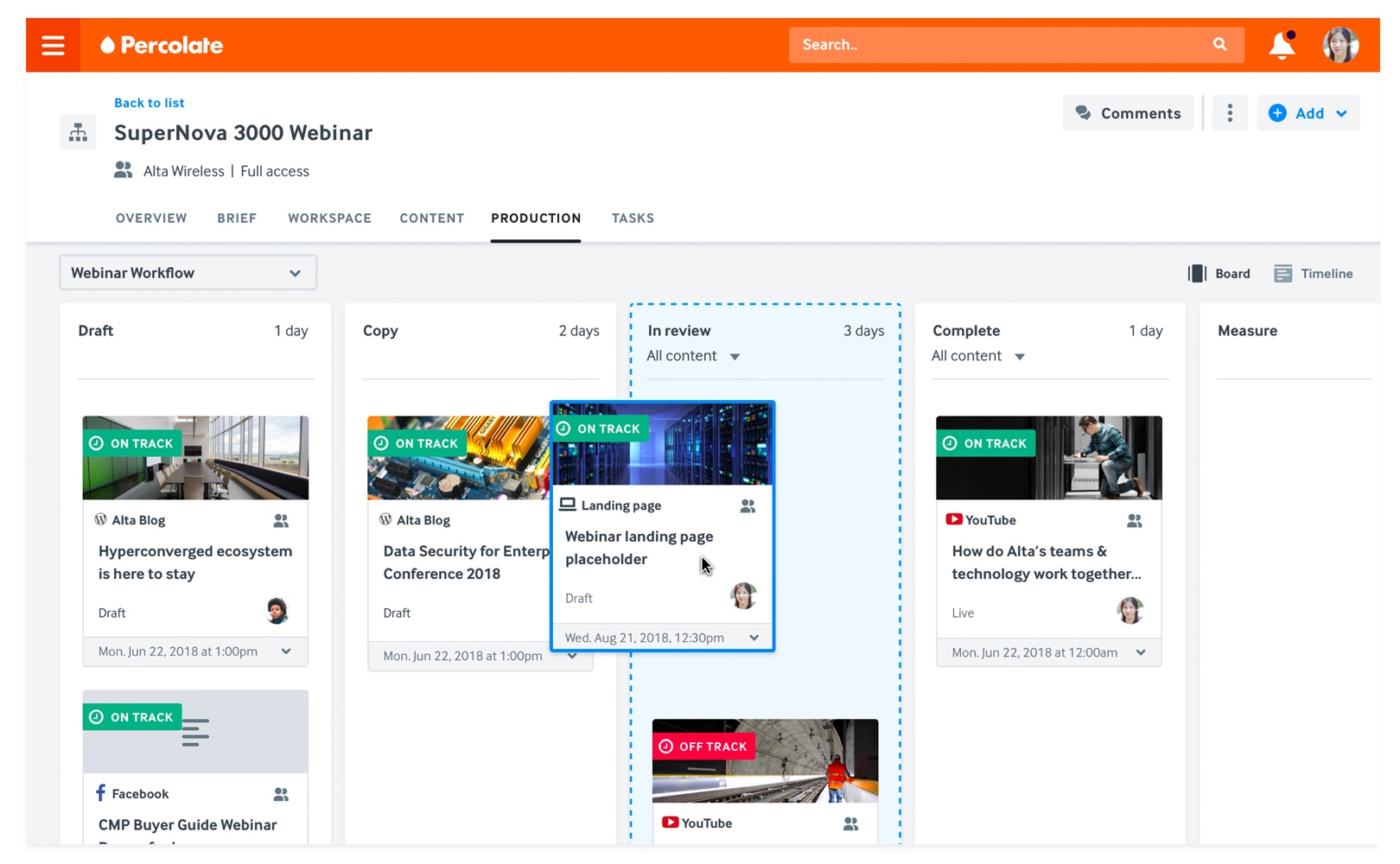
Percolate’s Integrated Campaigns modeled relationships between initiatives spanning products, channels and geographies. Campaign Workflows broke planning into phases and milestones. Intake Requests gave unexpected work a defined entrance. Instead of relying on everybody’s private understanding of the campaign, teams could inspect the same plan.
Its wider platform covered content assets, collaboration, approvals, publishing and analytics. Historical customer materials named Mastercard, Unilever, Cisco, Electronic Arts and Bosch. This was enterprise software for organizations with many contributors and many destinations. Its expertise sat in the passage between a marketing brief and a usable piece of content.
That positioning also explains the alternatives. A social publishing tool addresses the channel. A project tracker addresses tasks. A digital asset library addresses files. Percolate tried to connect those activities in a marketing-specific workflow. Against broader Adobe or Salesforce stacks, it argued for an orchestration layer connecting specialist tools.
PLAN02
CREATE03
APPROVE04
DISTRIBUTE
The work between the idea and the audience. Illustrative workflow, not a measured performance chart.
03 / The calendar had an enterprise price
Percolate sold cloud software through enterprise procurement. Software Advice and Capterra list a starting price of $100,000 per year. Treat that as a third-party indication, rather than a current Seismic quotation. At that level, the purchasing argument depends on the cost of coordination, repeated production and disconnected teams.
Building the company required capital, too. Percolate announced a $40 million Series C in May 2015, led by Lightspeed Venture Partners. In March 2019 it secured another $32 million in financing from existing investors and Capital IP Investment Partners. The latter announcement reported 53% year-over-year annual recurring revenue growth.
There is a complication. When Seismic bought Percolate that November, Forrester’s analysts described its growth trajectory as stalled. The two accounts concern different moments and come from different observers. Together, they discourage a tidy victory narrative. Forrester identified a wider commercial difficulty: buyers could struggle to justify content production efficiencies separately from the channels where that content went.
04 / Even the organizer had untidy work
Percolate faced operational friction of its own. Bern Digital’s case study describes expensive, inefficient campaigns and salespeople spending time on poorly qualified leads. Its response included better tracking, more precise targeting and revised messaging. The agency reports an 85.2% reduction in cost per lead; the published result is a supplier claim, without a stated baseline spend.
Engineering supplied another lesson. Hotovo says Percolate sought development capacity beyond costly New York and San Francisco markets, starting their collaboration in 2016. Existing mobile applications needed architectural understanding, maintenance and technical debt reduction. A Slovak development team helped modernize them while continuing to ship features.

The company’s published values included Ownership, expressed with unusual economy: “If it sucks, we make it better.” It is a useful principle for workflow software. A calendar cannot repair a process nobody is willing to own.
05 / The partner became the parent
In May 2019, Percolate announced a developer platform and an ecosystem program. Launch partners included Allocadia, Highspot, Showpad and Seismic. The approach let customers connect content work with adjacent activities, including investment planning and sales enablement. Six months later, one of those partners became the owner.
Seismic acquired Percolate on November 5, 2019. Marketing orchestration complemented Seismic’s sales content capabilities: the material created upstream could move closer to the people using it with buyers. The legacy Percolate homepage now redirects to Seismic. February 2026 software terms still explicitly name Percolate by Seismic’s Workato-powered Relay Services. In August 2026, its parent completed a merger with Highspot, bringing another former ecosystem partner under the Seismic name.
Give the work a home before asking the campaign to travel.The practical lesson
A reader can copy the operating logic: map the handoffs, assign an owner to each approval, and make approved assets easy to find and reuse. Start with one campaign. Count the delays before buying a solution. For a small team with few channels, enterprise orchestration may introduce more administration than it saves. For a fragmented organization, the question is whether people will actually use the shared process. Otherwise, the expensive calendar becomes one more place to forget a deadline.