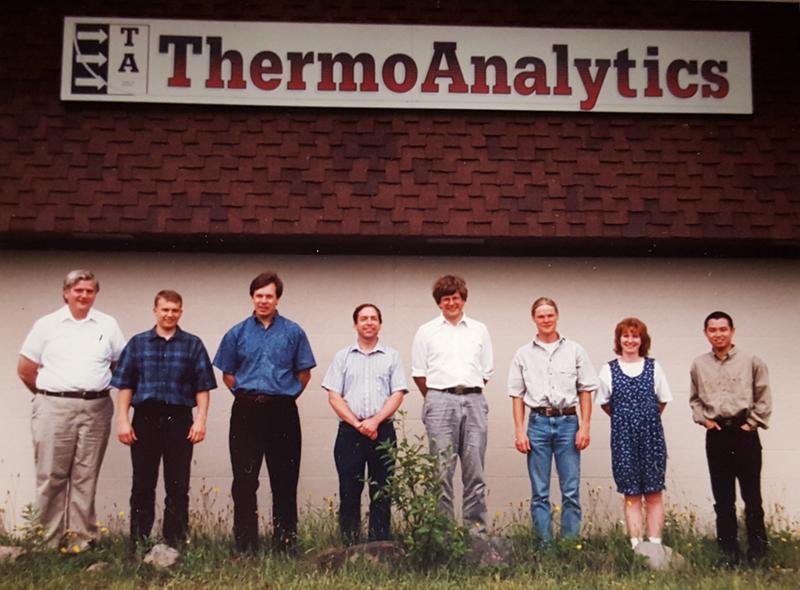
Ford wanted the software. The awkward part was buying it. The thermal tools emerging from a Michigan Technological University research group had a commercial customer, but licensing, training and support were difficult to arrange through a university nonprofit. A useful piece of engineering had reached the point where it needed a different kind of organization around it. In 1996, Keith Johnson and Allen “Al” Curran co-founded ThermoAnalytics.
It is an unusually practical beginning for a software business. There was research, a customer and a mismatch between the institution doing the work and the service the customer needed. Johnson, a mechanical engineer, stepped into that gap. Over time, his work shifted from engineering toward managing operations. The equations still mattered. So did making sure someone could buy the program and get help using it.
That change gives his career its shape. He worked on the behavior of heat, then helped build an organization capable of selling that knowledge. A calculation can be correct and still need a sales conversation. Physics is admirably indifferent to purchase orders; a software company cannot afford the same attitude.
Before the chief executive’s chair
Johnson earned a bachelor’s degree in mechanical engineering at the University of Minnesota. His working life included thermodynamics at General Dynamics and Global Analytics in San Diego, and work at the Georgia Institute of Technology in Atlanta. Before ThermoAnalytics, he was a researcher at Michigan Tech’s Keweenaw Research Center, involved in developing thermal analysis software.
The thread connecting those jobs was a technical specialty with consequences well beyond a laboratory. Thermal modeling asks how temperatures change across an object and through time. Infrared analysis adds another question: how will that object appear to a sensor? A vehicle has materials, surfaces and heat sources. It also sits in an environment. Getting the temperature right and understanding what a detector sees are related tasks, with different decisions riding on the answers.
As an executive, Johnson remained involved in signature management modeling and simulation while directing strategy and operations. That combination is worth pausing over. The company’s leader had worked on the technical problems its customers were trying to solve. He could discuss the business plan and still participate in the engineering behind the product.
Heat has more than one customer
The early business crossed between military and automotive work. That connection was already visible in 1998, when Johnson described the development of the Army’s PRISM infrared prediction code into MuSES, the Multi-Service Electro-optic Signature code, for licensing to defense contractors. The workflow began with a representation of an object’s geometry, then its materials and surface properties. Thermal analysis could turn that model into a prediction of surface temperatures.
For an automotive engineer, the questions might concern the components around an exhaust system. For a defense engineer, they might concern a vehicle’s infrared signature. The customers had different vocabulary and different constraints, yet each needed software that could represent physical behavior before a design decision became expensive to change.
Johnson’s public technical writing stayed close to those working questions. He wrote about heavy vehicles, brake systems and the economics of simulation. One article asked, “Does Simulation Cost or Pay?” Another urged engineers toward “Fix...then Test.” Those titles carry a plain commercial argument: the value of a model depends on what it lets an engineering team do earlier. A colorful result is pleasant. Avoiding an unnecessary round of hardware changes is rather more useful.
materials + geometry + environment
When the old name stopped fitting
By June 2015, ThermoAnalytics was making a conspicuous change to a familiar product. RadTherm became TAITherm with the release of version 12.0. The earlier name reflected a radiation visualization package; the software had grown into a tool for multiple modes of heat transfer. The new name was an attempt to catch up with the engineering.
There were changes underneath the label, too. Version 12.0 added support for distributed memory parallel processing, allowing thermal calculations to run across a cluster of machines. MuSES kept its name because it still described that product’s defense purpose. The announcement, posted under Johnson’s name, bundled a software release, a website refresh and the product rebrand.
Two years later, the company’s Exhaust Tool appeared in a Paris Air Show exhibitor announcement. It worked with TAITherm, using a convection model, flow pathfinding and built-in exhaust components to simulate changing thermal conditions. Johnson was listed as the company’s president and CEO. The example puts some useful machinery behind the software names: an exhaust system, nearby parts, heat moving through an assembly, and a designer deciding what needs to change. The company was bringing that specialized calculation to an international industry gathering, alongside the support and commercial work needed to sell it.
That is a revealing assortment of work for a research-born business. Improving the solver was one job. Explaining the product was another. Keeping a name that made sense and replacing one that had become too narrow were decisions about how customers would understand the company. Even a business built on thermal science eventually has to explain itself in words.
An overseas business, a northern address
The market was already extending well beyond Michigan. A 2015 business update recorded that ThermoAnalytics’ international sales exceeded domestic sales, while software product revenue had overtaken service revenue. The company had opened registered offices in Germany and France. Those were specific signs of a shift: a research and services operation was becoming a software business with customers abroad.
In January 2016, Xitadel announced a partnership to distribute ThermoAnalytics products and services in India. The agreement included technical support, training, engineering services, seminars and user events. Johnson welcomed the relationship: “We are excited to be supporting our esteemed customers in India.” The useful detail lies in everything that accompanied distribution. Shipping software across a border still leaves someone needing to answer a customer’s question.
Johnson also appeared on the 2016 Mackinac Policy Conference agenda, alongside Senator Debbie Stabenow, General Dynamics Land Systems president Gary Whited and Matrix Design Group’s Charles Perham. Their panel concerned Michigan’s defense assets and economic opportunities. His business occupied precisely that intersection: specialist engineering, military and automotive applications, and jobs rooted in a Michigan community.
The people who could stay
In 2018, Johnson spoke about Return North, a Thanksgiving weekend recruiting event for the Keweenaw region. The timing was sensible. People who had moved away would be coming home to visit family; local employers would be there to talk about work. Johnson described the opportunity for people to “either stay up here or move back here.”
ThermoAnalytics was recruiting across sales, finance, marketing, engineering and software development. That range says something about what Johnson had helped assemble. A software firm needs more than the people who write and validate its calculations. It needs people who can keep the organization working, explain its products and bring customers into the business.
Employee ownership gave the regional story another dimension. A 2018 update described 58 active employee participants and said the ownership arrangement was intended to keep the business independent, Michigan-based and sustainable. It also recorded 26 percent revenue growth in 2017 and ten additional professional hires. The company supported local arts, trails and student engineering activity. The ambition had a recognizable address: build work worth doing, and make it possible to do it here.
A partner, then a handoff
In July 2020, Gentherm and ThermoAnalytics announced joint development work on software for predicting automotive thermal comfort. For an electric vehicle, cabin climate competes for energy that could otherwise support driving range. Modeling gives designers a way to explore that trade-off as a system. Johnson’s company was working with a manufacturer of thermal technologies on the connection between a simulation and a product someone would use.
The following month, ThermoAnalytics promoted Bobbi Wood to president and chief operating officer. Johnson remained CEO at that point. Wood had been with the business from its beginning and had led its engineering services team. Johnson’s reaction was direct: “I am thrilled to have Bobbi assume this new role.” He pointed to her operating experience and contribution to the company’s development.
The sequence matters. It places the leadership transition inside a continuing technical business, with partnerships and product work still under way. Wood was taking on broader responsibility after years within the organization. The company Johnson had helped create was developing the leadership that would carry it forward.
“I am thrilled to have Bobbi assume this new role.”Keith Johnson, August 2020
The work beyond the founder
Johnson now describes himself as retired on his LinkedIn profile. ThermoAnalytics lists Wood as its CEO and president. In 2026, the company marks thirty years since its founding and describes itself as entirely employee-owned, serving customers internationally. Its products include TAITherm, MuSES and CoTherm, connecting thermal analysis, infrared prediction and simulation workflows.
Johnson’s responsibilities kept extending beyond the calculation. Ford needed a supplier it could deal with. Overseas customers needed support. A northern Michigan employer needed people who could see a career there. A founder’s company needed leaders with experience of their own.
Those problems do not produce the same attractive pictures as a thermal model. They do produce the conditions in which engineers can keep working. Johnson’s career runs through both kinds of effort: understanding how heat behaves, and helping a group of people make a durable business from that understanding. Thirty years later, the research has a company around it, and that company has a life beyond its founding chief executive.