Greg Lehmkuhl made a list. It was December 2024, and the president and chief executive of Lineage had plenty to put on it: new warehouses, new inventions, a stock market debut. The company had gone public that July at $78 a share. A listing ceremony in Times Square had supplied the photographs a chief executive could reasonably expect to keep.
In his annual ranking of the company’s achievements, the IPO finished second. First came the awards that followed it: stock, restricted stock units and cash bonuses recognizing employees’ contributions. Lehmkuhl called their celebrations his favorite moment of the year. In a business whose public vocabulary runs to cubic feet and pallet positions, he had chosen the people doing the lifting.
That choice offers a useful way into his career. Lehmkuhl runs a business that depends on enormous buildings, sophisticated software and a multitude of ordinary decisions made correctly. Frozen food has little patience for an inspiring presentation. Somewhere, a loading dock still has to work.
A career measured in movements
His route to that loading dock began with logistics itself. He studied materials and logistics management at Michigan State University, attending from 1991 to 1995, and later earned an MBA at Oakland University. His professional background includes Penske Logistics, Delphi Automotive and Menlo Worldwide Logistics. These were jobs in the movement of goods, years before his name became associated with keeping them cold.
A career presentation lays out the progression with the pleasing economy of a shipping manifest: logistics engineer in 1995, project manager in 1997, global logistics manager in 2000, director of automotive operations in 2001. By 2005 he was vice president of global automotive at Menlo. Operations leadership at Con-way Freight followed in 2008, then its presidency in 2011.
The titles matter because they describe the preparation. A logistics operator has to think across several businesses at once. One company’s finished product is another company’s incoming delivery. A warehouse can perform its own task perfectly and still disappoint a customer if the next movement fails. Lehmkuhl’s career put him among those connections, where a missed handoff makes itself known quickly.
In June 2015, Lineage announced that he would succeed Bill Hendricksen as chief executive, with the handover planned for mid-July. Hendricksen became vice chairman. Lehmkuhl arrived from Con-way as a corporate executive vice president and president of its freight business, bringing a background in integration and continuous improvement to a company already expanding through acquisitions.
The warehouse has neighbors
Lineage’s founders, Adam Forste and Kevin Marchetti, had started with a refrigerated warehouse in Seattle in 2008. Lehmkuhl joined seven years later. The distinction is useful: his story here is the story of an operator taking responsibility for a growing collection of businesses, each with its own customers and working habits.
The company’s heritage is full of family enterprises. Bringing them together creates a question that an acquisition announcement cannot answer. How does a group of locations become useful as a network? A customer sending food across a region needs the connections to work as well as the individual buildings. The commercial promise lives between addresses.
Lehmkuhl’s 2015 arrival statement paired the warehouse network with new technology and additional services. The ambition was already broader than finding somewhere to leave a pallet. Storage, transportation and the information accompanying the goods would have to fit together. His earlier career made that a familiar kind of problem, even when the temperature changed.
He also took on work outside Lineage. Since July 2018, he has served on Agree Realty’s board. It gives his public career a second connection to real estate, alongside a company where property and daily operations are closely entwined. A building’s location is fixed. Everything passing through it is on a timetable.
The reply from HR
In a 2018 interview, Lehmkuhl told a revealing story about a conversation between operations and human resources. The operating side needed more people. HR had already hired 1,600 that year. Its response was blunt: “What did you do with them?”
He described a shift toward retention, including attention to pay, treatment and time off. He also connected the staffing challenge to automation. The anecdote is funny because it punctures a familiar managerial habit: asking another department to solve a problem that might require changing one’s own.
In that same discussion, he described applying data to existing buildings and finding the equivalent of 600,000 square feet of additional capacity over 36 months. The underlying instinct was practical. Before commissioning more space, understand the space already available.
Those two problems belong together. People and buildings can both be counted, but the totals tell only part of the story. Hiring figures do not explain why people leave. A floor plan does not explain how effectively a room is used. Lehmkuhl’s examples suggest an operating approach that begins by asking what the headline number conceals.
“What did you do with them?”
The HR response Lehmkuhl recalled in his 2018 interview
Good software gets its boots dirty
The technology developed under his leadership is often concerned with questions that sound small until someone has to answer them repeatedly. Which case belongs on which pallet? In what order should it be collected? How should the load fit into a truck?
In August 2024, Lineage announced its 100th patent. The invention, known as Lego, helps organize the building and sequencing of outbound pallets. It aims to reduce unnecessary movement and fit more cases on each pallet. Sudarsan Thattai, then the company’s information and transformation chief, described patents as the consequence of solving practical problems.
The spelling may evoke a childhood toy, but the stakes are adult: labor, electricity, truck space and a customer expecting delivery. There is something appealingly unglamorous about a technology business that can explain its work by pointing to a better-packed pallet. The demonstration does not require a keynote.
Another algorithm, Libra, addresses truck loading. It considers dimensions, pallet weights, axle limits and the time required for different loading tasks. Lineage’s published examples show how changing pallet orientation can change the number of available positions. These are conditional arrangements, rather than a promise that every truck gains the same capacity.
A simplified view of distinct tasks in Lineage’s operations.
The physical counterpart arrived in Hazle Township, Pennsylvania, where Lineage celebrated an automated warehouse opening in October 2024. The facility covered approximately 386,000 square feet and offered about 85,000 pallet positions. Cranes, rail-guided vehicles and computer vision helped receive, move and retrieve products.
These projects give substance to Lehmkuhl’s role. He is the executive responsible for a business in which data scientists and warehouse teams must make each other’s work useful. A clever calculation has to survive contact with a real order. The test is whether the goods move as intended.
The bell and the people behind it
On July 25, 2024, Lehmkuhl joined Forste and Marchetti at Nasdaq MarketSite to ring the opening bell. Lineage began trading as LINE. Its initial offering comprised roughly 56.9 million shares at $78 each, raising about $4.4 billion before underwriting discounts and expenses, excluding the additional share option.
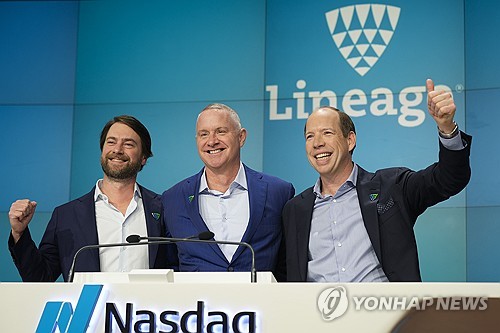
In an interview around the listing, he offered advice with the directness of someone who expects the listener to act on it: “If you can't dream it, no one else will dream it for you.” He connected the company’s work to reducing food waste and making food available. The message gave a public occasion an operating purpose beyond the ceremony.
Then came the workforce investment. On August 1, Lineage announced $100 million for its US workforce through IPO awards and ongoing equity incentives. The one-time Starting LINE awards were designed to reach the vast majority of more than 16,000 US employees. The announcement also described plans for a continuing program called Lineage Legacies.
The geographic detail matters. The US announcement set out a defined program; Lehmkuhl’s later year-end account described broader celebrations involving stock, restricted stock units or cash bonuses. Ownership can be expressed in a speech. Here there were actual awards to examine, with eligibility and forms that varied.
His decision to put those awards above the listing itself makes the annual list more than a cheerful corporate ritual. It suggests what he wanted colleagues to remember about the year: participation in the outcome. For a chief executive who had once recounted HR’s pointed question, it was a fitting choice.
After the photographs
By June 30, 2026, Lineage reported a network of 498 facilities and approximately 3.1 billion cubic feet of capacity. Its second-quarter revenue was $1.361 billion, up 0.8% from a year earlier, while adjusted EBITDA declined 1.8%. Lehmkuhl emphasized improved warehouse occupancy. The figures describe a more demanding chapter than the listing-day celebrations alone would suggest.
There was also the June fire at the company’s Big Bear warehouse in Boyle Heights, Los Angeles. By September, Lehmkuhl was answering questions about cleanup and whether the facility would be rebuilt. He said no rebuilding decision had been made. Lineage sued the rooftop solar operator and a contractor over responsibility for the fire; those allegations were disputed.
A public company chief executive has to inhabit both scenes: the bell ceremony and the interview after something goes wrong. His ambition to build a connected food network brings obligations to employees, customers, investors and the communities around its buildings. Those obligations remain when the celebratory photographs have stopped circulating.
Lehmkuhl’s career returns to the same practical question in different forms. What happens after the plan is announced? A new hire arrives. A pallet reaches the dock. An employee receives an award. A neighborhood expects an answer. The business takes its shape in what follows.