A bicycle does not care which version of CAD made it. The people designing it care rather a lot. In Onshape’s account of Trek’s move to its platform, aging servers, mismatched software versions and a cumbersome check-in/check-out process were getting between engineers and their work. Before anyone could improve the bike, they had to establish which design everyone was looking at.
- Design together: mechanical CAD and its history live in a shared cloud database.
- Pay for private work: Standard is $1,500 a seat annually; Professional is $2,500.
- Automate the tedious bit: FeatureScript lets teams build reusable modeling tools.
- Check the fit: connectivity, migration and manufacturing requirements still matter.
This is an unglamorous opening for a company devoted to making three-dimensional objects. It is also the point. Engineering software can produce an exquisite surface and still leave two colleagues arguing over an attachment. Onshape’s wager is that the machinery surrounding design deserves as much attention as the design tools themselves.

The veterans who questioned their own invention
Founded in 2012, Onshape came from people who knew the existing arrangement intimately. Jon Hirschtick, John McEleney and Dave Corcoran were among the founders; their experience included building and running SolidWorks. This was a fresh start by CAD insiders who had watched the conditions around their software change.
Hirschtick’s explanation was practical. Design teams once concentrated under one roof had become geographically dispersed. People joined projects, left them and worked from different devices. Meanwhile, conversations with users were drifting from the pleasure of making things toward the irritation of sharing files, managing versions and administering product data.
“Today is still the beginning. Today, we’re still just getting started.”Jon Hirschtick, co-founder
There is a pleasing impertinence in a founder treating his earlier success as unfinished business. Onshape’s answer was to rebuild the working environment around cloud, browser and mobile access. The public beta arrived in 2015. A designer could enter a workspace through a browser rather than begin with a desktop installation. More consequentially, the underlying design record would live in a database.
The file was doing two jobs badly
A CAD file carries geometry, but it also becomes a unit of possession. Someone has the latest copy. Someone has permission to edit it. Someone else is waiting. Product data management, or PDM, supplies order: history, access rules, revisions and approvals. In a conventional setup, it can also become another system for engineers to maintain.
Onshape combines these responsibilities. Its CAD tools let users sketch, build parametric parts, assemble mechanisms and produce technical drawings. Its built-in data management records edits and keeps the document’s history. The platform includes sheet metal, structural frames, configurations and surfacing. That breadth matters because a collaboration tool without useful modeling would merely make a team agree faster about its limitations.
The shared record changes several ordinary decisions. Engineers can inspect earlier states and compare versions. They can branch a design to explore an alternative, then merge selected work. A colleague can receive access to the design rather than another independent copy. Formal release workflows, available in the team-oriented plans, distinguish an experiment from the revision approved for production.
A simplified workflow. Shared history supports experimentation; approval rules govern what gets made.
The useful distinction is between access to a live workspace and delivery of a snapshot. Both can be necessary. Suppliers may still need exported STEP geometry or drawing PDFs. Onshape supports import and export formats precisely because manufacturing does not become a single-vendor world merely because a design team changes its software.
The toolbar can learn your trade
CAD vendors cannot anticipate every repetitive task in every factory. Onshape gives customers another route: FeatureScript, introduced publicly in 2016. It is a language for creating parametric features, with a development environment inside the product. The standard feature library is publicly viewable, so a programmer can study how existing tools work before building a custom one.
Using a custom feature does not require writing it. A designer can add an existing tool to the toolbar and use it much like a standard command. A team can also commission a feature for a recurring task. The attraction is specificity: a modest tool that understands your particular operation may save more time than a grand new menu.
Trek provides an example. Its published customer account describes a custom cable-routing feature that reduced a task from more than a day to under 30 minutes. That is a vendor-published customer result, not a promise for every bicycle company. The transferable lesson is to find a repeated operation, encode the rules and measure the result. Buying CAD alone does not perform that work.
Under 30 minutes
A result tied to a custom FeatureScript tool, not a general platform speed benchmark.
The price of a quieter working day
Onshape sells annual subscriptions. At the listed US-dollar prices checked on October 1, 2026, Standard costs $1,500 per user per year and Professional costs $2,500. Enterprise pricing requires a quote. Standard provides private storage and commercial CAD; Professional adds company-managed data, release management, advanced PDM and tools including simulation, rendering, ECAD/MCAD exchange and CAM.
For a five-person team buying five Professional seats, the published subscription arithmetic is $12,500 a year. That is an illustration, not a complete implementation budget. Training, migration, workflow changes and other systems consume time or money too. The appropriate comparison includes the existing costs of hardware, software administration and delays, rather than just the competing license fee.
The free plan is an entirely different bargain: noncommercial use with public documents. It is a useful entrance for personal experiments, provided public means public to the person creating them. Student and educator plans are separately free for educational use. In July 2025, Onshape reported more than 1.2 million students and teachers had used it during that academic year. Classroom access also gives the company a long introduction to future professional users.
PTC bought a way of delivering CAD
In October 2019, PTC announced an agreement to acquire Onshape for approximately $470 million, net of cash acquired. The acquisition completed in November. PTC said Onshape had raised more than $150 million and had more than 5,000 subscribers at the time. Those are historical figures, not a current customer census.
PTC’s stated rationale was the move toward software as a service. It already had on-premises CAD and PLM businesses; Onshape added a cloud-native product-development offering. The distinction remains useful within the wider market. Buyers can consider SolidWorks, Autodesk Fusion or Inventor, Siemens NX, Dassault CATIA and PTC’s own Creo, depending on their requirements. Onshape’s argument concentrates on shared data, access and administration.
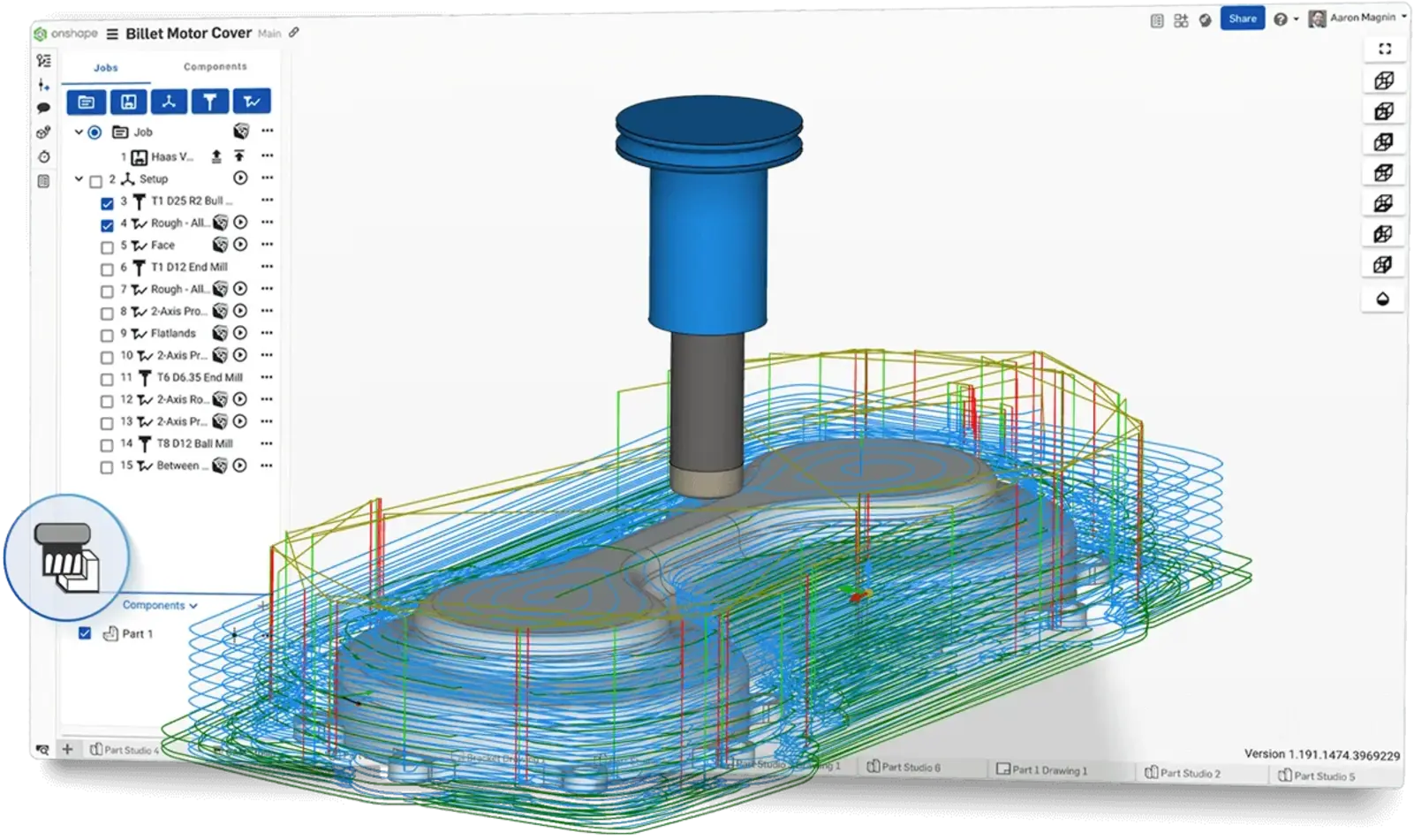
The platform now reaches beyond modeling. CAM Studio launched in beta in January 2025, bringing toolpath preparation and machining simulation into Onshape. Its collaboration has a boundary worth noticing: the launch announcement specified one CAM editor at a time. A shared platform need not mean every operation is edited simultaneously.
The connection to Arena, another PTC business, addresses a separate handoff. It links engineering data with product lifecycle management, including bills of materials and change approvals. Eligible subscriptions to both applications are needed. The connection itself is included, but that does not turn the whole manufacturing information system into a free service.
A browser still has conditions
Onshape needs a reliable internet connection. Its hardware guidance also discusses graphics performance; running in a browser does not make the device irrelevant. A team working in places with unreliable connectivity should test those conditions before making the design environment dependent on them.
Migration deserves the same seriousness. Importing geometry does not necessarily preserve its original parametric history. Onshape offers direct-editing tools for imported parts, but changing an existing face and recovering the original modeling decisions are different tasks. A sensible evaluation uses an actual assembly, its drawings, a supplier exchange and the intended release process.
Product development continues as well. February 2026 brought model-based definition. September’s release added Feature Studio history comparison and public-document thumbnail search as a Labs feature. AI Advisor provides guidance grounded in Onshape’s learning materials; its October 2025 in-product announcement said it did not access users’ design data. Help with the tool and responsibility for the engineered result remain separate obligations.
There is a lesson here for people who will never buy CAD. Before demanding faster work, inspect the handoffs. Who waits? Who checks which version is correct? Which repeated operation could become a tool? Onshape has made those questions part of its product. The bicycle still needs good engineering. At least the engineers can spend less of their attention deciding where the engineering went.