BREAKING: Bild raises $3M seed - months after the Yale MBA cap toss Revenue grew 10x in 2023 Built by an ex-Apple program manager who shipped iPhone 8 - 11 Mission: get engineers out of email and back into design BREAKING: Bild raises $3M seed - months after the Yale MBA cap toss Revenue grew 10x in 2023 Built by an ex-Apple program manager who shipped iPhone 8 - 11 Mission: get engineers out of email and back into design
Founder · Engineer · San Francisco

Pradyut Paul

He helped build the iPhone in your pocket. Now he is building the tool that hardware engineers use to build everything else.

$3MSeed raised
10x2023 revenue growth
iPhone 8–11Apple programs
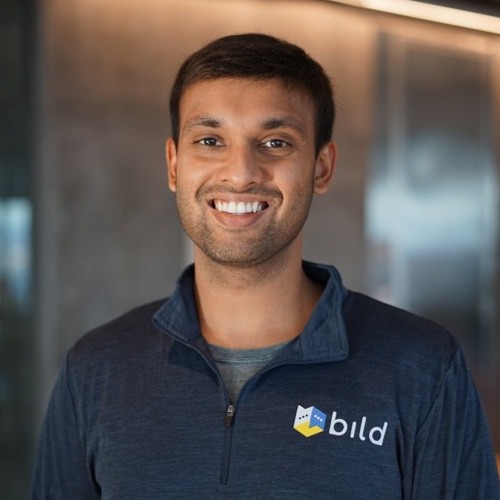
Portrait of Pradyut Paul, CEO and co-founder of Bild

// The smile of a man who has read 10,000 design-review emails and decided, with some force, that this is no way to live.

The plumbing of hardware, finally rebuilt for the cloud.

Pradyut Paul runs Bild, a San Francisco company with a deceptively dull job description and a deeply unglamorous enemy: the email attachment. Bild is a cloud-native product data management platform - the system of record where mechanical and hardware teams keep their CAD files, version history, bills of materials, and the long argument that is any real engineering project. Think version control, branch-and-merge, and audit trails, but for objects you can drop on your foot.

The enemy is specific. Most hardware teams still run their most expensive work out of generic file folders. Designs travel as screenshots pasted into slide decks. Decisions live in inboxes. A drawing gets "flattened" to 2D so a colleague can open it, and something true about the part is lost in translation. Paul has watched this happen up close, at scale, with products shipping by the thousand. Bild is his argument that it does not have to.

His pitch is less about software than about time. Engineers, he says, lose roughly a third of their week to coordination that has nothing to do with engineering. Bild exists to give that third back.

I'm not very smart, but I'm smart enough to know that engineers shouldn't be spending most of their time in meetings and sifting through emails.
// Pradyut Paul

Space chips, then a Bluetooth tracker, then the iPhone.

Before Bild, Paul collected the kind of resume that reads like a tour of how hard things get made. He grew up in the suburbs of Chicago and studied electrical engineering at the University of Illinois Urbana-Champaign - a bachelor's, then a master's. His first job was about as deep in the machine as engineering gets.

At Raytheon's Space and Airborne Systems division he was an RFIC designer, drawing radio-frequency integrated circuits for sensors bound for satellites and aircraft - low-visibility systems where you do not get a second chance to fix a chip in orbit. From the silicon, he moved up the stack. At TrackR, a Santa Barbara startup, he led the hardware team building Bluetooth tracking devices, owning design, sourcing, and manufacturing for both shipping products and R&D. It was a small AirTag before the world had an AirTag.

Then Apple. As an engineering program manager, Paul ran new product programs across the iPhone 8, 8+, Xs, Xs Max, and iPhone 11, and worked on early AirTags development. The job was orchestration at industrial scale - electrical, mechanical, firmware, manufacturing, and validation teams all rowing in time, products ramping to thousands of units a day, frequent flights to China for engineering builds. It is the kind of role where you learn, viscerally, exactly where hardware projects go to die: in the gaps between people.

That is the thread. Every job moved him one rung further from drawing the part and one rung closer to the problem of coordinating the people who draw the parts. By the time he arrived at Yale's School of Management for his MBA, he had a hunch dressed up as a complaint.
From chip to company.

01
Raytheon. RFIC designer at Space and Airborne Systems - next-generation chips and sensors for space and airborne military systems.
02
TrackR. Hardware team lead in Santa Barbara, owning design, sourcing and manufacturing for Bluetooth tracking devices.
03
Apple. Engineering program manager across iPhone 8 through 11, plus early AirTags - cross-functional orchestration at mass-production scale.
04
Yale, 2021. Earns his MBA and starts Bild while still a student, through SOM's entrepreneurship program and the Tsai CITY incubator.
05
$3M seed. Closes the round months after graduation, with co-founder and CTO Avinash Kunaparaju.
06
2022 pivot. After cycling through ideas weekly, the team locks onto version control and collaboration for mechanical engineering.
07
2023. Revenue grows tenfold; a sales team starts knocking on Fortune 500 doors.

The first idea didn't survive a month. Neither did the next.

The clean version of a founder story skips this part. Paul does not.

3-4
Weeks per idea, early on

"I don't think we held onto an idea for more than three or four weeks at a time." The first year was a churn of pivots, not a straight line.

~1 yr
Before product-market fit

Bild only hit its stride after a pivot more than a year in - when it stopped chasing products and started chasing one problem.

30%
Of an engineer's week lost

"They're spending too much time just not designing... going back and forth with cross-functional stakeholders."

40 yrs
On the same on-prem tools

"We work with a lot of companies that have said we're never going to move off our on-prem solutions - and they've been like that for four decades."

What finally stuck was the thing Paul had been living since Raytheon: mechanical teams were storing their crown-jewel design files in legacy systems or in Google Drive and Dropbox - tools that know nothing about how hardware actually gets designed. The result was a quiet, expensive bottleneck. Bild's answer borrows the discipline of software - versioning, branching, merging, a real history you can roll back - and rebuilds it for the messy, physical, manufacturing-bound reality of a 3D model that cannot simply be "flattened" without losing the truth of the part.

A technical founder who went looking for the part he was missing.

There is a certain type of engineer who believes the spreadsheet is the only honest document and that everything else - marketing, sales, the soft business arts - is decoration. Paul was technical enough to be tempted by that view, and self-aware enough to reject it. He went to Yale's School of Management precisely because he knew the gap in his own toolkit. "Avinash and I were technical by background," he has said. "SOM gave me a glimpse of the other factors successful organizations need."

The detour paid for itself before he even graduated. Through SOM's Program on Entrepreneurship he worked with associate director Jennifer McFadden and professors Tristan Botelho and Song Ma, and he ran early experiments inside Tsai CITY, Yale's startup incubator. The single most useful thing he took away was not a financial model. It was a sentence - Botelho's instruction to solve for a problem rather than fall in love with a product - and it is the discipline that eventually pulled Bild out of its early, idea-a-week fog.

It is a telling order of operations. Plenty of founders raise money and then go searching for a reason to exist. Paul raised $3 million months after graduation and then did the harder, less glamorous work of throwing away the ideas that did not earn their keep until one of them did. The pivot was not a failure of nerve. It was the method working as designed.

Where the engineering week actually goes

// Illustrative, based on Paul's public remarks on hardware team workflows

Coordination & email
~30%+
Meetings & reviews
significant
Actually designing
what's left

The pitch in one chart: Bild is built to grow the bottom bar by shrinking the top two.

The founder, unfiltered.

"My goal is to enable hardware teams to focus on innovation and engineering by providing a platform that removes the frictions in design collaboration."

// On the mission

"Almost all of our cross functional and external communication happened through screenshots of these designs over email, slide decks, and spreadsheets."

// On the problem he lived

"We're still living in that 2D world. Companies are still using these 2D flats and sharing these documents over email."

// On the industry's habit

"Avinash and I were technical by background. SOM gave me a glimpse of the other factors successful organizations need."

// On what Yale taught him

Selling the future to industries that distrust it.

Bild's hardest sale is not technical. It is generational.

Aerospace, defense, automotive, medical devices, industrial machinery - the customers Paul chases are the ones who have the most to lose and the strongest reasons to never change anything. Some have run the same on-premise data systems for forty years. ITAR rules, compliance regimes, and the simple fact that a recalled physical product costs orders of magnitude more than a buggy app all conspire to make these teams cautious by design. Paul is not annoyed by that caution. He treats it as the moat. If moving hardware engineering to the cloud were easy, someone would already have done it well.

So his bet is patient. The wedge is the workflow nobody defends - the screenshots, the flattened drawings, the version named "final_v3_REALLY_final." Win those small daily indignities and the rest of the platform follows: branch and merge for design experiments, engineering change orders, bills of materials, audit trails, role-based access, the whole grammar of grown-up engineering. Borrow what software learned about collaboration over the last two decades, and refuse to pretend a steel bracket is the same as a line of code.

The destination Paul describes is almost modest in its ambition and radical in its implication: hardware engineers who spend their hours engineering. No heroics, no all-nighters reconciling which file is current, no archaeology to find out who changed what and why. Just the work. For a man who has built radio chips for orbit, Bluetooth trackers, and the iPhone, it is a fitting final boss - not a new gadget, but the invisible system that lets every other gadget get made faster. If he is right, the most important thing he ever ships will be the time he hands back to everyone else.

Things that don't fit the pitch deck.

01

He worked on early AirTags - a product about never losing your keys - then founded a company about never losing track of a design.

02

The career runs the full spectrum of hard things: military space chips, consumer gadgets, then enterprise software. Few founders have stood in all three rooms.

03

Both Bild founders are engineers by training - which is exactly why the product reads like it was built by people who have felt the pain.

04

His sales pitch sometimes amounts to convincing companies to leave software they have happily used for four decades. He keeps making it.