Three people were standing in an office with two rooms. One room had windows and a pleasant view. The other felt like an entrance hall with ambitions. This was an early problem at Jama Software, and the founders solved it by squeezing three desks into the smaller room. Everyone got the light. Nobody got much elbow room.
- Jama connects product requirements with reviews, risks and tests.
- Its sweet spot is engineering across disciplines and regulated industries.
- Francisco Partners announced a $1.2 billion acquisition in 2024.
- The useful lesson: preserve decisions and their consequences as work happens.
Three desks, one view
In co-founder Derwyn Harris’s account of the first office, the choice was a small declaration about how Eric Winquist, Sean Tong and Harris intended to work. They were peers. Hierarchy had not yet earned a room of its own. The spare room became a place to stand up and think through problems.
The anecdote survives because it resembles the product. Jama’s subject is collaboration under awkward conditions: people with different responsibilities trying to build the same complicated thing. The company began in 2007. Winquist later described his frustration with teams spending time and money on features that nobody used. Connecting stakeholders and engineers was the initial ambition.
There is a familiar business comedy here. An organization can employ clever people, give them capable tools and still discover that each department has been pursuing a slightly different definition of success. Jama occupies the uncomfortable space where those definitions need to meet.
The promise and the proof
A requirement states what a product must do. A test supplies evidence about whether it does it. Between the two sit specifications, reviews, changes and decisions. Jama Connect puts those records into a connected system rather than leaving their relationships inside somebody’s memory.
Its users can author requirements, invite reviews, establish baselines, reuse information and manage testing. For a team developing hardware and software together, the attraction is being able to follow a change into the work it affects. A tidy document is pleasant. Knowing which verification activity depends on the sentence you just edited is useful.
Illustrative relationship chain. Real projects contain many branches, item types and dependencies.
Jama calls its approach Live Traceability. Its Traceability Information Model defines expected item types and relationships, giving a team a structure against which to inspect coverage. The point is to notice a missing connection while the work is still moving, when someone can act on it.
The integration catalog reaches into task management, design and simulation, source repositories and automated testing. Jira, Azure DevOps and specialist modeling tools can remain part of the workflow. Jama’s position is that the connections between tools deserve their own management layer.
A release held up by its own paperwork
Vave Health makes handheld ultrasound technology. Its published Jama customer story describes an earlier choice of Matrix Requirements for its low cost. As development expanded, reporting, adoption and parallel projects became problems. Some colleagues returned to Word and Excel. The team changed tools.
“The whole process just took too long.”Craig Loomis, VP of Product, Vave Health
After moving to Jama, Vave reported its release cadence falling from a couple of weeks to a day or two. This is a vendor-published customer account, not a prediction for every installation. Its lesson is wonderfully practical: evaluate the work around the requirements, including the reports needed to release a product.
of weeks
or two
A business model that lets people agree
Jama’s public licensing page divides access into four roles. Creators author and manage the work. Stakeholders view and comment. Reviewers participate in formal approvals. Test Runners execute testing and log defects; creating test cases requires Creator access.
Reviewer licenses, hosting, file storage and a hosted sandbox are included without an additional charge on the current pricing page. Dollar prices come through a quotation. That leaves buyers to evaluate a particular contract, deployment and mix of roles.
The reviewer policy is an interesting design choice. If agreement is the product’s value, charging an extra toll whenever another decision-maker joins could discourage the behavior the product needs. This is an interpretation of the model, but the incentive is easy to understand. A review is more useful when the relevant people can attend.
Jama sits in the enterprise requirements market alongside IBM DOORS and DOORS Next, Siemens Polarion and PTC Codebeamer. Its practical competition also includes a well-loved spreadsheet. Buyers should compare the complete workflow: authoring, approval, change impact, reuse, integration maintenance and verification evidence.
The customer mix explains that emphasis. Jama publishes references spanning medical devices, automotive, aerospace and semiconductors; its company page includes Grifols, Rimac and Telesat. These are environments in which hardware, software and quality teams need to keep their evidence intelligible to one another.
The $1.2 billion bet on coordination
Jama’s financing grew with its ambitions. In 2013 it announced $13 million in Series B funding, led by Trinity Ventures with Madrona participating, and reported more than 600 customers. In 2018, Insight Venture Partners led a $200 million growth equity investment with Madrona.
Francisco Partners’ acquisition agreement
The 2024 acquisition announcement reported that recurring revenue had tripled organically over five years. Francisco Partners agreed to acquire Jama from shareholders including Insight and Madrona. CEO Marc Osofsky would reinvest and continue leading the business.
The $1.2 billion figure describes a transaction, so treating it as money raised for product development would muddle the story. What it does show is the financial weight attached to this corner of enterprise software. Coordination may lack the glamour of the finished machine. It can still command a considerable price.
AI arrives with a permission slip
Jama Connect Advisor began in October 2022 as a natural-language assistant applying INCOSE guidance and EARS notation to requirements. The later release record shows a broader remit: requirement refinement in January 2026 and test case generation in February. Suggested tests remain connected to the requirements that prompted them.
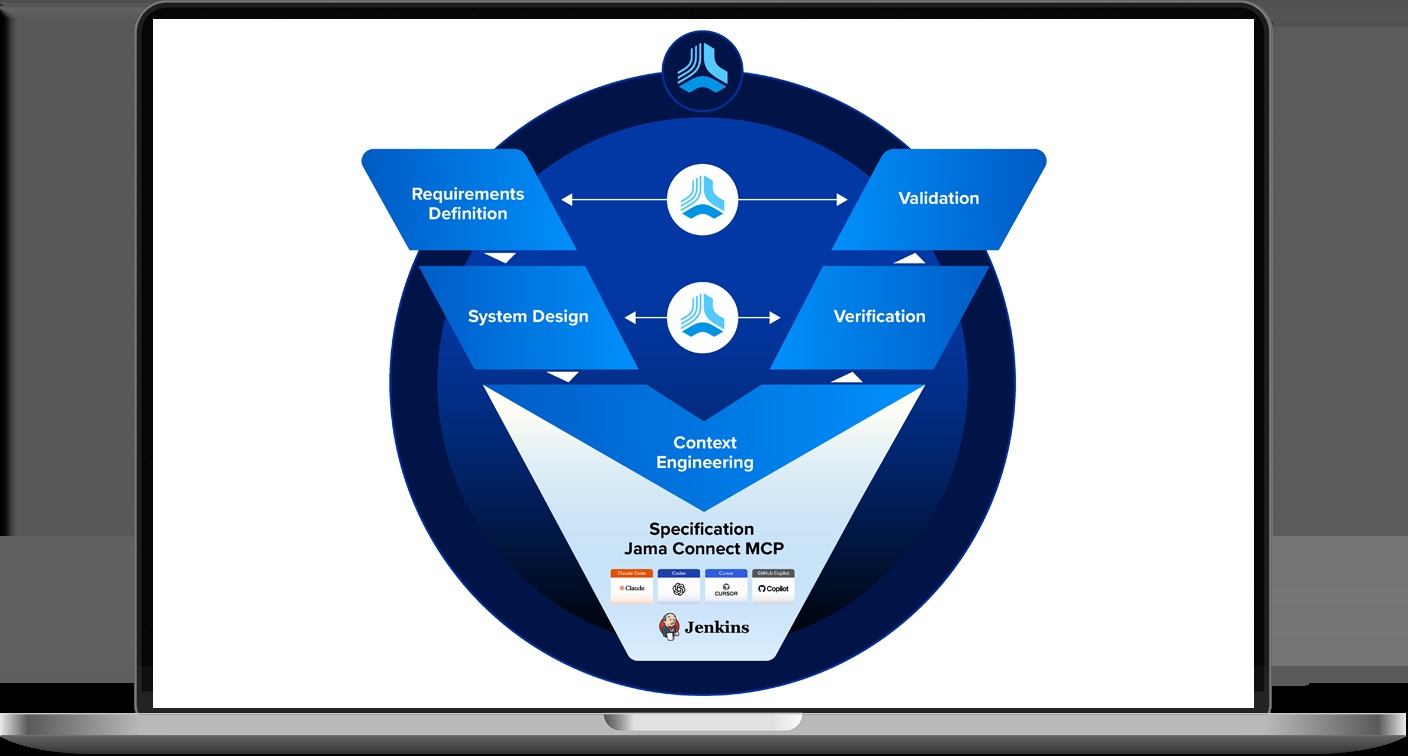
In May 2026, Jama announced an MCP server allowing compatible AI environments to work with engineering context while retaining existing permissions, lifecycle workflows and audit requirements. In December 2025, a separate Obeo connector had connected Jama requirements and tests to Capella architecture models.
The underlying proposition is coherent: faster creation needs better context. An AI assistant that can retrieve the relevant requirement and its relationships has more to work with than an isolated instruction. Whether that improves a particular project still depends on the quality of the record and the judgment applied to its output.
Jama’s September 2026 account of its own engineering workflow makes the method concrete. Senior practitioners started with real projects, then used workshops to spread the practice. The company says roughly 80% of engineering teams had applied spec-driven development to real work. Engineers reviewed specifications before code generation and checked the resulting behavior afterward. These are Jama’s reported practices, not an independent assessment of their results.
Copy the discipline before buying the software
Jama’s implementation guidance contains a useful restraint: the application supports a process, but does not supply the process by itself. Teams need measurable outcomes, people responsible for configuration and decisions about which information belongs in the system.
One sensible experiment is to take a single product change and trace it through the entire workflow. Record the intended behavior, identify the reviewers, link the verification activity and check whether another team can follow the chain. Measure time spent finding information and resolving gaps. Expand after the process works.
If ownership is vague, requirements are ambiguous or integrations are neglected, a connected platform can preserve confusion with impressive fidelity. A small project with few dependencies may need less machinery. The important purchasing question is how much coordination the project actually requires.
Even Jama’s workplace language follows the same theme. Its careers page describes a virtual-first organization and learning habits that include testing hypotheses and listening with empathy. Those are employer statements; the revealing detail is the preference for examining an idea rather than becoming attached to it.
The founders once put three desks beside the same window. Today the company sells a more elaborate way to share a view. The engineering challenge has grown considerably. People still need to see what the others mean.