Electric cars have an awkward talent: they let you hear everything. Remove the combustion engine's rumble and the small mechanical complaints step forward. A gear pair sings. A spline mutters. A housing amplifies a vibration that looked harmless on a component engineer's screen. By the time the sound appears in a physical prototype, the offending geometry may be expensive to change. Smart Manufacturing Technology, or SMT, has built a business around catching that conversation earlier.
The company, founded in Nottingham in 2002 by what it calls a collective of experienced engineers, makes MASTA. The name belongs to the unglamorous but consequential world of computer-aided engineering: software in which driveline teams design gears, shafts, bearings, housings and electric machines, then ask how the complete assembly will bend, heat, vibrate, wear and waste energy. SMT also sells the human layer around the code - consultancy, testing, training and support.
Its customers are engineers whose mistakes eventually become metal. SMT publicly names Honda, BMW, BorgWarner, Rimac Technology, Hewland Engineering, Joy Global and Brazil's Instituto Tecnológico de Aeronáutica among users or customers. The industries extend beyond cars into wind power, aerospace, marine propulsion, rail, robotics, mining and heavy machinery. Different machines, same irritating truth: a transmission is a system, even when the org chart treats it as a pile of components.
01 / The useful collapse
One model, several arguments
A conventional workflow can resemble a bureaucratic relay. Concept geometry starts in one tool. Gear rating goes to another. Finite-element work lives elsewhere. Noise, vibration and harshness - NVH to the initiated - becomes another model with another set of assumptions. Efficiency needs loss maps. Manufacturing tolerances arrive late and ruin the neat answer. Every export creates an opportunity to simplify away something important.
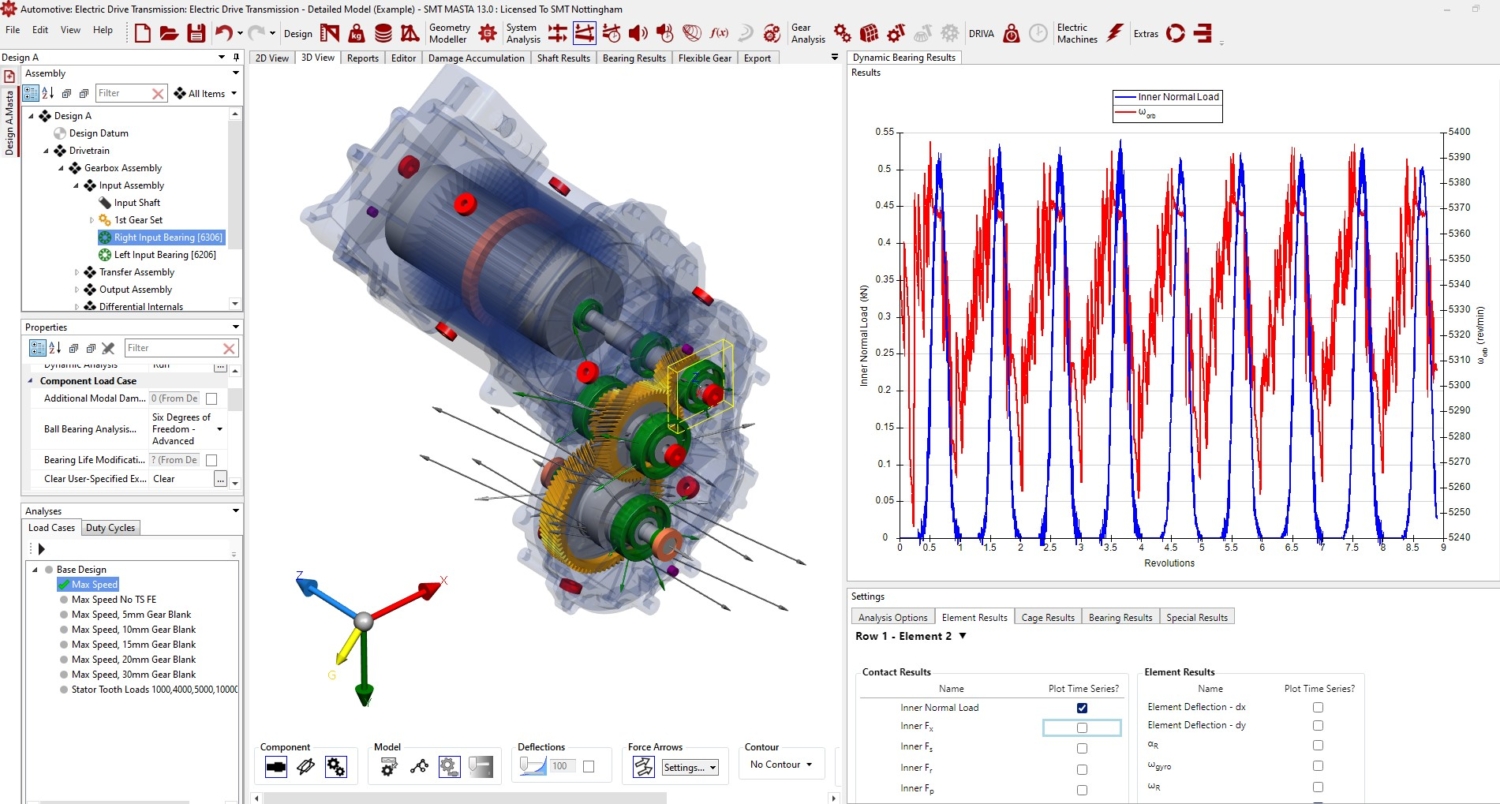
MASTA's pitch is continuity. Build the transmission once, keep each component inside the full-system context and move between quick calculations and higher-fidelity analyses as the question demands. It can calculate recognised ISO and AGMA gear ratings; model bearings, shafts, splines and housings; run loaded tooth contact analysis; estimate losses and efficiency; and follow excitations through the structure toward radiated sound. Electric-machine electromagnetic, mechanical and thermal behaviour can join the same model.
How a tiny tooth correction reaches your ear
excitation
response
vibration
microphone
That breadth is SMT's competitive argument against specialist component tools and collections of general-purpose solvers. KISSsoft and Hexagon's Romax products are the nearest familiar names; Ansys and Siemens Simcenter enter when a team wants a broader multiphysics environment. MASTA does not win by claiming physics has only one tool. It tries to make the transmission model the durable centre of the workflow, with links and scripts for everything around it.
“Engineers can spend more time engineering.”SMT's admirably plain case for automation
02 / The receipt
The best number is not a horsepower figure
Honda's outboard-motor division adopted MASTA in 2016 because, according to its chief engineer Nobuo Uesaka, the software was evolving quickly. The result Honda chose to publicise was a 60 percent reduction in design-review work hours during model changes. SMT also helped diagnose prototype problems and propose countermeasures. The customer verdict was concise: “We have achieved results that exceed our expectations.”
Fewer design-review hours during model changes, reported by Honda R&D.
The saving matters because a model change is not one calculation. It is the return trip through every affected component, load case and review.
Honda's public account begins with issues in prototype machines, where SMT supplied cause analysis and countermeasure proposals. SMT publishes no list pricing and routes buyers toward a demonstration or full-featured evaluation. That is ordinary enterprise-software behaviour, though inconvenient for anyone building a public spreadsheet. The honest economic case is therefore about avoided loops rather than a made-up payback period: fewer handoffs, more virtual iterations and earlier discovery of a failure mode before tooling or prototype hardware hardens the design.
The useful lesson is copyable without buying MASTA. Keep a canonical system model. Put tolerances, assembly errors, thermal expansion and duty cycles into decisions before sign-off. Use fast approximations to screen many designs, then spend expensive computation on the survivors. Preserve the link between a gear tooth and the housing that makes its mistake audible. Software helps, but the method comes first.
03 / Quiet machines, loud trade-offs
Durable, efficient, silent - pick all three carefully
The interesting work lives between targets. A microgeometry correction that spreads load across a gear tooth may improve durability. Another correction may reduce transmission error and whine. Friction and churning affect range. A lighter housing can flex more. An electric motor's thin rotor bridges may be electromagnetically attractive and mechanically nervous at speed. Optimisation is not a magic wand here; it is a disciplined search through compromises.
MASTA 15 makes that search more explicit. Its machine-learning microgeometry optimiser works across user-defined noise, durability and efficiency targets at multiple operating conditions. Network databases give teams shared, versioned component data. CAD export can include microgeometry for machining, moulding, sintering or 3D printing. Transfer-path analysis helps locate the route a vibration takes through the structure. Electric-machine thermal analysis combines faster lumped networks with finite-element detail.
The AI label deserves restraint. SMT is not asking a gearbox engineer to surrender judgement to a chatbot. The engineer chooses the variables, objectives and constraints; the optimiser searches. That is closer to a tireless numerical apprentice. It is valuable when the design space is large, the analyses are trustworthy and the goal can be expressed. It is useless when the inputs are fiction.
Loads, materials, tolerances and boundary conditions are credible; teams can validate models; and repeated design changes make automation worth setting up.
The problem is not drivetrain-centred, one-off simplicity beats model infrastructure, or missing test data makes a precise-looking answer untrustworthy.
MASTA can be scripted through Python, C#/.NET and MATLAB, exposing tens of thousands of parameters. That matters to companies with confidential calculations or house rules they do not want trapped in a vendor roadmap. Teams can automate model construction, run studies on a Linux high-performance cluster, connect optimisation packages and add private calculations to reports. The danger is equally plain: automation scales bad assumptions with great professionalism.
04 / Beyond the dry gearbox
The fluid has entered the chat
In June 2025, SMT announced a strategic partnership with Japan's Prometech Software. The companies are strengthening the interface between MASTA and Particleworks, Prometech's particle-based computational fluid-dynamics product. It is a practical expansion. Gears need lubricant; spinning components churn it and lose power; electric motors need cooling. Mechanical and fluid models have different jobs, but engineers need their answers to meet.
SMT lists MathWorks, JMAG, Altair, Motor Design, Klingelnberg and Gleason among technology partners. It also maintains academic links, including work with the University of Warwick on polymer-composite gears and hands-on MASTA teaching. Industry associations include NAFEMS and gear-manufacturing groups. This is how a specialist vendor fits into a large CAE market: not by pretending to own every domain, but by making its system model hospitable to the tools and standards its customers already trust.
The company itself has followed powertrain engineering around the map. Alongside its Wilford headquarters and Nottingham test facility, SMT lists operations in North America, Japan, South Korea, India and China. Its fourth India Technical Forum, held in Pune in April 2026, drew more than 70 customers and specialists for three days. Presentations ranged from spline-rumble analysis and gear manufacturing simulation to a MASTA 16 roadmap. This is not mass-market software. Its community gathers to discuss bearing connections.
That narrowness is the charm and the limit. A consumer app can hide complexity behind a swipe. MASTA exists because the complexity is the product. It is suited to organisations that design transmissions repeatedly, carry costly durability or noise risk, and have engineers capable of challenging a model. A team needing occasional component ratings may prefer a smaller tool. A general multiphysics group may value a broader platform. And no credible simulation package turns validation into an antique.
SMT's “zero prototypes” ambition is best read as a direction, not a victory banner. The company says it validates results against standards, literature, high-fidelity simulations and real tests. That last item keeps the pitch grounded. The aim is not to abolish metal. It is to make every piece of metal answer a better question.
The electric motor got quieter. The gearbox lost its alibi.Why SMT's old specialty found a fresh urgency
For the reader building an engineering process, the company offers a bracingly unfashionable takeaway. Start with context. Make the system model reusable. Automate the repetitive laps. Let specialists keep their private methods. Join domains where the physics joins them. Then test the result against the world, which remains stubbornly unwilling to read a software brochure.