In Northampton, Massachusetts, Subaru’s researchers encountered a clue that a less curious company might have filed away. The owners arriving for focus groups were women. Many were lesbians. They liked the cars for practical reasons: carrying things, going camping, getting through bad weather. The audience existed before the advertising did. Subaru’s useful discovery was that it could stop imagining an ideal buyer and start paying attention to the people holding its keys.
- Listen to the owners already buying.
- Make utility the reason to stay.
- Give retailers a local role in the promise.
By the early 1990s, sales were struggling against much larger rivals. Subaru hired the agency Mulryan/Nash, which understood gay and lesbian audiences. Its ads eventually tucked references into license plates: XENA LVR, for the television heroine, and P-TOWN, for Provincetown. A person could see a sensible car; another could spot a small acknowledgment.
A car for the life you actually have
Malcolm Bricklin and Harvey Lamm founded the American business in 1968. Its first offering, the little Subaru 360, arrived with the advertising phrase “Cheap and Ugly.” The company’s later direction was more durable: a four-wheel-drive passenger wagon reached the U.S. in 1975. Utility gave Subaru a reason to exist beyond being another imported badge.
Today, Subaru of America markets and distributes vehicles, parts, and accessories through about 640 U.S. retailers. It is an indirect wholly owned subsidiary of Japan’s Subaru Corporation. The Camden operation manages the American market and retailer relationship; it is not a freestanding startup designing and manufacturing every car on its own.
Its center of gravity is the crossover: Crosstrek, Forester, and Outback. The larger Ascent serves families needing three rows. WRX and the rear-wheel-drive BRZ keep an enthusiast corner of the showroom alive. Forester and Crosstrek offer hybrid versions; Solterra, Trailseeker, and Uncharted extend the electric range. Buyers can choose by seating, cargo, terrain, and powertrain rather than treat the mountain-road imagery as a purchasing specification.
The boring bits do the work
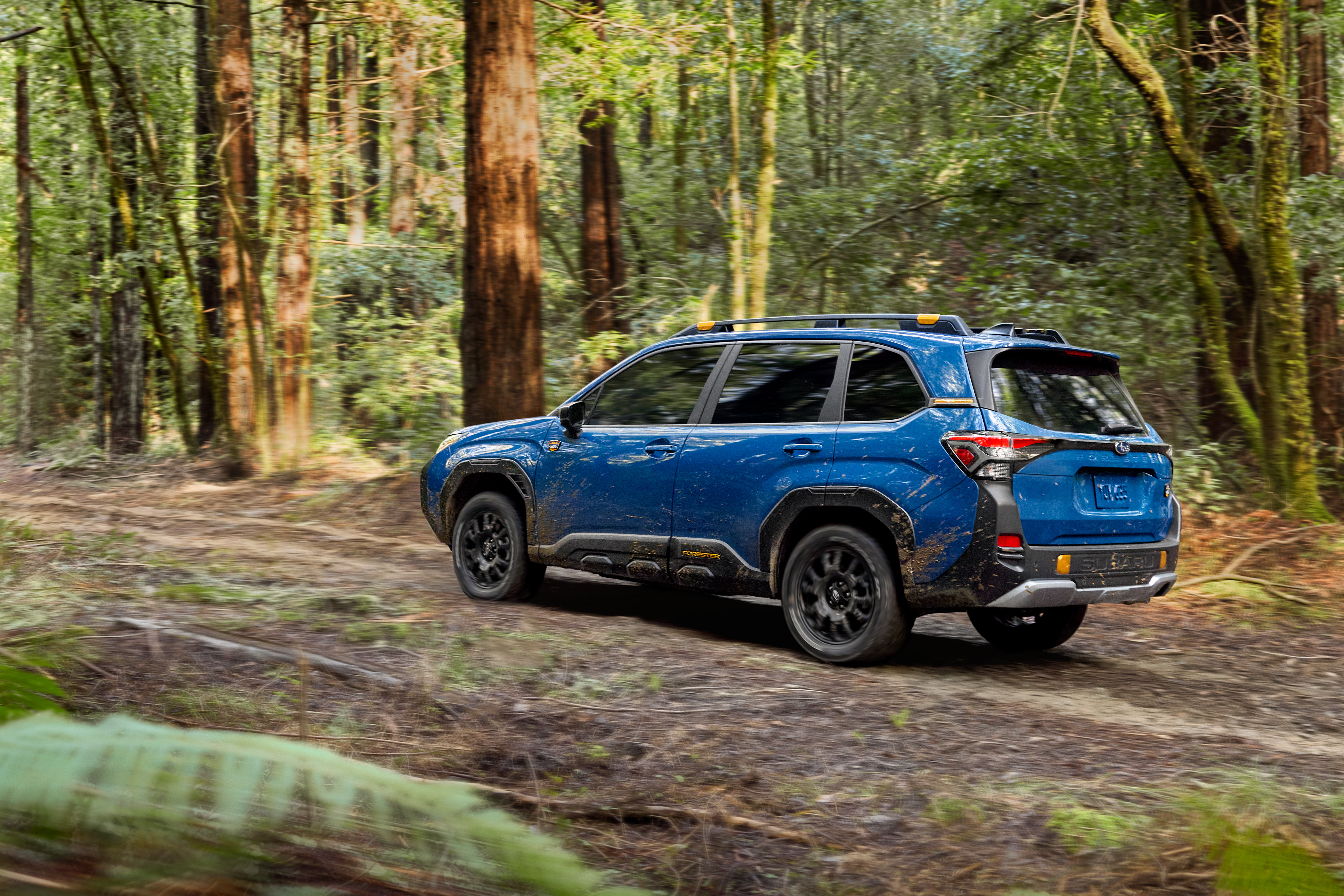
The engineering supports the positioning. The 2026 Forester has standard all-wheel drive and 8.7 inches of ground clearance. Its Wilderness version adds off-road equipment. EyeSight combines driver-assistance functions such as adaptive cruise control, lane support, and pre-collision braking. These are useful answers to ordinary anxieties: a long commute, changing weather, the car ahead stopping suddenly. They assist a driver; they do not remove the driver’s job.
Toyota RAV4, Honda CR-V, Mazda CX-5, and other crossovers compete for much the same household budget. Subaru’s distinction is how consistently its capability, safety messaging, and outdoor identity point toward the same buyer. All-wheel drive alone cannot carry that distinction forever. Nor does every Subaru have it: BRZ uses rear-wheel drive, and Uncharted includes a front-wheel-drive option.
The money follows a familiar automotive pattern: distribute vehicles to retailers, then support ownership with parts and accessories. Retailers sell and lease cars and provide servicing. Subaru’s less ordinary skill is making those transactions feel connected. A dog adoption event in a showroom gives people a reason to enter that has little to do with negotiating a monthly payment.
Love has a line item
A second part of the outdoor promise concerns waste. Subaru says its vehicles are made in zero-landfill plants. Its 2025 sustainability reporting also describes eliminating protective body wrap from domestic vehicle shipping, avoiding 120,000 pounds of single-use plastic annually. Zero landfill measures where factory waste goes; it does not mean manufacturing or driving a vehicle has no environmental cost. The distinction becomes more important as the lineup adds electric models.
The company calls its guiding vision the Love Promise: “show love and respect to all people.” Its community work covers education, health, pets, the environment, and local needs. The phrase could float away without operations underneath it. The annual Share the Love event supplies a mechanism: a purchase or lease directs a donation toward participating charities, including hometown organizations selected by retailers.
For the announced 2026 event, running November 19 through January 4, 2027, Subaru commits $250 per eligible new vehicle when the customer designates a participating charity. Participating retailers contribute at least another $50 to their registered hometown charities for every new vehicle sold or leased during the event. That makes the spending concrete. It is charitable expenditure tied to the sales process, with a local choice built in.
By October 2026, Subaru reported more than $346 million donated through the event over eighteen years. Its new cumulative goal exceeds $360 million; that is a target, not money already delivered. Separately, the 2025 impact report records more than 15,000 employee volunteer hours and $1.6 million donated to Camden County organizations. Those measures describe different activities and should not be added into one impressive-looking total.
*With a participating charity designation. Retailer contributions support registered hometown charities. Program terms apply.

The next test costs $32,995
The strategy has limits visible in the sales sheet. Subaru sold 643,591 U.S. vehicles in 2025, down 3.6 percent. Crosstrek set its own annual record, yet the overall business shrank. In September 2026, monthly sales rose 13.2 percent to 52,056, while the year-to-date total remained below the prior year. Affection does not make a carmaker immune to product cycles or competition.
On October 22, Subaru announced a new entry-level 2027 Outback at $32,995 MSRP, before destination charges, lowering the lineup’s entry price by $2,000. The vehicle was due at retailers later in the year. That is a practical response to affordability pressure: make the familiar proposition easier to buy. Meanwhile, the parent company’s Toyota partnership supports shared sports-car development and electrification.
For a shopper, the sensible next step is almost aggressively ordinary: compare the models, sit in the back seat, and examine the exact equipment list. Someone choosing an EV should check charging access against the journeys they actually make. Someone attracted by Wilderness branding should match its equipment to the roads they use. Subaru gives these buyers a coherent starting point, but the brand story cannot make the choice for them.
The audience existed before the advertising did.
The transferable idea is demanding. Investigate who already values your product, learn the job it performs, and give local operators a repeatable way to serve those people. Copying the dogs and charitable language would be easy. Copying the customer attention takes work. Without useful products, credible follow-through, and prices people can manage, the imagery has very little to pull. Subaru’s next chapter depends on delivering those particulars again.