Jim Farley had been driving somebody else’s car for six months. That was the awkward part. The car was a Xiaomi SU7, an electric sedan from a Chinese company better known for putting phones in pockets. Ford’s chief executive had arranged for one to come from Shanghai to Chicago. By October 2024, he had become rather attached to it.
“I don’t want to give it up,” he said.
A car company ordinarily prefers its chief executive’s enthusiasm to remain within the family. Farley’s had wandered overseas. Yet the confession made sense for an executive whose career has involved an unusually close relationship with the thing being sold. He wanted to drive the competition. The troublesome discovery was that he liked it.
There is a useful way into Farley’s story here. His affection for cars is easy to document. The harder question is what that affection requires when the product you admire belongs to a rival, and the company you run has spent generations teaching customers to love its own badge. Sentiment gets you into the garage. It offers limited assistance with the accounts.
A toy car at the dinner table
As a child, he was Jimmy Car-Car. A toy vehicle accompanied him to church and dinner, an early indication that changing the subject might prove difficult. Born in Buenos Aires in 1962, he had a family connection to Ford long before he had a job there. His grandfather, Emmet E. Tracy, had started at the company in 1913.
During a teenage summer in California, Farley worked in an engine-remanufacturing business and rebuilt a Mustang. Then he drove it back to Michigan without a license. The story has the usual ingredients of youthful independence, with the additional administrative complication that the driver was not yet legally qualified to undertake the journey.
The mechanical work matters as much as the trip. This was a car he had helped make usable, giving him something more intimate than an owner’s appreciation. There were parts that needed attention before there could be freedom. Years before he would sell the idea of mobility, he had learned that the engine needed to run.
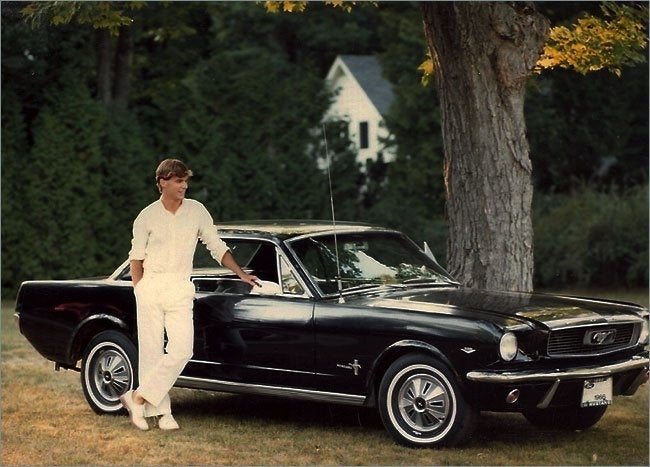
At Georgetown, he switched from government to economics and graduated in 1985. He later earned an MBA at UCLA. Business school also meant work at Hill and Vaughn, the classic-car restoration shop founded by racing driver Phil Hill and collector Ken Vaughn. His assignments included interiors, sewing unusual hides, as well as mechanical work. There are several ways to finance an education. Rebuilding engines and stitching upholstery has the advantage of making the customer’s expectations quite tangible.
The long way back to Dearborn
The grandson of a Ford worker went to Toyota. He joined in 1990 and built his career across strategy, product planning and marketing, working in the United States and Europe. He helped launch Scion, Toyota’s attempt to reach younger American buyers, and eventually became group vice president and general manager of Lexus.
Those jobs placed him in different corners of the same argument. A new youth brand needed a reason to exist. A luxury brand needed customers to believe the experience justified the price. Product planning required decisions well before buyers could deliver their verdict. Farley’s education in the industry took place where engineering, aspiration and a sales transaction meet.
He joined Ford in November 2007. His subsequent assignments included global marketing and sales, Lincoln’s reinvention and introduction in China, European operations, global markets, and new businesses and technology. The marketing executive’s remit kept expanding into the machinery of the company itself.
Farley became chief operating officer in 2020, then succeeded Jim Hackett as president and CEO on October 1. The job gave him responsibility for the institution his grandfather had entered more than a century earlier. It also made inherited affection a practical matter: which products to fund, which customers to pursue, and which assumptions could survive being tested.
- 1990Toyota
Product, planning, marketing - 2007Ford
Arrives from Lexus - 2020Chief executive
Takes office October 1
The stopwatch has no use for a job title
Farley’s attachment to old machinery has never been confined to displaying it. In a 2011 portrait, his commute sometimes involved a modified 1934 Ford coupe with a supercharged flathead engine. His interests ran toward vehicles that demanded attention from the person behind the wheel. The executive parking lot had acquired some volume.
Racing gave that enthusiasm a competitive outlet. In January 2023, at 60, he stepped into professional competition at Daytona in a privately entered Multimatic Mustang GT4. He had already raced vintage cars for years. A new class meant becoming a learner again, with the process visible to anyone watching.
In August 2025, he won the Ken Miles Tribute Race at Laguna Seca in a Shelby Cobra. The result joined a racing life that includes GT40s and a Lola. These are vehicles with histories, demanding enough to keep their drivers occupied with the present. Even a chief executive has to get the corner right.
His curiosity has a quieter outlet in DRIVE, the podcast he launched in May 2022. Dax Shepard was the first guest. Conversations have brought in Jimmy Kimmel, Tom Brady, the Duke of Richmond and others, with cars supplying a route into upbringing, ambition and memory. A first car can reveal a person rather efficiently. It establishes a place, a budget, a measure of independence, and often something that went wrong.
“I learn by talking to people,” Farley said when the show launched. He wanted time to let a conversation develop, something the podcast format could accommodate.
“I learn by talking to people.”
Jim Farley, on launching DRIVE, 2022
The price of changing direction
Listening becomes more complicated when the audience consists of millions of customers who want different things. Ford’s reorganization gave that problem names: Ford Blue for gasoline and hybrid vehicles, Model e for electric vehicles, and Ford Pro for commercial customers. By 2023, the company was reporting the businesses separately.
The divisions make the competing demands easier to see. A household choosing a truck, a fleet operator managing vans and a buyer considering an electric vehicle may all visit Ford, but they bring different calculations. Commercial customers have work to complete. Drivers considering a battery have charging and price questions. The company has to serve them while paying for the next generation.
- Ford Blue
- Gasoline & hybrids
- Model e
- Electric vehicles
- Ford Pro
- Commercial vehicles & services
The arithmetic became particularly uncomfortable in December 2025. Ford announced a shift of capital toward trucks, hybrids, affordable electric vehicles and battery storage. It expected about $19.5 billion in special items, mostly in the fourth quarter of 2025, with the remainder in 2026 and 2027. Approximately $5.5 billion was expected to involve cash effects. Those figures describe an announced reset, rather than an annual operating loss.
The reset included moving the next F-150 Lightning toward extended-range electric technology. Ford’s ambitions for electrification were changing shape, along with its judgment about where customers would pay and where the business could earn a return. For Farley, the product enthusiast’s appetite had to meet the operator’s obligation to stop spending on the wrong plan.
Approximate special items Ford expected in its December 2025 EV-related reset.
ANNOUNCED ESTIMATE · SPREAD ACROSS 2025–2027Another wager was already taking form in Louisville. In August 2025, Farley described a manufacturing system for a new affordable EV platform. The proposed assembly process had three branches: one for the front, another for the rear, and a third for the structural battery with interior components already fitted. The branches would meet near the end.
Ford targeted a midsize electric pickup for 2027, with a starting price around $30,000. Those were promises about a future vehicle. Their significance lay in what Ford was trying to change underneath it: the cost and method of production. Making an electric vehicle attractive was only part of the assignment. Making one affordable required attention to the factory as well.
By late September 2026, Farley was publicly arguing that competition from China required a complete reinvention. The driver who had enjoyed the Xiaomi was now describing an industrial problem. Admiration had become an uncomfortable form of homework.
The badge on the desk
Farley’s public concerns also extend to the people who build and repair things. He has argued for greater attention to the “essential economy,” drawing on his own restoration-shop experience. On DRIVE in May 2026, he and Mike Rowe discussed skilled-worker shortages, apprenticeships and respect for hands-on work. The conversation connected the tools of his early jobs with the workforce his company and its customers need.
In Detroit, he chaired the capital campaign for the Pope Francis Center’s Bridge Housing Campus, a $40 million project that opened in June 2024. Its 40 studio apartments provide a stage between life on the street and permanent housing. The work gives his connection to the city a purpose beyond selling vehicles.
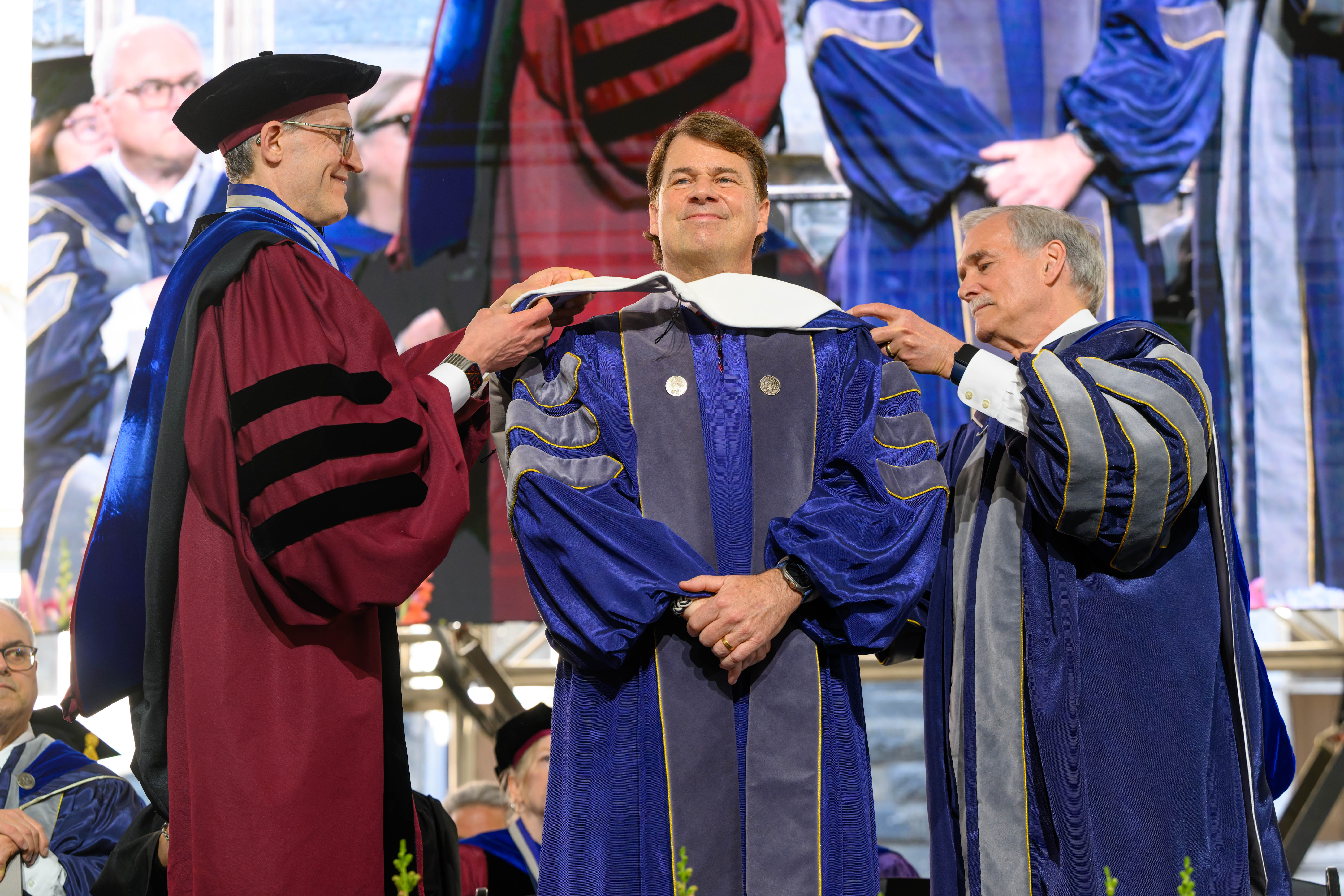
That May, he returned to Georgetown to address its graduating class. He spoke about learning to enjoy difficult problems and about Jan Karski, the professor whose example had stayed with him. He also described the objects on his desk: his grandfather’s Ford badge and photograph. The family history had acquired a very small, very physical form.
There is plenty of history available to a Ford CEO. Farley has chosen to keep a worker’s badge within reach. It makes a useful companion to the racing trophies and the product plans. Cars begin as things people imagine, become things people build, and eventually have to earn the affection of someone who can choose another car. Farley has spent his life moving between those stages. He now has to make them add up.