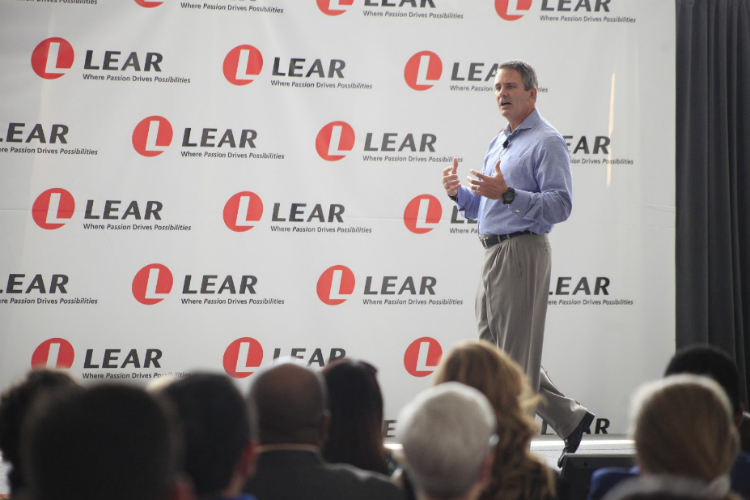
When Ray Scott returned to Flint for the opening of Lear’s seating plant in August 2018, the location carried a family history. His mother and father had worked for Buick. During college, he had worked at a terminal serving Buick City, and at GM’s Truck and Bus operation. Now Lear was building seats near the ground that had helped shape his own working life. For most chief executives, a plant opening comes with a map. Scott arrived with memories.
He had become Lear’s president and CEO that March, after joining the company in 1988. Thirty years inside one supplier had taken him through sales, customer accounts, European assignments and leadership of both its principal businesses. Yet this particular stop brought him back to a much smaller geography: the city where he had grown up, and the people whose work he understood before he had a corporate title.
Scott described Flint as part of his identity when he explained his attachment to the city at the opening. His explanation was brief enough to escape the usual ceremony. Around him, a factory was beginning to give that attachment an industrial shape: seats to make, teams to hire, trucks waiting at the other end of the supply chain.
The address mattered
Lear celebrated the opening on August 11, 2018, with employees, families, customers and local officials. The 156,000-square-foot plant was expected to employ about 600 people by the end of 2019, including more than 400 new hires. Those were the ambitions announced at the opening, rather than a retrospective count. The distinction matters in a city where promises about jobs have a history of their own.
The site occupied part of the former Buick City property. Lear planned just-in-time seat deliveries to GM assembly operations, giving the new building a practical reason to be there alongside the personal one. Manufacturing geography has an unsentimental side: a seat has to arrive when an assembly line needs it. Affection for an address becomes more durable when the delivery schedule agrees.
The plant also carried an experiment in responsibility. Associates were to help manage aspects of their teams, including hiring and quality assurance. Lear described open meeting spaces and a work environment designed around collaboration. For Scott, whose business depends on thousands of people executing closely linked tasks, this made employee involvement a question of how the factory would operate.
The investment belonged to a company and its workforce, with public support also part of the project. Michigan backed Lear’s $29.3 million investment with a $4.35 million performance-based grant. Scott’s connection gave the opening emotional weight; the economics and the work would have to sustain it. A ribbon, however photogenic, cannot assemble a seat.
by the end of 2019
within that total
Thirty years before the corner office
Scott’s route through Lear helps explain the mix of sentiment and operating detail. He started in 1988 and built experience in program management and sales. Later positions put him in charge of customer businesses associated with General Motors and Fiat, as well as operations and leadership assignments in Europe. He learned the supplier from several angles before being asked to run it.
He also accumulated a formal business education: an economics degree from the University of Michigan and an MBA from Michigan State’s Advanced Management Program, followed by executive education at Stanford and Wharton. The combination fits the territory he would eventually cover. Economics asks how resources are allocated. Automotive customers tend to ask the same question with a firmer delivery date.
In 2011, Scott became executive vice president and president of Seating. He had previously led the electrical business now called E-Systems. When Lear announced him as Matt Simoncini’s successor in November 2017, the board emphasized his experience across both divisions and his knowledge of customers, products, employees and global operations. He was being promoted from within a business he had already seen at close range.
The transition became effective in March 2018. Simoncini remained available as an adviser through the end of that year. There was continuity in the arrangement, and a considerable assignment for the successor: keep two different manufacturing businesses moving while the products their customers wanted were changing. Scott’s preparation had been lengthy. The industry was unlikely to reward him with a quiet introductory period.
- 1988Joins Lear
- 2011Leads Seating, after E-Systems
- 2018Becomes president & CEO
- 2024-25WIP and StoneShield acquisitions
A seat has become a systems problem
Lear’s two businesses sit unusually close to the driver’s everyday experience. Seating supplies the place where a passenger settles in. E-Systems supplies electrical distribution and electronic capabilities that help the vehicle function. Scott had led each separately before taking responsibility for both, a useful background as comfort features and electronics became more intertwined.
ComfortMax offers a concrete example. In February 2025, Lear announced an engineering integration with General Motors, scheduled to begin in the second quarter, that placed thermal comfort technologies into seat trim covers. Scott linked the development to customer satisfaction and simpler manufacturing. The promise involved how the seat felt and how it was made, joining two concerns that can otherwise arrive at different meetings.
The electrical side has its own version of simplification. Lear’s Zone Control Module with Algorithmic Circuit Protection received a 2025 Automotive News PACE Award. It supports vehicle architectures organized around physical zones and uses software-based protection in place of conventional hardware fuses. The award recognized a company technology, developed by its teams. It also illustrated the kind of product business Scott was responsible for steering.
By February 2026, his Autoline After Hours conversation ranged across seating, China, wiring harnesses and zonal computing. The range was revealing. A supplier executive must follow the seat covering and the electrical architecture, the customer’s purchasing decision and the factory’s ability to deliver. There is no especially glamorous name for keeping those subjects connected. Doing so occupies a good deal of the job.
“It’s where I grew up. It’s a part of who I am.”Ray Scott, on Flint
Buying a better way to make it
Scott’s more recent strategy has given manufacturing technology a prominent place. Lear calls the approach IDEA: Innovative, Digital, Engineered and Automated. In his own public explanation in 2024, he connected it to product development, profitability and the use of advanced technology in operations. The acronym is tidy. The work underneath it involves considerably more machinery.
Lear agreed to buy Spain’s WIP Industrial Automation in April 2024 and completed the acquisition that July. WIP brought robotics and AI-based computer vision capabilities. It joined earlier automation investments in ASI, Thagora and InTouch. The purpose was to build up the company’s ability to improve its production processes, rather than depend entirely on capabilities bought one factory project at a time.
Another purchase followed in February 2025: StoneShield Engineering in Castelo Branco, Portugal. Its specialties included wire harness automation, robotic systems, automated taping and high-voltage harness assembly. Scott described the intention plainly: accelerate automation in E-Systems and develop additional production technology. This was an investment in the method of making a product as much as in the product itself.
For a business so closely tied to customers’ production schedules, those methods have commercial consequences. A clever component still needs a repeatable manufacturing process. The acquisitions show where Scott has chosen to place resources, while the eventual results depend on implementation across Lear’s operations. Announcing the purchase is the brief part; making the equipment useful is where the calendar fills up.
The numbers keep their own counsel
The financial record supplies some friction to a comfortable success story. Lear reported revenue of $23.3 billion for 2024, compared with $23.5 billion in 2023. Net income declined to $507 million from $573 million. At the same time, E-Systems margins improved for a second consecutive year. A business can make progress in one part of its operation while the total result moves in the other direction.
By the second quarter of 2026, revenue reached $6.2 billion, up 3 percent from a year earlier, and net income was $193 million, up from $165 million. Lear raised the midpoints of its full-year outlook. Global vehicle production was flat over the quarter, while production on Lear’s particular mix of platforms continued to matter to its results.
These are company outcomes, produced across plants, engineering groups and customer programs. They give a more useful measure of Scott’s assignment than a heroic account of individual leadership would. His strategy has to survive changing production volumes, pricing negotiations and the cost of running the network. The income statement grants no extra allowance for having an appealing hometown story.
A larger map, with Flint still on it
Scott’s public responsibilities extend beyond Lear. He joined Penske Automotive Group’s board in 2025. He also serves on Kettering University’s board of trustees in Flint, preserving an institutional connection to the city alongside the manufacturing one. In 2024, the University of Michigan-Flint announced him as the keynote speaker for its School of Management anniversary business summit.
In Detroit, his community connections include the Pope Francis Center, where he is a board member. He and his wife, Maria, chaired the Capuchin Soup Kitchen’s 2019 SOCK Dinner. These are specific commitments with organizations and dates attached. They put some substance behind the frequently repeated corporate idea that a company has obligations to the communities around it.
There is also a small, useful picture of Scott’s organization in action. At a leadership gathering attended by David Novak, the hotel lost power. Lear’s team moved the meeting outside and had people set up within 45 minutes. Scott credited the team. For a company in the electrical business, the interruption supplied an excellent opportunity for everyone else to make the obvious joke.
The Flint plant offers the more lasting picture. Scott’s career had taken him through international assignments and into the CEO’s office, then brought him back to familiar industrial ground. His parents had worked for Buick; he had worked there too. A new workforce now had its own reasons to arrive. The address remained part of his story, while the work inside gave other people a story of their own.