Joseph Fadool wanted to get off the road. His work involved enough travel that he had missed his son’s birthday two years running. When he raised the problem with his boss, the answer was a manufacturing assignment in Huntsville: a unionized plant, a turnaround, a billion-dollar business. It was an imposing way to arrange dinner at home.
He took it. Looking back in a 2026 conversation with Devin Frosheiser, he described the assignment as a turning point that gave him the operating experience behind his eventual move to BorgWarner. The personal decision and the professional opportunity arrived together. His route to running an automotive supplier included an attempt to spend less time travelling for work.
There is a pleasing complication here for anyone who draws careers as ascending arrows. A change made for family reasons can broaden a career. An assignment that looks like a detour can supply the experience a later job requires. Fadool’s story has room for both ambition and a calendar.
A Ford engineer, with other doors to open
Before the global responsibilities came a fairly local ambition. Fadool grew up in East Dearborn, near Ford, tinkering with small engines and the go-karts his brother built. He wanted to become an engineer there. After graduating from Lawrence Technological University, he got his wish.
His education fits the industry’s growing reliance on electronics: a bachelor’s degree in electrical engineering, followed by a master’s in computer and electronic controls at Wayne State University. At Ford, he spent seven years in product development and worked on vehicle launches. He subsequently moved into the supplier business, with responsibilities at Siemens VDO Automotive and Continental spanning sales, program management, general management and operations.
That sequence matters because each function asks a different question. Engineering asks whether something works. Sales asks whether someone will buy it. A launch asks whether it can arrive on time. Operations asks whether it can arrive again tomorrow, and the day after that, at the agreed quality and cost. Running the whole business requires making those answers agree.
Electrical engineering → sales and programs → factory operations → business leadership
A career crossing functions before taking responsibility for the company.Fadool also talks publicly about an assignment that went wrong. He took a role before he was ready, missed launch deadlines and was removed from it. It is a useful detail in an executive biography: a failure with an actual consequence. Later success did not require the earlier episode to disappear.
Fourteen years before the announcement
He joined BorgWarner in 2010. The titles that followed describe a long apprenticeship across the company’s products. From May 2012, he led Morse TEC; from July 2015, he led the business doing business as Morse Systems. In January 2017, his responsibilities encompassed emissions and thermal systems. Turbo systems followed in 2019.
These are functional names rather than glamorous ones. They concern the movement of air, heat and power, the arrangements that make a vehicle’s performance possible. A driver generally notices the car. Someone inside a supplier has to notice the component, the production process and the customer program behind it.
In May 2024, BorgWarner announced his promotion to executive vice president and chief operating officer, effective July 1. Business unit presidents would report to him. Frédéric Lissalde, then CEO, pointed to Fadool’s understanding of technology development and commercialization, alongside his work strengthening relationships with automakers.
- 2010Joins BorgWarner
- 2012–19Leads successive product businesses
- July 2024Becomes chief operating officer
- February 2025Becomes president and CEO
The succession announcement came that November. Fadool would become president, CEO and a board member at the close of business on February 6, 2025. He described Lissalde as a mentor: “Fred has been an incredible mentor to me.” His stated priorities included the product portfolio, competitive costs and support for teams around the world.
Moving from a business unit to the whole company changes the size of the question. A product leader can concentrate on a particular market and its customers. A chief executive must decide how those businesses fit together, where to commit resources and how much uncertainty each investment can carry. The operating history supplies context; the responsibility still changes.
There was continuity in the appointment. He knew businesses from inside the operating structure before taking responsibility for all of them. That does not settle the decisions a CEO must make. It does give him a history with the people and products affected by those decisions.
“Fred has been an incredible mentor to me.”
Joseph Fadool, on succeeding Frédéric Lissalde
A silver trophy and the work behind it
Shortly before taking the top job, Fadool stood between Josef Newgarden and Roger Penske at the Henry Ford Museum of American Innovation. BorgWarner was presenting the miniature Indianapolis 500 trophies known as Baby Borgs. Newgarden was receiving his second; Penske was receiving his twentieth team owner’s trophy.
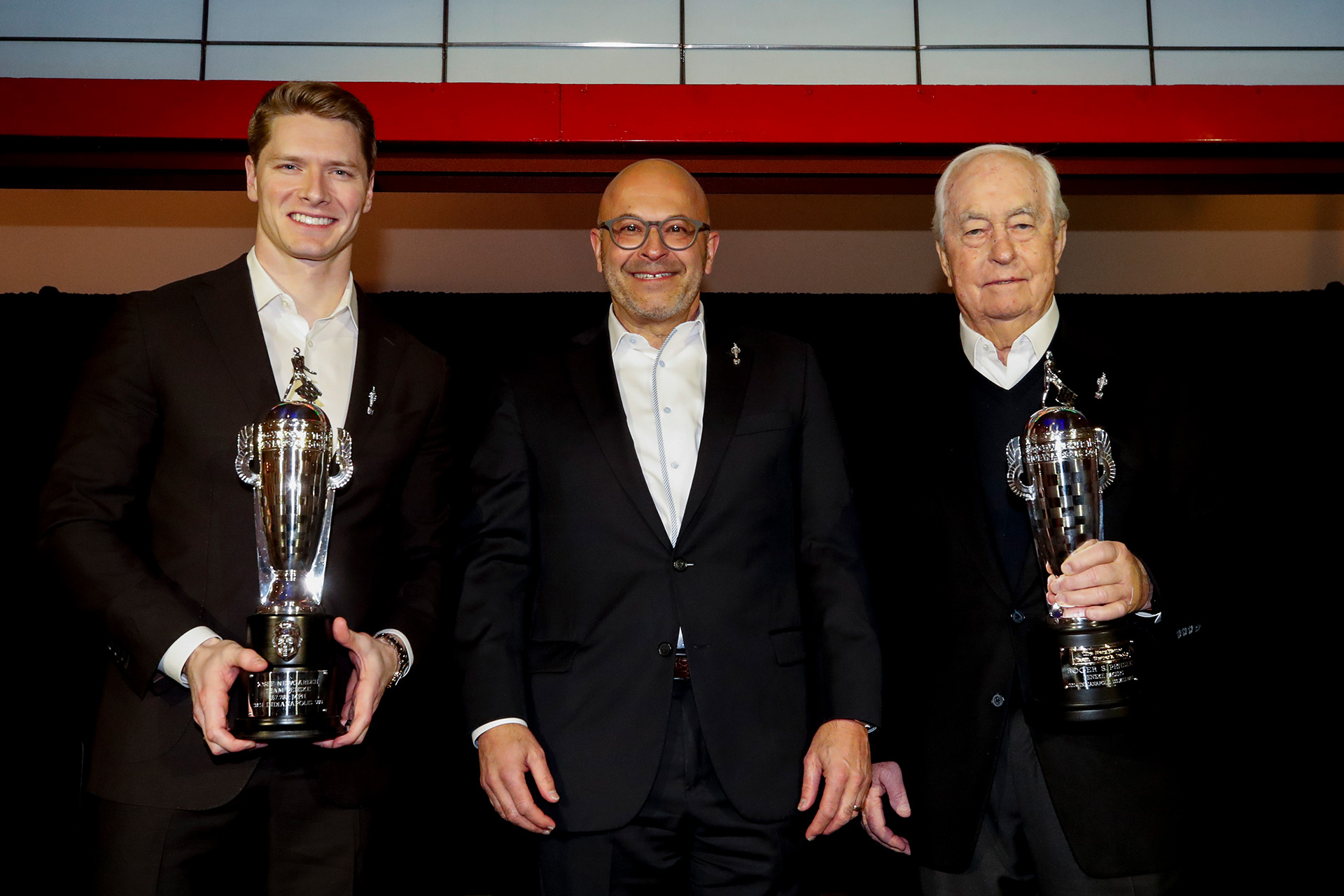
A presentation like this gives an industrial company a public face. Most of its work travels inside somebody else’s vehicle, behind a badge with another name. The trophy brings BorgWarner into the picture. Fadool stands beside the driver and team owner, representing the company whose name the award carries.
The word “Baby” does some work here: the driver’s award is a 20-inch version of the full Borg-Warner Trophy. It carries a name, a team, an average speed and a sculpted likeness. Manufacturing companies rarely get to make their achievements quite so literal.
Fadool’s job also involves celebrations that are less likely to be televised. In 2025, Ford recognized BorgWarner’s Arden team for its response to Hurricane Helene. The North Carolina plant had delivered customer products on time and returned to full production in 11 days. The Ithaca team also received a nomination for collaboration.
The recognition brought his career back to Ford, now from the supplier’s side. He credited the teams’ work and the value they delivered to their customer. The useful number was 11 days. It made the operating achievement comprehensible without a tour of the factory.
What speed means when you make things
In a June 2026 interview, Fadool argued that speed had become a competitive advantage alongside innovation. His description was specific: decisions routed through distant global centers can lose time and local understanding. Regions need enough authority and expertise to respond to their own customers.
He gave the example of turbochargers adapted for China, where different driving conditions allowed a different design and lower cost. The point was to match engineering to the use. A common design can deliver scale; it can also carry requirements a customer does not need to pay for.
“Leadership has to start by accepting the uncertainty,” he said. His answer involved planning for several scenarios, maintaining flexibility and giving people clarity about priorities. That is a demanding combination for a supplier: develop products with long lead times while customers reconsider what they will build.
A choice that is difficult to reverse deserves careful consideration.
A reversible choice gives a team room to act, learn and adjust.
On Autoline After Hours that May, he described competing in China as a way to sharpen the company. Faster development and tough competition were reasons to participate. He also remained committed to electrification over the longer term, while pointing to affordability and charging infrastructure as practical constraints.
The argument is easy to state and harder to organize. A company needs people to share what they know across borders, while allowing local teams to respond to differences. Too much distance can delay an answer. Too little coordination can waste an advantage. His emphasis on operating responsibility puts that tension inside the business, where it has to be managed.
For a CEO with responsibilities across combustion, hybrids and electric propulsion, that means holding several customer needs in view at once. The product plan has to accommodate what people buy, where they buy it and how quickly their preferences change.
The next customer may run a data center
One of the more revealing developments of his tenure takes BorgWarner beyond vehicles. In February 2026, the company announced a master supply agreement with TurboCell, part of Endeavour, for a modular turbine generator system aimed at data centers and other microgrid uses.
The connection is technical. Turbocharging, thermal management, power electronics, controls and high-speed rotating electric machinery are capabilities the company already has. Combined differently, they can serve a customer whose pressing question is how to power computing equipment.
BorgWarner said it expected production to begin in Hendersonville, North Carolina, in 2027, with an initial two gigawatts of installed capacity. Those were plans, with manufacturing still ahead. For Fadool, the work extends a familiar problem into another market: connecting engineering capability to a product that customers can actually use.
In September 2026, his message accompanying BorgWarner’s sustainability reporting tied environmental priorities to the business strategy. The connection runs through the same practical work: developing more efficient technologies and reducing the impact of operations. For an engineer running a supplier, an aspiration eventually has to reach a design decision, a production process or a customer program. Those are the places where a company can turn a stated direction into something measurable.
A guitar, a bowling club, a longer view
Back at Catholic Central for an April 2026 podcast, the conversation had a different scale. Fadool, a member of the class of 1984, remembered joining the bowling club. He had also been a diver, and he still picked up the guitar, an instrument a school friend had begun teaching him as a teenager.
Those details give the executive chronology some air. The boy who wanted a Ford engineering job did not begin with a plan for every later title. Sales, programs and a factory widened the possibilities. Even the request for less travel became part of the preparation.
His story leaves a practical question for an ambitious reader: what experience is the next job supposed to give you? Fadool’s career offers several answers. One of them came from a plant in Huntsville. Another was waiting at the dinner table.
Watch, listen, follow
- Autoline After Hours: Fadool on competition, China and propulsion - video
- Talk Real Shift: career decisions and factory experience
- Slightly Less Scripted: returning to Catholic Central
- Joseph Fadool on LinkedIn
- BorgWarner · Company YouTube channel
- The CTI interview: speed, local decisions and engineering