In January 2009, Tom Tan was asked when a new transmission would reach a Chinese car. His answer contained a small rebuke to the impatient: development generally took three years. There was a planned application, a timetable and a customer. There was also the stubborn business of making machinery work. A motor show could announce the future in an afternoon. A production programme needed rather longer.
Tan was then president of BorgWarner China, explaining dual-clutch transmission technology and its prospects among domestic manufacturers. The conversation moved between affordability, technical choices and the time required to bring a system to market. He resisted declaring a universal winner among competing designs. Commercial use would provide the test. For an executive selling technology, it was a useful willingness to leave the verdict to the road.
That exchange offers a way into his career. The finished car attracts the photographs. Tan’s working world has been the machinery underneath, the business arrangements around it and the people required to get it built. Follow those details and his story becomes a close view of how an automotive market changes its capabilities.
A promotion measured in factory arithmetic
Tan joined BorgWarner in 1995 in the finance organisation of its torque management business. His early assignments included finance director at the Beijing joint venture, Asia finance responsibilities and business development. In 2003, he became general manager of the Beijing operation. By the time his promotion to China president was announced in January 2008, the company credited his leadership with sevenfold sales growth over the preceding years.
The new appointment carried a revealing job description. Tan would handle customer and government relationships, lead headquarters functions and shared services, and chair the China management council. He would also sit on the technical centre’s management committee. The remit connected commercial diplomacy with the less theatrical work of coordination. Somebody had to make the separate operations behave like a business.
The numbers explain the promotion; the responsibilities explain what followed. Growth created more points of contact, more decisions and more opportunities for different parts of the organisation to misunderstand one another. A country president’s work extended well beyond standing beside the newest product.
Two educations, several operating languages
His preparation crossed disciplines and countries. Tan earned an engineering diploma at Tongji University in Shanghai and an MBA at the University of St. Thomas in St. Paul, Minnesota. His later executive education included Kellogg’s Advanced Management Program and programmes at Oxford, INSEAD and Stanford. The combination placed engineering, finance and management in the same professional toolkit.
Before BorgWarner, he held management positions at United Technologies and Shanghai International Investment and Trust Corporation. His work covered programme management, business development, international trade and foreign direct investment. Within BorgWarner, subsequent responsibilities stretched across transmission systems, drivetrain operations, turbocharging and emissions systems in China.
Those appointments matter because the boundary between a good component and a viable business is crowded. Engineering has its requirements; finance has its calculations; customers have their production schedules. Tan’s career repeatedly put him where those conversations meet. The varied résumé gives substance to a title that can otherwise sound mostly ceremonial.
The gearbox learns to share
The transmission project also had an unusual commercial structure. BorgWarner’s Chinese partner, CDUI, brought together a consortium of domestic automakers. A supplier was developing core modules for companies that would compete for the driver’s money. Shared industrial capability could coexist with competition in the showroom. The arrangement made cooperation an operating necessity rather than an agreeable word in a speech.
By 2019, the Dalian joint venture had a concrete anniversary present: its three-millionth dual-clutch module. The earlier landmark had been 30,000 in 2014. BorgWarner held 66 percent of the venture and CDUI 34 percent. The achievement belonged to an organisation of customers, employees and partners; it should not be mistaken for one executive’s personal production tally.
Tan used the occasion to discuss the next application, including components for P2 hybrid architectures. An anniversary might invite nostalgia. Here it also became a discussion about what the existing manufacturing base could do next. The gearbox had acquired a second career possibility.
An electric future, with room for drivers
By January 2017, Tan was discussing a broader change in the market. He expected China’s automotive industry to continue expanding, though more slowly than during its earlier double-digit growth. The interesting question was becoming the mix of vehicles and the ways people would use them, alongside the number sold.
Asked about autonomous driving, ride-hailing and demand for car ownership, he allowed for some reduction in private ownership, particularly in cities where parking was costly and troublesome. He also expected many people to keep wanting a vehicle of their own. His explanation included the enjoyment of driving and the social meaning attached to ownership.
It was a human complication in a discussion easily dominated by technology. A vehicle can be a means of transport, a purchase someone has waited years to make, and a pleasure its owner is reluctant to surrender. Tan’s answer left space for those motives. The future could contain more sharing without everyone immediately handing back the keys.
“There is a social meaning to car ownership that won’t quickly change.”Tom Tan, 2017
From exhibition stand to customer programme
At Auto Shanghai in April 2017, BorgWarner displayed products for combustion engines, hybrids and electric vehicles together. Particular attention went to 48-volt hybrids and pure electric applications. The exhibits included an electric drive module, an electrically driven compressor and products for P2 hybrids. Tan publicly identified electrification as a major trend in China.
The range is significant. An established supplier had to serve customers developing different propulsion systems at different speeds. The electric opportunity arrived alongside continuing engineering work on the vehicles already being made. The exhibition stand gave that overlap a physical shape: several routes through the transition, all requiring parts.
A more specific commercial example arrived in September 2018, when BorgWarner announced a three-year strategic cooperation agreement with WM Motor. Its electric drive module would power the EX5, combining an electric motor and transmission in an integrated package. Tan described the agreement as an expansion of the company’s participation in China’s new-energy vehicle market. Here was a customer programme behind the general direction of travel.
The quieter revolution inside the box
In August 2021, another announcement moved the story into power electronics. BorgWarner had dual-inverter projects with Great Wall Motor and a second Chinese automaker. The Great Wall application covered hybrid and plug-in hybrid versions of the LEMON platform; the other programme was planned for 2023 models. Tan connected the contracts to the confidence customers had developed in the company’s electrified applications.
A dual inverter can control two electric motors in a single unit. In the announced system, combining functions offered packaging, weight and installation advantages. For the driver, the machinery largely disappears into the experience of the vehicle. For the supplier, fitting the required functions into the available space is the assignment.
That same year, the Auto Shanghai product list included drive modules, inverters, controllers, motors, batteries and coolant heaters. Tan’s public discussion now covered an increasingly electrical set of components. The vocabulary of his work had travelled a considerable distance from the transmission interview of 2009, even while the underlying problem of making systems work together remained familiar.
Someone still has to train the next manager
The people question runs through Tan’s account of growth. In an extended interview published by Multinationals in China, he discussed a graduate programme launched in 2012. Recruits received professional and management training, with rotations across plants, regions and countries during their first two years. He also described sending employees abroad to gain experience of other working cultures.
The purpose was practical: develop managers capable of operating internationally. Local recruitment and global responsibility could be parts of the same progression. A growing operation needed people who understood its customers and could also work with colleagues elsewhere in the company.
By January 2023, BorgWarner had received Top Employer China certification for a fifth consecutive year. Its employee initiatives included a feedback survey and a recognition platform. Tan’s accompanying remarks emphasised culture, collaboration and a dependable talent pipeline. Certification is an organisational distinction. In his career story, it also shows how consistently the work of developing people sat beside the work of developing products.
A different chair at the table
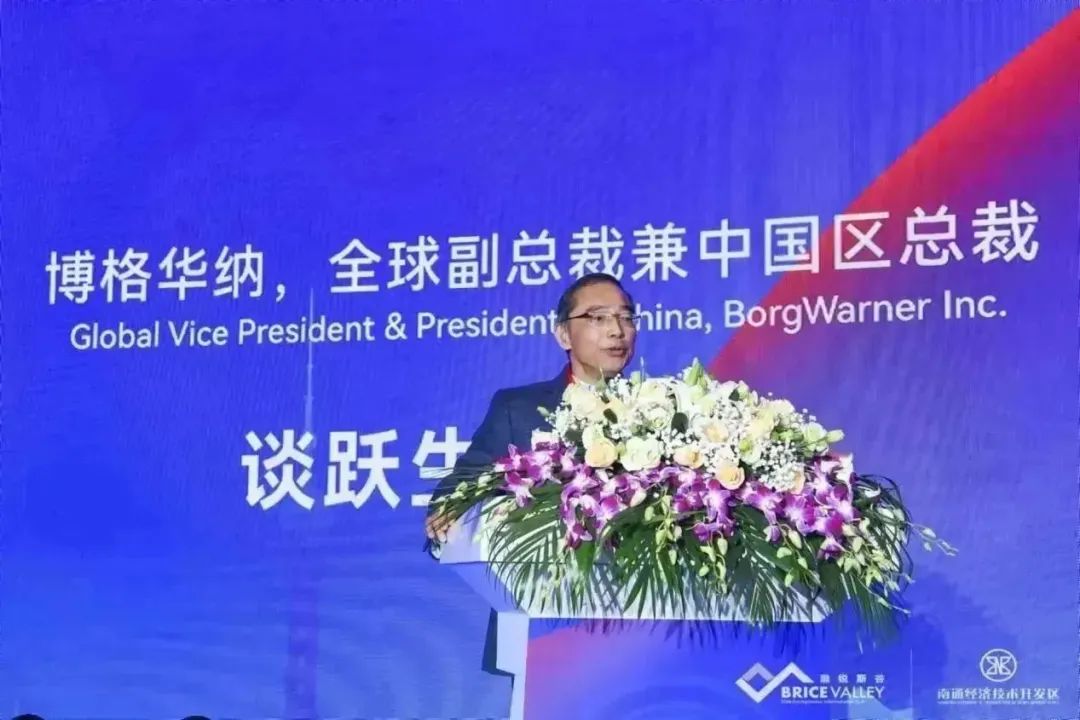
In March 2024, Tan appeared in coverage of a forum on cooperation between Chinese companies and multinationals. The gathering brought together more than 260 professionals. His roundtable considered how multinational capabilities could contribute to sustainable development in China. The discussion also addressed the talent needed for global operations, a concern already visible in his earlier comments about managerial training.
Later that year, his role changed. A November 2024 corporate filing identified him as adviser to BorgWarner’s global CEO and recorded that his tenure as global vice president and China president had ended before July 1, 2024. Separate board work continued: Shanzi High Technology’s 2025 annual report, published in April 2026, listed him as an independent director.
The change in title gives the story a fitting pause. The early finance assignments, the Beijing operation, the transmission partnerships and the electrical programmes all remain part of the experience he brings to an advisory role. Tan’s career has repeatedly returned to the interval between an idea and something a customer can use. In that interval, three years can pass surprisingly quickly.