The restaurant had customers, a menu and a working kitchen. What it lacked was a particular hour. In a 2020 interview, Shiheng CEO Wang Taizhou described an early assignment for Taoyuan Village, the Taiwanese-style restaurant brand. The team spotted demand for breakfast and proposed opening a morning service window beyond the usual schedule. That required conversations with the restaurant and its property management. After the change, he said, breakfast accounted for one-third of that store’s daily orders.
- Restaurant software for orders, money, ingredients and delivery.
- Built around chain headquarters and franchise control.
- Combines operating services with connected software.
The hour the restaurant forgot
There is something pleasingly unglamorous about this origin story. The intervention was an earlier opening time. Finding it required looking beyond the dining room. Shiheng had spent about six months winning its first customer, working through packaging, staff procedures, pickup routes, prices and menu combinations. An online listing was the beginning of the assignment. The useful work happened in the arrangements behind it.
Founded in Shanghai in 2017, 食亨科技 Shiheng Technology entered a gap between delivery platforms and restaurant operators. The platforms could gather consumers. A restaurant still had to choose what to sell, present it sensibly, prepare it on time and handle the consequences when something went wrong. Shiheng offered to do that operating work.
A sale is only the start
Today, its website organizes the job around money, goods and operations. That is a revealing choice of language. A generic analytics company sells the ability to see patterns. Shiheng also sells ways to act on the transactions that create those patterns: collect revenue, allocate payments, replenish stock and notice when a store stops taking delivery orders.
Its Smart Store product brings together point-of-sale functions, orders, kitchen coordination, memberships and headquarters reporting. Delivery Link gathers operating information across platforms including Meituan, Taobao Instant Commerce and JD, with tools for alerts and reviews. The practical promise is that the operator can spend less time switching accounts and more time deciding which store or time slot needs attention.
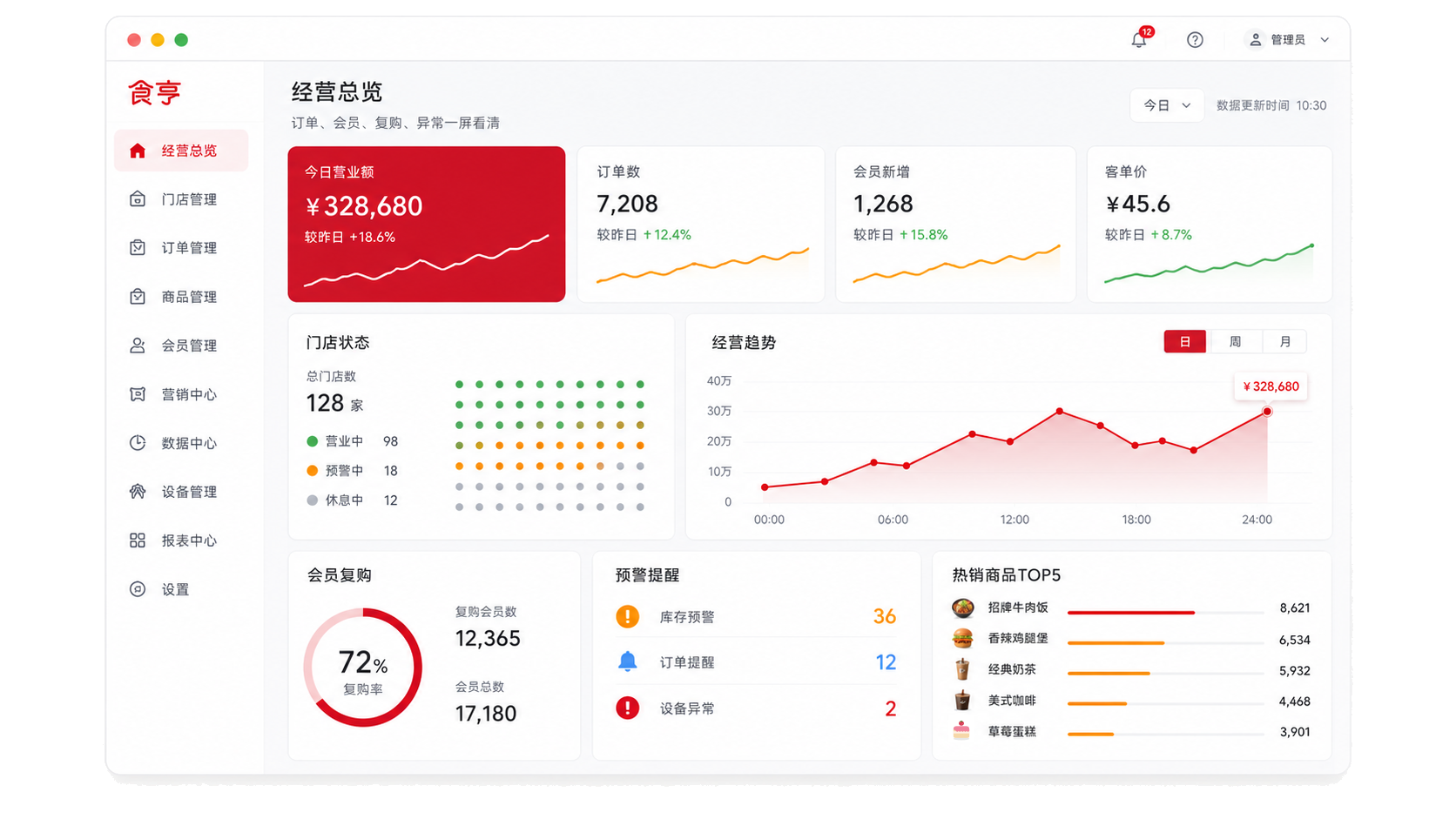
The company reports serving more than 6,000 brands and 200,000 stores across over 240 cities and regions. Those are company figures, useful as an indication of claimed reach rather than an independent count. The current emphasis is Chinese restaurant franchises, although its earlier delivery work also covered retail brands.
The franchise problem has three moving parts
Consider what headquarters needs to know after a franchise store sells a drink. The order belongs in the sales record. The proceeds may need to be divided. The ingredients will eventually need replacing. When those events sit in separate systems, staff must reconstruct the relationship. Shiheng’s positioning rests on connecting them.
Headquarters sets the rules. Stores produce the records.
The settlement product covers revenue collection, platform deductions, payment confirmation and rule-based allocation. Ordering Link handles purchasing rules, replenishment and checks between purchases and sales. It accommodates centralized warehouse delivery, cross-docking and direct supplier delivery. These are different jobs, but a franchise can encounter all of them before the next lunch rush.
Shiheng’s Huaxiaoxiao case makes the connection concrete. The rice-noodle chain’s management fees had involved manual collection. The published solution places fee deductions and daily allocation inside the payment workflow, alongside store permissions and ingredient purchasing controls. The change moves work from chasing money afterward to applying an agreed rule when money flows.
Other customer cases show different versions of the same problem. LINLEE’s tea business combines fragmented ordering channels with fast-moving, short-shelf-life ingredients. Tastien’s burger network needs coordination across stores, regions and warehouses. Shiheng presents both as customers for its connected store, settlement and purchasing suite. Their published network sizes describe the brands, not a verified count of Shiheng installations.
Software with someone on the other end
By 2021, Wang was publicly describing a SaaS-plus-services approach. Operating methods learned with customers could become software; customers could also receive help using them. That is the company’s commercial proposition: business software accompanied by customer-success work and, where needed, managed operations.
The distinction matters when a delivery storefront is accidentally closed. An alert identifies the problem. Someone still has to contact the manager and get orders flowing again. Shiheng’s managed delivery service describes precisely that kind of follow-through, along with menu work, promotions, review handling and recurring reports. Its in-store growth service also works with Meituan and Dianping.
Alternatives include assembling specialist systems or keeping operating teams in-house. Shiheng argues for integration. For a buyer, the useful comparison is whether the connections remove enough reconciliation and follow-up work to justify adopting the suite.
Growth has a bill
The company’s expansion attracted reported funding rounds in March and October 2018, each above RMB 100 million. A February 2019 round, variously labeled B+ or B2, raised tens of millions of dollars from SoftBank Ventures Asia. These are financing figures, separate from restaurant sales processed through the service.
Capital did not settle every management question. In an April 2025 interview, COO Zhang Wei acknowledged room to improve early expansion spending, concentrate on core work and control acquisition costs. He also described greater emphasis on developing staff internally. His advice to his younger self was compact:
“Focus.”Zhang Wei, April 2025 interview
Translated from Chinese
For prospective customers, the Starlight program offers Smart Store system usage free for an eligible brand’s first three stores. Payment fees remain separate, and allocation and policy conditions apply. The offer gives a small operator a way to test the system before building a larger commitment.
Copy the question before the software
The breakfast example offers a practical habit: examine demand by time slot, test a change and measure the result. A morning window only helps if staffing, kitchen capacity and property arrangements support it. Likewise, connected franchise software needs consistent records, agreed rules and people prepared to respond. Shiheng’s story rewards attention to the small operating decision. Sometimes the next business opportunity arrives before the owner thinks the working day has begun.