Ben Yang had the idea. He had the colleagues. He even had the web address. What he did not have was the piece of paper that would let the business become the business he intended. In 2007, he helped establish Howbuy, a Chinese fund supermarket built around a simple frustration: a fund company could offer customers only its own funds. The permission to sell public funds independently arrived in February 2012. Five years is a rather long time to keep a shop ready for opening.
The interval gives Yang's story its shape. Known in China as Yang Wenbin, or 杨文斌, he had already spent years inside the institutions whose products he wanted to compare. He was leaving a familiar career for an unfamiliar position between the customer and the fund manager. The question was practical, almost domestic: when people have money to invest, who helps them decide what to buy?
Today, the Shanghai-based founder, chairman and CEO of Howbuy Wealth Management still returns to that question. His vocabulary has expanded to include algorithms, global allocation and artificial intelligence. His recurring subject is the person trying to make sense of the choices. In a business that can make buying appear wonderfully effortless, Yang has spent much of his public career explaining the work that should precede a purchase.
A supermarket with an awkward opening date
Yang entered securities in 1992. His career took him through the Shanghai business department of Tianjin Securities, Barings' China research operation, HuaAn Fund Management, China International Fund Management and HSBC Jintrust. The progression put research, fund development and distribution within his experience. At HuaAn, he participated in the design and launch of HuaAn Innovation, China's first open-ended fund.
His education crosses science and management: a Bachelor of Science from Peking University, an MBA from Shanghai Jiao Tong University's Antai school and a financial EMBA from its Shanghai Advanced Institute of Finance. He also holds a CPA qualification. By the time he founded Howbuy, he was bringing a substantial financial career to a problem he had encountered from the inside.
A friend gave him Charles Schwab's autobiography. Its discussion of a mutual fund supermarket caught his attention. Here was a way to put funds from different providers together and help customers choose among them. The idea suited a dissatisfaction Yang would later describe at Howbuy's tenth anniversary: even good fund companies were limited to selling their own products.
There was a small piece of luck in the naming. During the 2007 Spring Festival, Yang found that the Howbuy.com domain had become available. Using an American classmate's credit card, he registered it for $50. The English name preceded the Chinese one, 好买财富. A financial platform's first acquisition was a web address bought with borrowed access to a credit card.
Yang gathered colleagues with whom he had worked in the fund industry. The early team included Le Jiaqing, Tao Yi, Zhang Ru and Chen Da, bringing research, ecommerce, marketing and operations experience. That familiarity mattered. They were attempting something new with people whose judgment they already knew.
They also expected permission sooner. In a 2011 interview, Yang acknowledged that the team had been too optimistic about the timetable for independent fund sales licences. The waiting years forced Howbuy to find customers and revenues while continuing to prepare for public fund distribution. A good idea, it turned out, came with an unexpectedly expensive waiting room.
The waiting room had bills
The 2008 financial crisis arrived while the company was young. Yang later recalled selling an investment property to help finance it. Other founders added money, and friends invested on the strength of their personal trust. This is an unusually concrete episode in a career devoted to discussing allocation: the founder put a property into the survival of his own enterprise.
Howbuy found a foothold in research and services around private funds. It assembled information about managers and their products, giving interested investors somewhere to look. Public fund distribution remained the ambition, but the emerging private fund business helped sustain the operation. The company learned to serve a market while waiting for another part of its plan to become possible.
Yang's early comments show how much attention he gave the adviser. He described testing investment consultants and tying assessments, along with customer satisfaction, to their pay. The desired intermediary had to understand the products and stay useful after the transaction. If a manager changed, the customer needed an explanation of what that change meant.
The long-awaited licence placed Howbuy among the first four independent institutions approved for fund sales in February 2012. It was a turning point with a precise date, rather than the vague anniversary that business stories often favour. The original supermarket could finally offer the public fund service its founders had prepared to deliver.
Choosing the people who choose the stocks
Yang has often explained funds through ordinary experience. In a 2009 discussion, he recalled university dining: the inexpensive communal dishes and a smaller, dearer window serving special food. It was his way of describing different investor segments and the access problem surrounding private funds. Even in finance, a university canteen can provide useful terminology.
In the same period, he discussed funds of funds as a way to pool smaller amounts and invest across underlying funds. The division of labour was central: an intermediary evaluates managers; managers evaluate securities. Howbuy's proposed value sat in knowing which specialists to trust and how their work fitted together.
By Howbuy's tenth anniversary in 2017, Yang was explicitly arguing that transaction access alone provided little distinction. Banks, brokerages and internet platforms could all facilitate purchases. He identified additional professional knowledge, asset allocation, product selection and product creation as areas where an independent firm had to earn its place.
That argument also set a demanding standard for Howbuy itself. Offering more choice creates another obligation: explaining it. A supermarket with countless shelves can be bewildering. Yang's answer increasingly involved teaching customers how to think about their money, alongside the research used to select the products.
“Loyal to clients' real interests.”
Yang's description of Howbuy's central cultural principle, translated from Chinese
At a CEO discussion published in 2020, he drew attention to the difference between customers' wishes and their longer-term interests. Customers could want high returns without risk. A wealth manager had to deal with the actual trade-offs. He connected that responsibility to company culture and to the way leaders were assessed, giving the principle an operational consequence.
The classroom inside the fund shop
Writing became another outlet. Yang published China's Fund Industry in Transition in 2012 and Money With Nowhere to Go, a collection of his Forbes columns, in 2017. These English renderings describe the Chinese titles. The second book follows changes in China's investment world and the experiences of its investors and fund managers.
Howbuy also developed an investor education programme. In 2018, Yang explained the purpose of its offline business school: customers who had made money on one product could still lack a method for the next decision. His introductory module covered asset allocation, with further teaching on private securities funds, equity investment and overseas investing.
The planned classes focused on basic knowledge rather than particular products. That choice follows naturally from his supermarket problem. Once a customer can buy many things, a conversation about why and how becomes more useful. A single successful purchase does not supply an enduring framework.
Yang remained involved in wider professional conversations. At a 2023 Shanghai Advanced Institute of Finance forum, he joined Charles Schwab's Shanghai general manager Thomas Pixley and Xiangcai Securities president Zhou Lefeng to discuss investor experience. He emphasised advisers' responsibility for helping clients form reasonable expectations. The institution that inspired his supermarket was now represented across the discussion table.
Three dimensions, and a room full of people
Yang calls his recurring investment framework “length, width and height.” Length means a long horizon. Width means asset allocation across different categories. Height means drawing on professional expertise. The spatial language gives a complicated subject an approachable structure: time, breadth and the help of people equipped to do specialised work.
A long investment horizon.
Allocation across asset categories.
Professional research and judgment.
At Howbuy's fourteenth annual private fund investment forum in Shanghai on March 28, 2026, he returned to those three dimensions in his opening address. The event covered technology, value and quantitative investing. An AI robot appeared as a guest host. Yang's familiar framework shared the programme with a distinctly newer kind of stage presence.
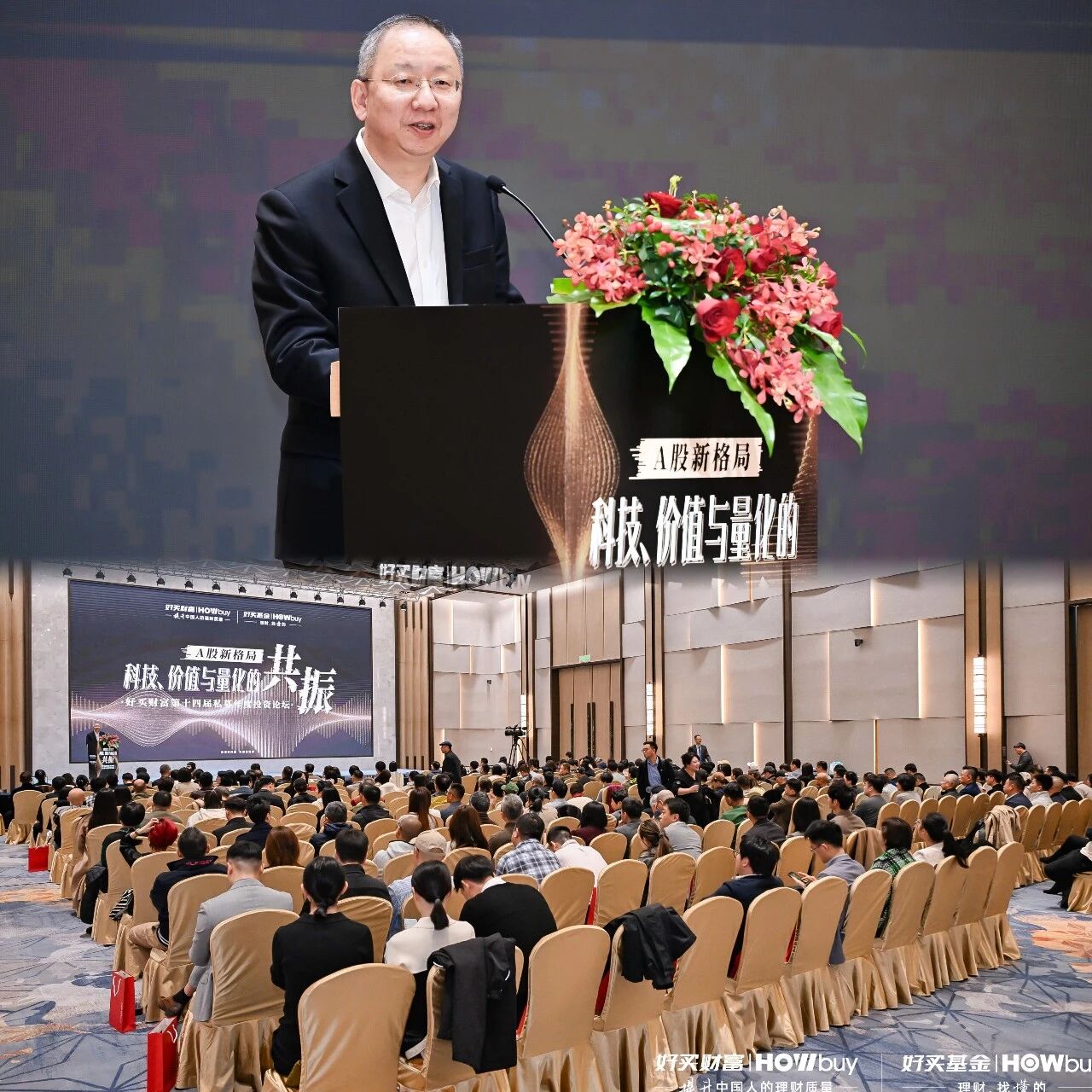
Technology has been part of his plans for years. In 2017, he described Howbuy's early business plan as a fintech plan and discussed automated allocation. He also voiced reservations about investment platforms encouraging people to follow the fastest-growing portfolios without considering whether the risks suited them. Ease of imitation could outrun understanding.
His public work extends beyond the firm. At a Peking University physics alumni gathering in Shanghai in April 2023, he spoke as vice-president and secretary-general of the university's Shanghai alumni association. The setting brought together academics and alumni. It places the financial executive within a continuing university community, rather than confining him to the next product launch.
In July 2026, Howbuy marked its nineteenth anniversary with a nineteen-question conversation with Yang. Its framing paired the AI era with the same longstanding questions about judgment and serving clients through market cycles. The available tools had changed considerably since the founders secured their web address.
The original complaint remains easy to recognise. A customer deserves a useful choice, and a choice deserves an explanation. Yang's career has followed the consequences of taking that seriously: research, advisers, a licence worth waiting for, books and classrooms. The $50 domain gave the enterprise somewhere to live. The harder task has been giving people a reason to keep returning.