The difficult part of investing may arrive after the purchase. The account is open, the transaction has gone through, and the investor has acquired something else along with the asset: the obligation to live with it. Then the market falls. A screen can report the damage with exquisite precision. Explaining what to do next takes a different kind of work.
Ishkaran Chhabra has made that work central to his public argument about wealth management. As founding partner and chief investment counsellor at Centricity WealthTech, he operates where investment products meet the people expected to hold them. His interest in technology comes with a persistent concern about the investor on the other side of the interface.
In May 2026, he described a weakness in do-it-yourself investing platforms: investors may receive little expert support when falling markets unsettle their expectations. He connected that absence of guidance with stopped systematic investment plans and panic exits. Getting someone into a fund, in this account, is only the beginning of the relationship.
It is an unfashionably patient idea for a digital business. Convenience can shorten the distance between intention and action. Chhabra keeps returning to the question of whether the action makes sense, and whether the investor will still understand it when the numbers turn an unwelcome colour.
Private banking, with the doors opened wider
His background helps explain the emphasis. His 2025 professional biography describes 17 years in the industry, including more than 13 as a private banker and nearly a decade as a partner at 360 Wealth. Those are dated career figures, rather than a running tally. They place him in an established profession before they place him in a startup.
At Centricity, that biography described a remit spanning the partner-led distribution business and private wealth, with a team of ten investment counsellors across India. The stated ambition was a consistent family-office experience for clients ranging from the emerging affluent to ultra-high-net-worth investors and family offices.
The phrase carries a demanding promise. A family-office relationship asks someone to consider the whole financial picture, rather than celebrate one attractive product in isolation. Extending that kind of attention across different levels of wealth means translating expertise without assuming that every client has the same experience, resources or concerns.
Chhabra's education offers an earlier glimpse of the analytical side. His LinkedIn profile lists SP Jain School of Global Management in 2011-2012, involvement in its Finance Club and Industry Interface Committee, and an applied research project on Basel III and ten nationalised UAE banks. The project examined risk-management systems, capital and preparedness for the banking framework. The subject was institutional resilience, a useful counterweight to the romance of returns.
Private-banking experience described in Chhabra's 2025 biography. His work at Centricity brings that background into an assisted digital model.
The young investor deserves a fair hearing
In July 2025, Chhabra wrote about five ways Gen Z was handling money differently. The tone was more curious than scolding. He presented early investing as a life skill, examined the appeal of liquidity, and discussed younger investors' willingness to explore unfamiliar assets and investments aligned with their values.
That matters because commentary about young people and money can become a competition to sound disappointed. Chhabra gave their choices a rationale. Digital access could encourage someone to begin sooner, ask questions about an investment's purpose, or seek flexibility rather than reproduce an older generation's portfolio.
He also identified the hazard: social media and peer conversations can supply financial tips without credible expertise. His argument for assisted platforms followed from that tension between curiosity and discipline. An investor may be engaged and informed while still needing help assessing a particular decision.
A subsequent August essay compared millennial and Gen Z money goals. He treated economic experience and changing access to information as forces shaping financial attitudes. That is a more useful starting point than assuming that one generation inherited prudence and another mislaid it somewhere between two phone notifications.
Read alongside his later comments about panic exits, these pieces suggest a coherent concern: entry into investing and endurance in investing are separate achievements. The first can be made easier by an app. The second requires expectations that survive an ordinary bad week.
“The responsibility of new-age platforms is to ensure this generation does not end up losing significant amounts of money.”
Ishkaran Chhabra, May 2026
A microphone beside the portfolio
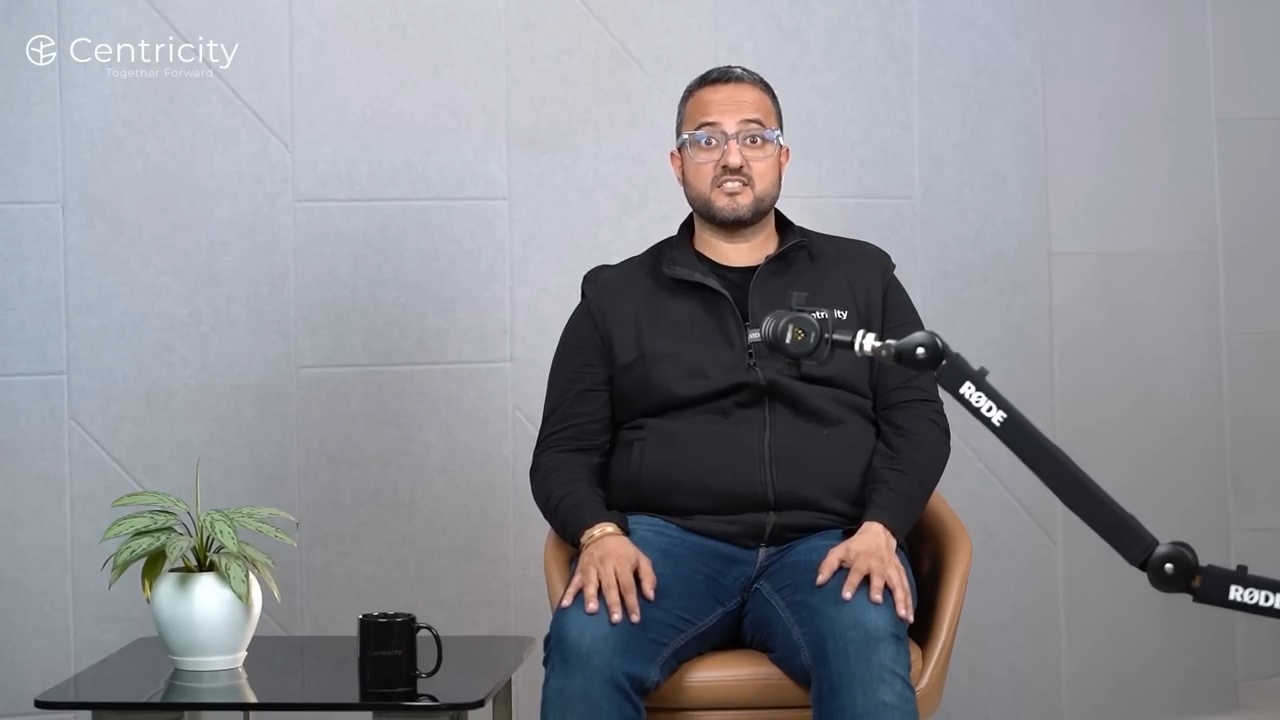
Education is also part of his visible work. In 2023, Centricity shared his explanation of portfolio management services, covering their varieties, benefits and taxation. In January 2026, its Centricity Speaks series featured him in a discussion titled Private Credit: India's New Growth Engine.
The format puts an investment counsellor in front of a microphone as well as a portfolio. It gives people a place to encounter a product before encountering a proposal. The distinction is practical: an unfamiliar name can make an investment feel more sophisticated than its underlying purpose warrants.
His role in these explainers fits the wider job. A product catalogue can tell an investor what is available. A discussion can slow things down enough to ask what the product does and why someone might consider it. The microphone, at least, does not charge extra for a pause.
Start with something you can understand
His comments on new investors make the same case through a familiar choice: mutual funds or individual stocks. In July 2025, he favoured mutual funds as an entry point for beginners, citing professional management and diversification. He acknowledged that direct stock investing could be rewarding while demanding time, knowledge and an appetite for volatility.
The interesting part of that answer is its attention to readiness. A choice that is available to an investor is not automatically a choice they are prepared to manage. Access and understanding need to develop together, especially when short-term losses can prompt decisions that undo a longer-term plan.
He described a gradual progression as financial goals change, with investors able to explore direct equity over time. It is a view of investing as something learned through habits and experience. The beginner is allowed to begin. There is no requirement to arrive with the temperament of a fund manager and the spare afternoons of a retired detective.
A calendar can matter as much as a forecast
Chhabra's public comments also stray into details that rarely make a glamorous investment pitch. In an April 2026 discussion of the Public Provident Fund, he highlighted contribution timing and the cumulative effect of missed interest. His point was about small, repeated decisions across a long horizon.
“Over a 15-year horizon, these small misses add up and drag overall compounding,” he said. It is a revealing subject for someone working in wealthtech: the calendar still deserves attention, even when the surrounding conversation is full of analytics and digital platforms.
The appeal of such an example is its modesty. It requires no prediction of the next market favourite. It directs attention to something the investor can organise. In Chhabra's commentary, understanding the mechanism of an investment sits beside choosing it. The unexciting detail gets a seat at the table.
Gold has a family life, too
His May 2026 observations about gold show a different kind of practicality. He separated discretionary jewellery purchases from occasions such as weddings, where households might be less willing to postpone buying. He noted that demand is connected to culture and household saving habits, and that buyers might respond to high prices by reducing purchase sizes.
That is an investment conversation with room for the family calendar. People buy assets for reasons that extend beyond a chart. A wedding purchase comes with a date, relatives and expectations. A price graph is welcome to express an opinion, but it has yet to negotiate with an entire guest list.
For investment exposure, Chhabra favoured gradual accumulation over attempts to pick the perfect moment. The same preference appears in his comments on equity corrections: begin by reviewing allocation, risk tolerance and long-term goals, then consider deploying capital in phases.
Across these subjects, his public advice repeatedly makes room for circumstances. It takes seriously both the arithmetic of an investment and the reasons a person might make it. The combination is especially relevant to a counsellor whose clients do not all arrive with the same financial vocabulary.
An editorial synthesis of his public commentary, rather than a prescribed portfolio.
When a large number meets a long life
Retirement is another setting in which Chhabra asks readers to look beyond the headline amount. Discussing a ₹2 crore corpus in 2026, he said sustainable withdrawals depend on the asset mix, expected returns, inflation, tax efficiency and the retirement horizon. The size of the pot alone cannot answer the monthly-income question.
In a separate illustration, he examined withdrawals that rise each year, showing how increasing spending can exhaust a corpus even when investment returns are positive. He also outlined a bucket approach, separating near-term liquidity, intermediate income needs and longer-term growth.
Those examples belong to the assumptions used in the discussion. Their value in a portrait of Chhabra is the habit they reveal: an impressive total has to be tested against time and use. Money expected to pay next year's bills has a different job from money intended for a much later decade.
The counsellor's task, as his commentary presents it, is to make these differences legible. A number becomes more useful when the investor understands what it must provide, for how long, and under which assumptions. A reassuring balance can otherwise become a very expensive misunderstanding.
A larger platform, the same human question
Centricity was founded in 2022 by private-banking professionals. Its model combines a partner-led distribution platform, One Digital, with Invictus Private Wealth and a global private-client business. Chhabra belongs to a founding group whose responsibilities span investment products, growth, operations, technology and client service.
In August 2026, the company announced ₹280 crore in Series A funding led by SMBC Asia Rising Fund. It said the capital would support technology, distribution and expansion of its private wealth and international businesses. That gives his work a growing organisational setting, without turning a company funding round into a personal accomplishment.
The question running through Chhabra's writing remains intimate even as the platform grows. What will help this particular investor understand the choice, live through volatility and keep the plan connected to a real goal? His public work answers with explanation, context and repeated attention to behaviour.
A digital platform can put more investment possibilities within reach. Chhabra's contribution is the second thought: the conversation before a decision, the review after circumstances change, the explanation when confidence wavers. In an industry well supplied with invitations to act, there is a useful place for someone who asks the investor to think again.
Keep the conversation going
- Ishkaran Chhabra on LinkedIn
- Centricity leadership
- His essay: five ways Gen Z handles money
- His essay: money goals across generations
- Watch: Centricity Speaks
- Watch: the portfolio management services explainer
- Read: Gen Z investors and the guidance gap
- Read: Centricity’s August 2026 funding round
- Centricity website
- Centricity Speaks on YouTube