A person can leave a company without leaving behind the need for a company’s benefits department. The designer becomes a freelancer. The consultant opens a practice. The founder pays herself. Somewhere between the first invoice and the first tax return, each discovers an unglamorous promotion: head of retirement administration. Carry’s business begins in that gap between working for yourself and arranging the financial infrastructure that employment once supplied.
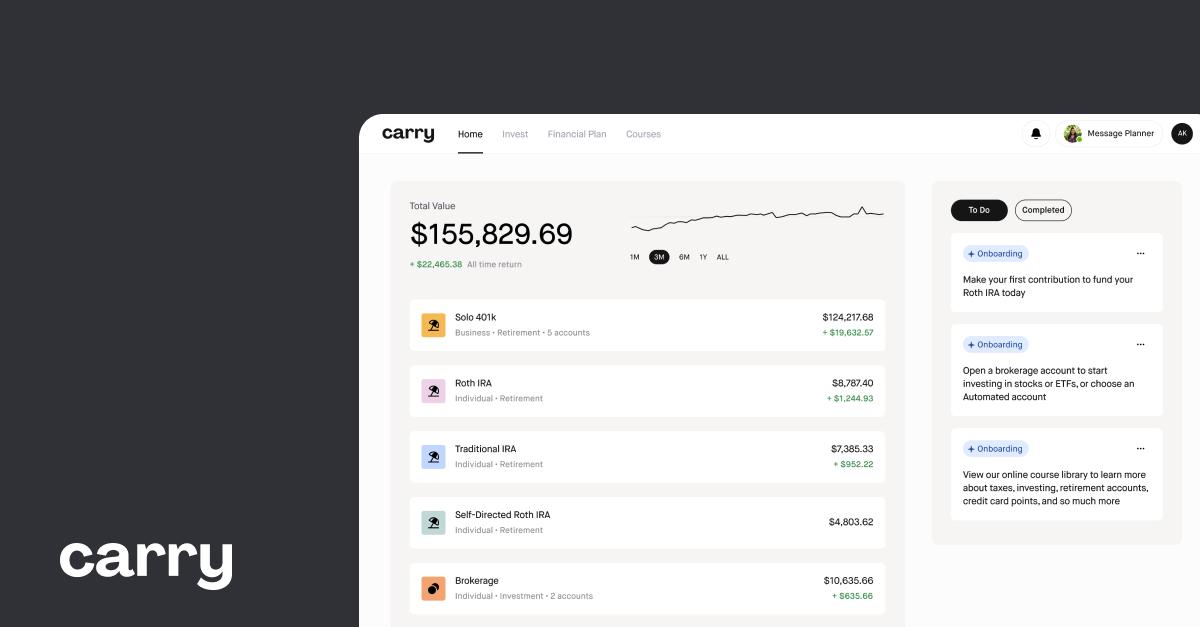
- Solo 401(k)s, IRAs and brokerage accounts share one platform.
- Core costs $299 a year; Pro costs $499 and adds alternative investing and crypto IRAs.
- Carry’s retirement platform joined Lettuce in 2026, connecting it with a broader business-services operation.
The founder became the customer
In December 2022, Ankur Nagpal introduced the company as Ocho. He had already founded Teachable, the course platform acquired by Hotmart in 2020. His next problem was closer to home. In his launch post, he described setting up a Solo 401(k) for himself and disliking the available solutions. “I set one up for myself earlier in the year,” he wrote. His proposed remedy combined an intuitive interface, financial education and wider investment choice.
That origin matters because the account itself was no invention. A Solo 401(k) is an established retirement arrangement. Carry’s opportunity was to make the surrounding work less forbidding: creating the plan, opening accounts, moving money and putting it to work. A perfectly legal financial opportunity can sit unused if claiming it feels like adopting a small bureaucracy. Software has a fair chance when the bureaucracy is the obstacle.

By October 2023, Ocho had become Carry. Nagpal’s public explanation was that the platform and its ambitions had outgrown the old name. He reported more than 500 business owners, over $200,000 in annual recurring revenue and more than $5 million invested. The customer list he described ranged from creators and freelancers to startup founders and employees with side businesses. The common thread was independent income, rather than a particular job title.
The tax code needs a user interface
Carry’s centerpiece remains the Solo 401(k). Eligible owners can use pretax and Roth accounts; an after-tax account supports the mega backdoor Roth workflow when enabled. The important word is eligible. Self-employment income, employee status, compensation and plan rules shape what someone can contribute. A subscription does not manufacture contribution room. Nor does a large advertised limit tell an individual what their own business can support.
The practical appeal is coordination. Carry’s guided setup brings plan documents and investment access into the same experience. Users can fund accounts, handle rollovers and select investments. Its August 2024 product announcement added dashboard tools for creating and tracking alternative investments, automated conversion of optional after-tax contributions to Roth, and a Gusto payroll integration. These are the details that make a complicated strategy repeatable instead of an annual expedition through unfamiliar forms.
- 01Establish the plan
- 02Fund the account
- 03Choose investments
- 04Keep it compliant
The platform also offers Traditional and Roth IRAs and an individual taxable brokerage account. Stocks, ETFs and mutual funds sit alongside managed investing tools. Pro opens access to alternatives such as private companies and real estate, with crypto available through self-directed IRAs. This is a menu of account types and investments, each with its own rules. The choice of container can matter as much as the thing placed inside it.
Convenience has a price tag
Carry sells annual memberships. Core is $299; Pro is $499. The extra $200 buys access to the broader investment offering and premium features. It is sensible to compare that bill with a free Solo 401(k) from a conventional brokerage, or a specialist provider such as My Solo 401k or Rocket Dollar. Their features and administrative arrangements differ. Someone satisfied with ordinary securities and a simpler plan may have little reason to pay for a broader toolkit.
The membership is not the entire economic story. Custodian transactions and fund expenses can add costs. Carry lists a 0.20% annual advisory fee for Smart Yield and its roboadvisor, currently waived until further notice. Disclosures also describe revenue from idle cash arrangements. A single interface does not mean a single institution: DriveWealth carries brokerage accounts, Grasshopper supplies Solo 401(k) banking, and American Estate & Trust handles self-directed IRA custody.
Smart Yield, launched in May 2025, neatly expresses Carry’s approach. It selects money market funds using tax inputs and changing yields, looking beyond the headline rate to the amount a person might retain. It is an investment product, with variable returns and potential losses, rather than an FDIC-insured savings account. Likewise, a retirement wrapper does not make crypto or a private investment safe or liquid. More flexibility calls for more judgment.
For a prospective user, the sensible starting point is the account needed, rather than the most adventurous investment available. Check eligibility, estimate contributions, compare plan features, then decide whether to move an existing account or fund a new one. Carry publishes setup guides and a contribution calculator for that homework. Its advantage is most tangible when several steps need to happen regularly. A person making one uncomplicated annual contribution may place a much smaller value on automation. That difference helps explain why free brokerage plans and paid specialist platforms can coexist.
A perfectly legal financial opportunity can sit unused if claiming it feels like adopting a small bureaucracy.
The benefits department gets a back office
Carry’s growth offers a useful business lesson. At its July 2024 Series A, the company reported 1,400-plus paying customers and roughly $100,000 monthly burn, with no paid marketing budget. Nagpal separately put ARR near $900,000 and platform assets above $35 million. Education and public updates helped make the product legible. The copyable principle is to explain the neglected task before selling its solution; the founder’s existing audience makes the acquisition economics harder to reproduce.
Accomplice led the $10 million round at a $65 million pre-money valuation. Carry reserved $1 million for accredited community investors after customers asked for a stake. In April 2026, Lettuce announced its acquisition of the retirement platform, reporting over $225 million in platform assets. A separate AngelList transaction concerned Carry’s parent company. Carry and Lettuce had already partnered since 2024; payroll, taxes and retirement were becoming neighboring tasks.
The June 2026 terms identify Lettuce as Carry’s operator, while memberships remain separate from Lettuce’s. The attraction is straightforward: fewer handoffs between earning money and preparing for life after earning it. For an eligible independent worker who values that coordination, Carry offers a useful administrative shortcut. The owner still has decisions to make. At least the benefits department now has software.