An investment menu can be a dangerous kind of hospitality. There is always another course, another fashionable ingredient, another reason to believe the table next door is having a better evening. Vinayak Magotra works in the business of deciding what should actually be served. At Centricity WealthTech, where he is a founding member and investment product head, the choice of product sits alongside the less photogenic work of research, analytics and portfolio construction.
The distinction matters because a portfolio can look sophisticated while answering the wrong question. An investor might ask for a higher return when the real concern is an approaching expense. Another might want a new strategy because an old one has become familiar. Magotra’s public commentary repeatedly brings these conversations back to purpose, time and the risks a person can carry. That pattern supplies a more useful portrait of his working outlook than an inventory of financial acronyms.
In April 2023, early in his Centricity chapter, he was discussing interest rates, taxation and equities. His emphasis was on allocating across asset classes and keeping trading risk under control. He also resisted treating a single month as a satisfactory forecasting horizon. Markets invite the dramatic prediction; his answers kept making room for the conditions attached to it. There is a certain professional courage in giving an answer that comes with a calendar and a qualification.
A career through the portfolio room
His route to that position passed through several corners of finance. His publicly listed career begins at Axis Bank in 2012, followed by International Money Matters, where his roles progressed from sales support to client relationships and financial advice. In 2016 he moved into investment consulting at Mercer. The sequence then took him to family-office analysis at IIFL Wealth and, in 2021, to ASK Wealth Advisors as an associate vice president.
He joined Centricity’s founding team in December 2022. The earlier roles put customer relationships, investment analysis and private wealth on the same career map. Each addresses a different part of the distance between an investment proposition and the person expected to live with it. A financial product can be described neatly on a screen. Its place in a family’s affairs is a much longer conversation.
At Centricity, that conversation has an organizational home. The company’s leadership listing places him within both its founding group and investment product team. Around him are colleagues responsible for equities, investment counselling, technology, growth and private wealth. The work is distributed across specialties. His responsibility lies in investment products, a position where the appeal of an offering has to meet the research behind it.
Investment consulting
Family-office analysis
Associate vice president
Founding team
When the new thing can wait
By July 2026, a new category was providing a public test of that judgment: specialised investment funds, or SIFs. Asked about hybrid and equity long-short strategies, Magotra favoured a cautious evaluation of what each was meant to deliver. He argued that hybrid offerings had a clearer role for investors seeking a different balance of risk and return. For equity long-short funds, he wanted evidence of performance before assuming they could improve on established equity approaches.
The interesting detail was his willingness to leave time in the evaluation. A launch gives a product a birthday; it does not give it a market history. He was interested in how the newer equity strategies would behave over subsequent months, particularly in comparison with familiar alternatives. His reservations were specific to the opportunity and the evidence available, rather than a blanket dislike of financial innovation.
That stance gives the founding-team title some texture. Working inside a wealth technology business does not require enthusiasm for every financial novelty. Someone still has to ask whether a new offering deserves a place, and whether the answer changes across different investors. In a business where a fresh label can attract attention before a track record exists, waiting is a decision with commercial consequences. A velvet rope is sometimes more useful than another open door.
“We first want to see their track record.”Vinayak Magotra, on equity long-short SIFs, July 2026
The troublesome arithmetic of a crowd
His explanations of ordinary investor behaviour have a similar habit of slowing the story down. In June 2026, rising closures of systematic investment plans were generating concern. Magotra pointed to the expansion of the investor base and the fact that the closure count includes plans completing their tenure. A larger system can produce more departures without every departure signalling a retreat from investing.
He also considered reinvestment and reallocation within mutual funds, alongside investors broadening their holdings into other assets. He presented these as interpretations of the data, rather than proof that every investor remained comfortable. The useful move was to question the meaning of the count before accepting the mood attached to it. A number can be perfectly accurate and still be an unreliable storyteller.
Elsewhere, discussing financial content on social media, he warned about aspirational success stories and repeated changes of strategy. The appeal is easy to understand: every feed refresh offers someone else’s apparent shortcut. His concern was that investors move between small-cap stocks, options and themes without continuity. The result, in his view, can undermine the portfolio they are trying to improve. Attention has its own transaction costs, even when the app is free.
Money with a date attached
Magotra’s retirement commentary makes the question of suitability tangible. In March 2026, he described organizing investments around when the money would be needed, including a reserve for near-term expenses in safer, liquid holdings. He favoured beginning the adjustment of a retirement portfolio at least 24 months ahead of retirement, with changes made gradually and with withdrawals, taxation and exit costs in mind.
The point of that structure is to reduce the pressure to sell equities at an inconvenient moment. A future expense cannot always wait for a favourable market. His explanation treats the withdrawal schedule as part of the investment problem from the beginning. It shifts attention away from the largest possible projected balance and toward the conditions under which that balance can be used.
When discussing fixed and recurring deposits in May 2026, he gave them a defined role in capital protection and more predictable short- to medium-term planning. He also questioned relying too heavily on them for long horizons, where inflation and taxation affect what the money can buy. The same product can be reassuring for one purpose and inadequate for another. Context does much of the work that a headline interest rate cannot.
That attention to the mechanics appears in his comments on rebalancing, too. When equity values fall, the proportions of debt and gold in a mixed portfolio can rise without any new purchases. He urged consideration of forward-looking expectations, taxes and exit loads when restoring the mix. The calculation begins with percentages, but the decision cannot end there. Moving money has consequences beyond making a pie chart look tidy.
An open mind, with a measuring tape
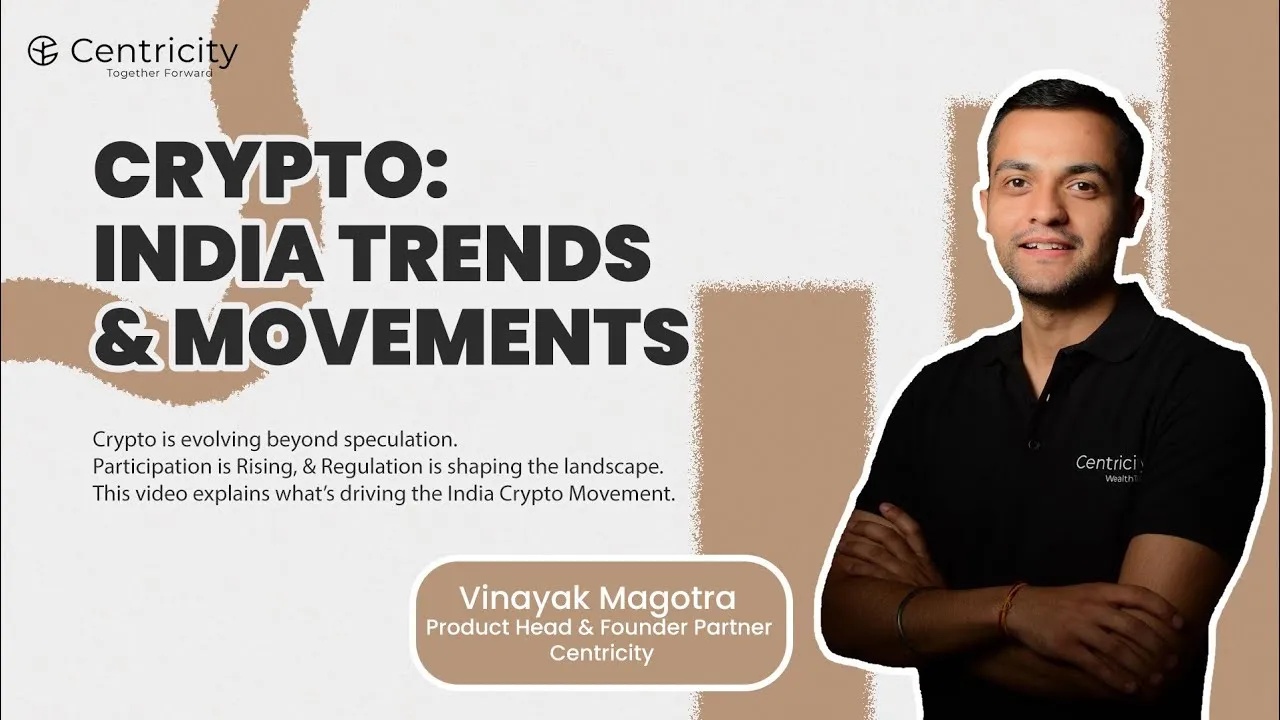
There is room for curiosity in this approach. In February 2026, he appeared in a Centricity Speaks conversation about crypto, speculation and the possibility of a new asset class. The episode’s framing acknowledged participation alongside volatility, security and regulatory uncertainty. It was a different subject from retirement deposits, yet it belonged to the same broader task: making an investment category intelligible before giving it a place in a portfolio.
His range extends to passive investing. A Value Research episode featured him on constructing a portfolio across equity, debt and global markets. In a separate Centricity clip, he discussed using broad indices for overseas exposure. The recurring question is how a method fits the market being entered. Complexity is an available tool, but it does not automatically earn its keep.
Nor does a lower price automatically settle the case for taking more risk. Commenting on small-cap valuations in June 2026, he argued that a correction had brought them toward fair value rather than a deep bargain, and that the margin of safety remained thin. It is an unglamorous distinction until the purchase has been made. “Cheaper than before” and “cheap enough” can occupy very different places in an investor’s experience.
The conversation beyond the screen
The work also takes him into rooms with other finance professionals. He announced a January 2026 Network FP session in Mumbai about building beyond mutual funds. In July, the Indian Institutional Quant Conference in Gurugram listed him on a panel about the role of SIFs in Indian portfolios, alongside Rishi Kohli, Amit Goel and Puneet Jain, with Kshitij Anand moderating.
These appearances connect his product responsibilities with a public teaching role. Advisors must explain what an investment does before clients can judge whether it belongs. A discussion of alternative products has to survive that translation. The language may begin with a specialist category, but the practical questions remain recognizable: what is the money for, when might it be needed, and what must happen for the strategy to work?
Seen together, Magotra’s public arguments suggest a professional outlook that leaves room for both exploration and restraint. He discusses new funds, global indices and digital assets while returning to the practical demands of liquidity and allocation. The interest lies in that combination. An expanding investment menu gives a product head more to examine; it also gives him more opportunities to decline a dish.
For the investor, the final choice can be surprisingly modest. A portfolio need not contain everything that its owner has learned about. Some ideas can remain interesting without becoming holdings. In Magotra’s public work, the useful question arrives before the transaction: what job would this investment do? It is a question that fits on a small piece of paper, and can save a considerable amount of paperwork later.