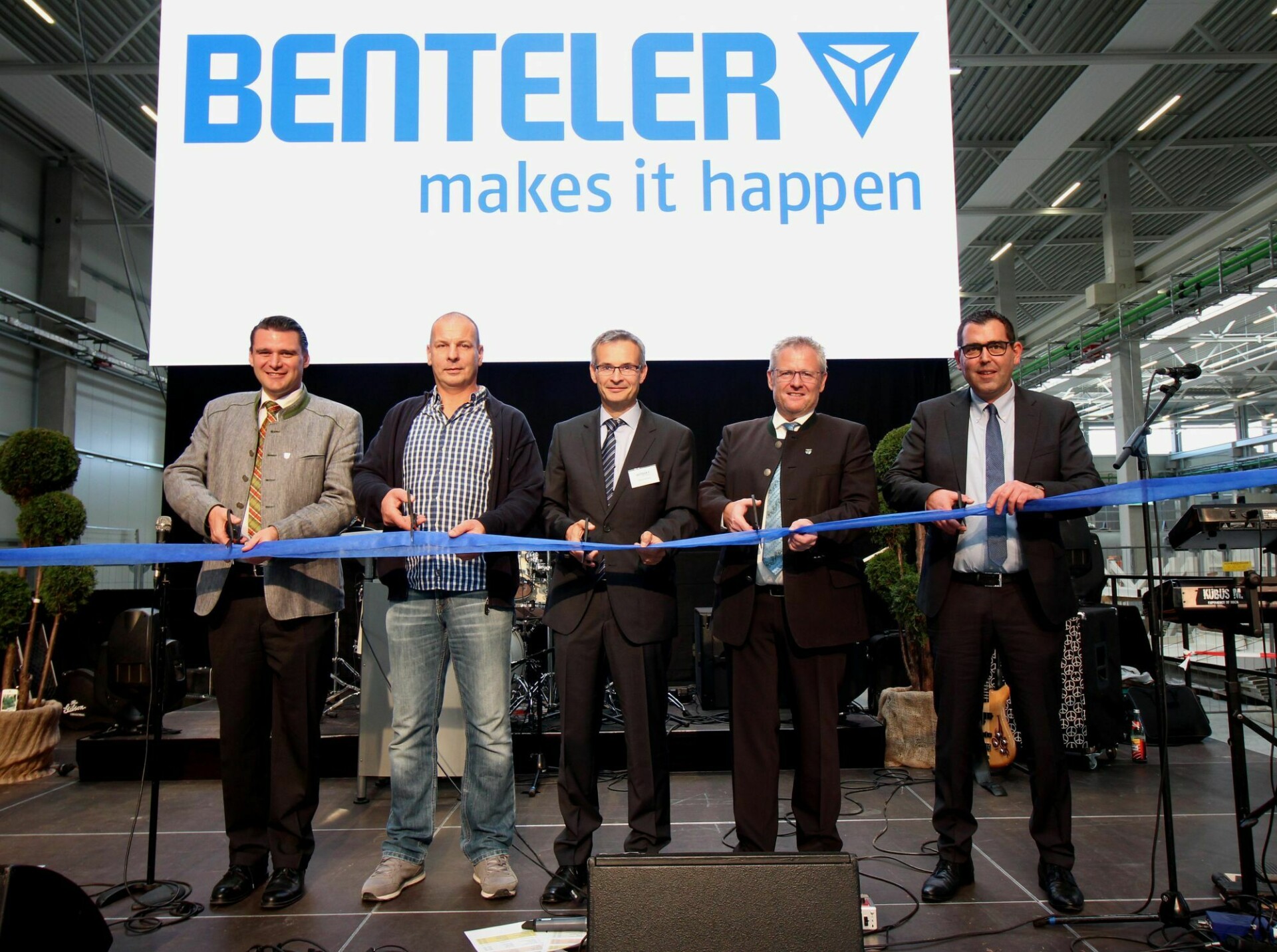
Five men stand with scissors behind a blue ribbon. There are instruments in the background and a factory roof overhead. At the far right is Martin Weidlich, then Benteler Automotive’s executive vice president for Western Europe. It is October 13, 2018, in Schwandorf, Bavaria, and the occasion is the opening of expanded production facilities. The ribbon is doing what ribbons do: making a complicated industrial undertaking briefly look manageable.
The undertaking concerns battery trays. Benteler is preparing to manufacture them for a new generation of electric vehicles, with production scheduled to begin in early 2019. The enlarged site puts a physical shape around a change that is often discussed in abstractions. Electrification requires somewhere to put the battery. Someone must make that somewhere.
Weidlich’s career offers a view of the automotive industry from this practical distance. Across Ford, Getrag, Benteler, MAHLE and eventually One Mobility, his responsibilities have moved between engineering, manufacturing and the organization of supplier businesses. The products change. The distance between a design and a functioning production operation remains a useful measure of the work.
The gearbox years
Born in Cologne on March 5, 1971, Weidlich began his career at Ford in 1991. A decade later, he graduated from RFH University of Applied Sciences Cologne after studying production technologies and technical business administration. Engineering and business appear together in that qualification, an appropriate combination for the responsibilities that followed.
In January 2001 he moved to Getrag. His assignments there included PowerShift operations at Getrag Ford Transmissions, management of Getrag Precision Gear in Charleston, South Carolina, and a directorship and chairmanship at Getrag High-Tech Gears in India. The list crosses functions as well as borders. Operations, company management and product development all appear before the later regional executive titles.
From 2010 to 2013, he served as vice president of research and development and director of core engineering. These were years spent with transmissions, the machinery that sits between a driver’s demand and the way a vehicle delivers motion. His subsequent move would widen the range of components and the scale of organizational responsibility.
- 1991Ford
Career begins - 2001Getrag
Operations & engineering - 2014Benteler
Regional leadership - 2020MAHLE
Management Board - 2025FIT / One Mobility
Business integration
A factory is a promise with a roof
Weidlich joined Benteler Automobiltechnik in January 2014. He held a strategic project role and became executive vice president for North America and president of Benteler Automotive Corporation. From 2018, he was responsible for Western Europe. The progression took him from the engineering organization of one supplier to regional leadership at another.
The Schwandorf photograph catches that European assignment in a particularly tangible form. The expansion increased the site’s production and property area by roughly half. More than 600 people worked at the plant at the time. Local officials, the plant’s works council chairman and its manager joined Weidlich at the ceremony. A supplier’s investment is also an event in a town’s working life.
Battery enclosures gave the occasion its industrial purpose. Benteler planned to use the site’s lightweight materials expertise to manufacture them in Germany. The photograph records the opening; the production schedule points beyond it. There is a useful discipline in looking at both. The ceremony occupies an afternoon. Manufacturing is the commitment that survives the removal of the ribbon.
His Benteler years also leave a smaller, more personal trace. Procurement manager Daniela Martinez identified Weidlich, human resources vice president Erika Lapish and purchasing vice president Don Luby as three leaders who welcomed and supported her after she joined. It is a colleague’s account of a working relationship, at a different scale from a regional appointment.
Factory improvement featured in his public comments, too. In March 2018, Benteler was working with Fraunhofer IEM on the European BOOST 4.0 project. Weidlich described production data as information that could help make processes more efficient. The initiative concerned industrial data analysis and exchange, including the possibility of spotting equipment problems early enough to act.
In a separate contribution on manufacturing digitalization, he argued for compatible data interfaces and described leadership in terms of developing people, giving them responsibility and encouraging communication in both directions. He put trust in employees at the center of that argument. It gives the discussion of connected factories a recognizable human starting point.
“We trust our employees. They want to do a good job.”
Martin Weidlich, on leadership at Benteler
Engine peripherals, new directions
On January 1, 2020, Weidlich joined the MAHLE Management Board, taking responsibility for Filtration and Engine Peripherals. His appointment accompanied a reorganization in which Wilhelm Emperhoff moved to lead a new Electronics and Mechatronics business unit. The division of responsibilities placed Weidlich inside an established automotive supplier as it adjusted its organization around changing powertrain technologies.
The title needs a little unpacking. Engine peripherals are part of the equipment that allows a powertrain to operate, rather than the conspicuous object on a motor-show stand. The portfolio also put Weidlich in conversations about newer applications. In September 2022, MAHLE and cellcentric signed a memorandum of understanding covering development and series production of a flat membrane humidifier for fuel cells.
Weidlich described fuel cells as part of MAHLE’s technology-open approach to mobility. The component was intended for commercial vehicles and other applications. Here was another example of transition arriving through a particular manufactured part, with development and production considered together. The corporate strategy had a component number somewhere underneath it.
His responsibilities also reached beyond the business unit. By 2024, his MAHLE portfolio included operational excellence, production systems and consulting, and purchasing. These functions connect decisions made at group level with the conditions under which plants work. Purchasing concerns what comes into the organization; production systems concern how work is organized inside it. Alongside a product portfolio, they gave his board assignment an operational dimension across the company.
By late 2024, MAHLE was reorganizing again. It announced a reduction of its Management Board from seven members to four and the regrouping of business units. Weidlich’s management office ended in November, and he left the company at the end of December. His next appointment had already been announced. Another supplier combination was waiting.
Two businesses, one name
On December 9, 2024, Foxconn Interconnect Technology announced that Weidlich would become managing director of the newly founded FIT Mobility GmbH on January 1. The brief followed an acquisition: Voltaira had completed its purchase of Auto-Kabel at the end of November. The transaction brought together wire-harness, sensing and connectivity capabilities with automotive power distribution expertise.
The acquisition announcement described a combined footprint of more than 50 locations and over 11,500 people. Those figures belong to that moment in the business’s development. They convey the scale of the organization being combined, rather than a personal scorecard. Weidlich was taking responsibility for bringing existing industrial capabilities into a more unified relationship with customers.
The customer-facing ambition was to offer a unified relationship while preserving the divisions’ specialist knowledge. That distinction is practical: a customer may want one point of coordination without losing access to the people who understand a particular component. The appointment put Weidlich between those requirements, with FIT’s broader capabilities available alongside the established automotive businesses.
The sequence matters. FIT had acquired Voltaira in 2023 and Autokabel in 2024. Weidlich arrived after those acquisitions, with integration ahead of him. Buying a business and operating a combined business are separate undertakings. Different histories, products and customer relationships must acquire a workable common arrangement.
On September 17, 2025, in Taipei, FIT unveiled One Mobility. Weidlich was identified as CEO of One Mobility GmbH. The new brand covered power distribution, voltage modules, charging and other vehicle components, drawing on the acquired businesses and FIT’s electronics capabilities. The offer extended from development work to production.
His statement at the launch distilled the customer argument into a sentence: “Automotive customers need a true development and production partner.” It was an apt formulation for someone whose earlier responsibilities had included both core engineering and regional manufacturing operations. The pairing of development with production had accompanied him long before it became part of this brand’s proposition.
The assignment has an ending
Later in 2025, One Mobility announced a leadership transition. It credited Weidlich with leading the integration and restructuring of Voltaira and Autokabel, and said he would step down following completion of the mission. Tobias Kerle, then chief operating officer, was named to assume operational responsibility and the managing director role before Christmas.
A December register notice subsequently recorded Weidlich’s departure as a managing director of One Mobility GmbH. That closing date is part of the career, just as the January appointment is. The company’s account describes an assignment with an outcome and a handover. Treating the launch-day title as permanent would miss the shape of the work.
Return to the Schwandorf photograph and the career becomes easier to picture. An engineering qualification, operations across countries, a factory expansion, a board portfolio, two businesses brought together. The setting changes from a production hall to a corporate combination, but the practical questions persist: what can be made, who will make it, and how will the organization support the task?
At the ribbon cutting, five people share the scissors. Years later, the integration ends with responsibility passing to another executive. Both scenes have room for more than one person. In a career spent among factories and supplier businesses, that seems a fitting place to leave the picture.