Sidney Lu completed 58 credit hours in his first year at the University of Illinois. A normal freshman might have considered surviving one degree a respectable ambition. Lu eventually left with two, in mechanical engineering and mathematics, both in 1981. Years later, he would return to the campus with a different sort of calculation: how to give another generation room to learn.
There is a pleasing continuity here. Lu’s working life has revolved around connectors, the components that allow an electronic system’s parts to cooperate. His giving has helped create laboratories, workshops and gathering spaces where people can do much the same. The analogy has limits, of course. Students are considerably harder to standardize than sockets. But the recurring interest is practical: what has to be in place before something useful can happen?
Three brothers, one Illinois address
Sidney and his brothers, Nicholas and Christopher, left Taiwan to attend Illinois. Their mother, Tungchao Julia Lu, made education a family undertaking. She lived in Champaign from 1979 to 1981 while her sons were studying there. The international journey belonged to the children on paper; in daily life, it also belonged to her.
Lu has repeatedly credited her with making that education possible. His gratitude became unusually tangible. A professorship bears her name. The naming choice matters: before a university building carried Sidney’s name, he had found a way to put his mother’s into the academic life of the department. A family’s investment in learning could continue beyond the family.
Illinois also supplied teachers he remembered long after the examinations were finished. Professor Shao Lee Soo taught him two thermodynamics classes and helped awaken his interest in mechanical and thermal engineering. Decades later, Lu said he could still recall some of Soo’s equations. Many alumni remember the social calendar. Lu remembered thermodynamics. There is room in a university for both sorts of loyalty.
“I learned hard work here, and I learned how to learn.”
Sidney Lu, on Illinois
The career inside the connector
After graduation, Lu went to the Packard Electric Division of General Motors in Ohio. From 1981 to 1988, his engineering work concerned connector products. He then moved to AMP, where he worked in manufacturing between 1988 and 1990. Before he became a chief executive, he had experience with both the calculations behind a component and the business of producing it.
He joined Hon Hai, the company known as Foxconn, in 1990. His early responsibilities included connector design; later came management of engineering and manufacturing. The progression is important because it locates his career in a specific trade. Electronics manufacturing can sound like an anonymous expanse of factories. Lu’s starting point was more particular: the connection itself, and the work required to make it dependable.
A connector rarely gets a glamorous introduction. It is unlikely to appear in an advertisement beside a sunset. Yet a device needs its components to exchange power and signals. FIT’s business occupies that practical territory, supplying interconnect components for industries whose finished products receive much more public attention.
At Foxconn, Lu promoted scientific analysis and total quality systems across engineering, product development and manufacturing. These are sober words for consequential habits: calculate, test, control the process. They also help explain the bridge between his education and his eventual authority. The executive career grew out of technical work rather than replacing it with a completely unrelated occupation.
- 1981Illinois
Two degrees - 1981-88Packard Electric
Engineering - 1988-90AMP
Manufacturing - 1990Hon Hai
Connector business - 2013FIT
Company leadership
When FIT was spun off from Hon Hai in 2013, Lu became the leader of the new entity. He is now its chairman and chief executive officer. The formal company name, FIT Hon Teng, and the operating name, Foxconn Interconnect Technology, can make the corporate family look more complicated than the underlying career. Across the changes in title and structure, interconnect technology remained his field.
A building with room to make mistakes
Back in Illinois, the Mechanical Engineering Building needed a different future. Its older configuration lacked student laboratories. The transformation project proposed space for hands-on instruction, making and collaboration. Lu’s support ultimately reached $21.5 million, and the university approved naming the building for him in May 2019.
That amount can dominate an account of the gift. The more interesting question is what it bought. A student can understand a principle in a lecture and still need a bench, a tool and time to discover how stubborn the physical world can be. A makerspace puts that discovery within reach. It allows an idea to acquire dimensions, friction and the occasional inconvenient wobble.
The project had begun with a $12 million cornerstone pledge for an east-wing addition in 2014. Further support followed. Rather than a single ceremonial gesture, the giving became a sustained involvement in a substantial construction project. The overall undertaking was budgeted at about $41 million. Lu’s contribution was part of a wider effort to change what the department could offer its students.
In October 2018, he joined students, alumni, faculty and university officials for the groundbreaking at Green Street and Goodwin Avenue. The setting makes a useful counterpoint to the factories of his working life. Here was another physical project, with an eventual opening date and a community waiting to use it. A campus ambition had reached the stage where people could gather beside the ground it would occupy.
The redesigned building officially opened on October 1, 2021. Students gave tours after the ceremony. Inside were spaces intended for education, innovation and community, including an Innovation Studio and a student center. Those three purposes sit comfortably together. Learning to build something is easier when there are other people nearby who can ask an awkward question or lend a hand.
By the start of that fall semester, students were already being invited to explore gathering areas, classrooms and MakerWorks. The building included study booths, lounge seating and even a foosball table. Its ambitions were serious; its occupants were allowed to be people. Engineering education apparently could accommodate a small ball as well as large ideas.
The Innovation Studio’s facilities included woodshop equipment, 3D printing, laser cutting, waterjet cutting and assembly space. Those details make the gift legible. They are opportunities to try a design, discover its shortcomings and try again. Lu’s career had involved turning technical knowledge into manufactured objects. Students in the building carrying his name were being given places to begin that process themselves.
His mother’s name came first
The building is only one part of Lu’s relationship with the department. A $5 million gift in 2013 supported the Tungchao Julia Lu Professorship, scholarships and other projects. In April 2014, department head Placid Ferreira became the first holder of the professorship. Lu attended the investiture, saw its plaque unveiled and toured research facilities.
The choice of advanced manufacturing as the first recipient’s expertise gave the occasion a particular fit. Lu was supporting a scholar working in a field close to his own industrial experience while honoring the person who had helped him acquire that experience’s educational foundations. Family memory, academic work and manufacturing met in a single appointment.
There is a quiet generosity in a professorship’s timescale. A ceremony occupies an afternoon. An academic post continues through courses, research and successive students. A donor cannot script every result. Supporting the conditions for work means accepting that other people will decide what to do with the opportunity. That is part of the point.
The triangle follows him home
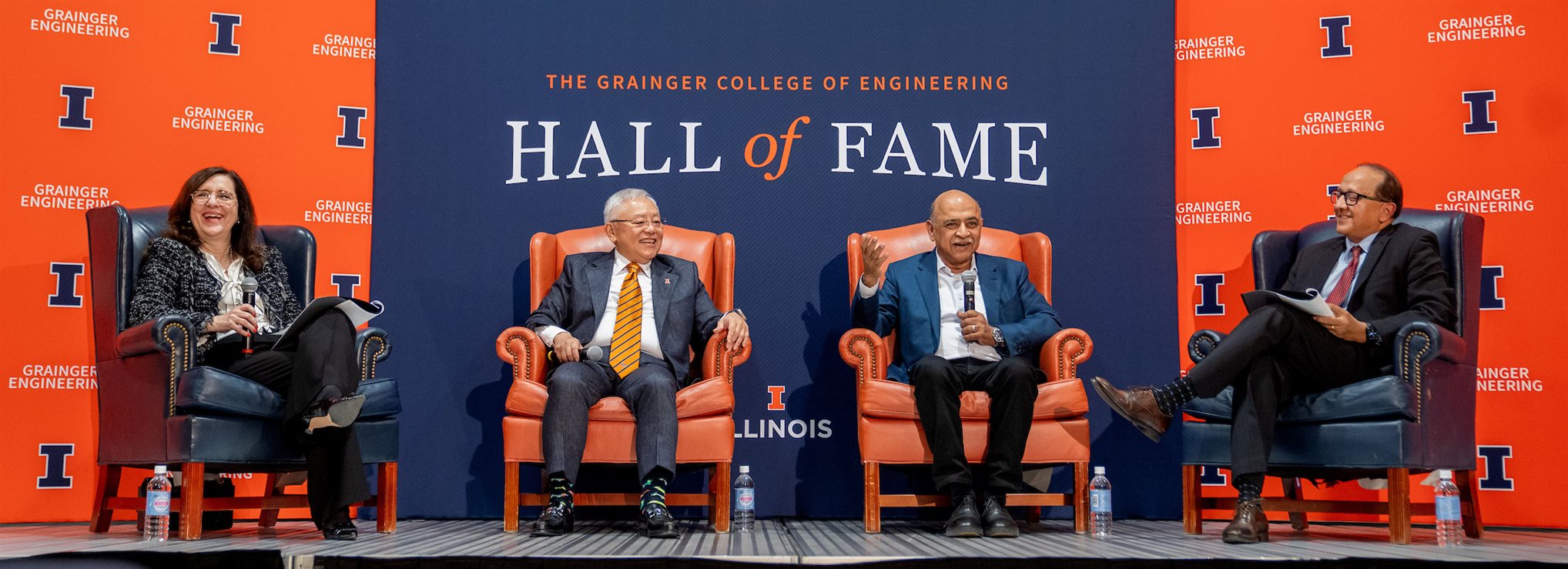
In 2025, Grainger Engineering inducted Lu into its Hall of Fame. On campus, he discussed a manufacturing dilemma he calls the Bermuda Triangle: quality, delivery time and cost. His account of leadership involves understanding the problems a team encounters and helping with them, alongside setting a direction. The factory experience remains close to the surface when he talks to students.
A conceptual trade-off, not a measured performance chart.
The honor also drew opposition. In November 2025, the campus Graduate Employees’ Organization called for its reversal, criticizing labor practices in the broader Foxconn manufacturing network. The objection belongs in the account of his public recognition. It concerned the industrial system behind the achievement the university was celebrating, rather than the educational usefulness of the rooms his gifts helped create.
The next connection
Lu’s current business reaches into mobility as well as electronics. One Mobility Group is a FIT subsidiary, combining automotive connectivity and power-distribution capabilities. Lu leads the parent company; Martin Weidlich is One Mobility’s chief executive. Keeping those roles clear helps locate Lu’s influence without assigning him somebody else’s job.
FIT’s acquisitions of PRETTL SWH in 2023 and Auto-Kabel in 2024 helped form that automotive business. In September 2025, Lu was scheduled to open and close FIT’s Tech Day in Taipei, an event focused on AI and mobility. The subject matter had moved forward from the components he worked on in Ohio, while the recurring questions of data, power and connection remained.
He has a brisk rule for staying interested. In a 2026 interview, he described aiming for a new “wow” every three years. He also recalled a failed CPU socket in 1994: the team corrected the clamping force, produced a redesign within 48 hours and demonstrated the repair to the customer. The anecdote gives the rule some ballast. An ambition to surprise customers needs an equally practical response when the surprise is unwelcome.
For all the corporate titles, Lu’s story keeps returning to the places where work becomes possible: an engineering department, a production operation, a workshop. He learned equations that stayed with him, worked on components whose usefulness depended on connection, and helped equip rooms for people he would never teach personally. The next student to walk through those rooms has a rather good starting point. The rest is theirs to make.
Follow the connections
- FIT leadership ↗
- Sidney Lu on LinkedIn ↗
- The Illinois Hall of Fame profile ↗
- The 2025 campus conversation ↗
- The engineering building’s transformation ↗
- Watch the building’s opening ceremony ↗
- The Tungchao Julia Lu Professorship ↗
- Inside the Innovation Studio ↗
- The 2026 leadership interview ↗
- One Mobility’s leadership and history ↗
- FIT’s current director biography ↗
- The union’s statement on the honor ↗