Start with a jet engine. It makes a useful corrective to the breezy language of technology. An idea can be sketched quickly; an engine demands years of design, prototypes, tests, and manufacturing. Thousands of decisions must survive the journey from a neat diagram to an object that works. Vik Bajaj chose that example when, in June 2026, he finally spoke at length about Prometheus, the company he co-founded and co-leads with Jeff Bezos. The choice of object was revealing. It put the engineer, rather than the software, at the center of the story.
The interview took place at the company’s San Francisco headquarters. Outside the window were ships and civil structures, the sort of things Bajaj pointed to as evidence of engineering’s quiet ubiquity. He called the people responsible for such work “unsung heroes.” It was a modest phrase in a conversation dominated by large numbers: a $12 billion funding round, a roughly $41 billion valuation, and a company of about 150 people across San Francisco, London, and Zurich. Yet the phrase explains the wager better than the financing does. Prometheus wants to make tools useful to the people who turn physical ideas into physical objects.
Bajaj’s path to that room was long and, viewed from a distance, unusually varied. He studied biochemistry at the University of Pennsylvania and earned a doctorate in physical chemistry at MIT. He continued research at Berkeley, where magnetic resonance was a way of learning from signals too subtle for ordinary sight. Later came Google X and the founding of Google Life Sciences, now Verily. Then GRAIL, Foresite Capital, Foresite Labs, Xaira Therapeutics, and finally Prometheus. The names change; the practical question keeps returning. How do you gather the right evidence about a complex system, and how do you give capable people better tools for acting on it?
The prize was for a way of looking
In 2013, while working in Berkeley’s Alex Pines laboratory, Bajaj received the first Anatole Abragam Prize from the International Society of Magnetic Resonance. The award citation listed a collection of method advances: work involving strong magnetic fields, the detection of flow in tiny channels, optical methods, and new sensor designs. Such a list is a reminder that scientific advances often arrive as better instruments before they become better answers. A researcher changes what can be observed, and other people discover what that new view permits.
The award was also unusually personal in its framing. The new prize honored Abragam, a scientist remembered not only for his contributions to the field but for nurturing younger colleagues. Bajaj was its inaugural recipient. Years later, his descriptions of company building would keep returning to people as essential equipment. In a 2021 interview about Foresite Labs, asked to define its platform, he began with the team. The databases and analytical tools mattered, but experience in making and using data mattered too. That is a practical answer from someone who has spent time near both instruments and institutions.
“You don’t build a bridge or a jet engine through words.”Vik Bajaj, June 2026 interview
At Google X, the question of instrumentation widened. Bajaj helped found Google Life Sciences and served as its chief scientific officer. He later held the same title at GRAIL. His Stanford appointment sits alongside those company roles, a compact illustration of a career that moved repeatedly between research and organization building. To describe that simply as a jump from science to business would miss the mechanism. Bajaj’s work has often involved assembling a place where scientists, engineers, data, and capital can meet long enough to tackle a difficult problem.
A laboratory for starting laboratories
In 2017, Bajaj joined Foresite Capital. He went on to co-found Foresite Labs, its company creation effort, which was announced publicly in 2019. The premise was that emerging computational methods could be put to work on hard scientific questions if somebody built the supporting data and teams. In a long interview two years later, Bajaj resisted the idea that an incubator should impose the same kit on every startup. Some capabilities belonged in a shared platform; others needed to be developed inside each new company. The distinction sounds administrative. It is really about giving an idea enough structure to grow without pressing every idea into the same shape.
Bajaj’s own writing from that period gives a similar impression. His announcement of Foresite Labs was a substantial essay, not a slogan. He described a center for entrepreneurial work with a clear interest in data science, teams, and the act of launching companies. By 2023 he had also co-founded Xaira Therapeutics. The company names may suggest separate chapters, but his public interviews link them through a repeated concern: in fields outside consumer software, useful training data rarely sits in a tidy public archive waiting to be downloaded. Someone has to design the experiment, collect the observations, and understand where the record is thin.
That point became especially clear in a 2025 conversation with Wilmington Trust. Bajaj distinguished the internet’s enormous store of text and images from the data needed for science and engineering. The latter often has to be made deliberately, at considerable cost. He argued that AI’s influence across physical disciplines would be measured by whether it shortened development cycles. There is a charming severity to that standard. It leaves little room for a dazzling demonstration that cannot survive contact with the workshop, the laboratory, or the production line.
A sequence of work, not a published measure of Prometheus’s performance.
A partnership and a rather large clock
Prometheus began its work in late 2024, according to Bezos’s public account. He initially came in as a founding investor, then decided to take a co-CEO role. Bajaj and Bezos spoke together publicly in June 2026, when the company announced its Series B. Its stated aim is broad: develop AI tools that help with engineering and manufacturing, from chips to engines and other intricate physical systems. The company calls the long-range idea an artificial general engineer. That phrase can sound as if the machine will replace an entire profession. Bajaj’s own explanation was more immediate: he wants tools that let engineers get from design to finished object faster.
He walked the interviewer through the engine. Teams must create the design, establish that it will work, build prototypes, and then manage a manufacturing chain with a staggering number of operations. The hard part is not finding a clever sentence about an engine. It is representing shapes, assemblies, forces, and changing conditions well enough to help with decisions made over years. Bajaj said the recent change is that this full route can be treated as a connected AI problem. That is a claim about an approach, rather than a public record of a completed product. The distinction will matter as the work matures.
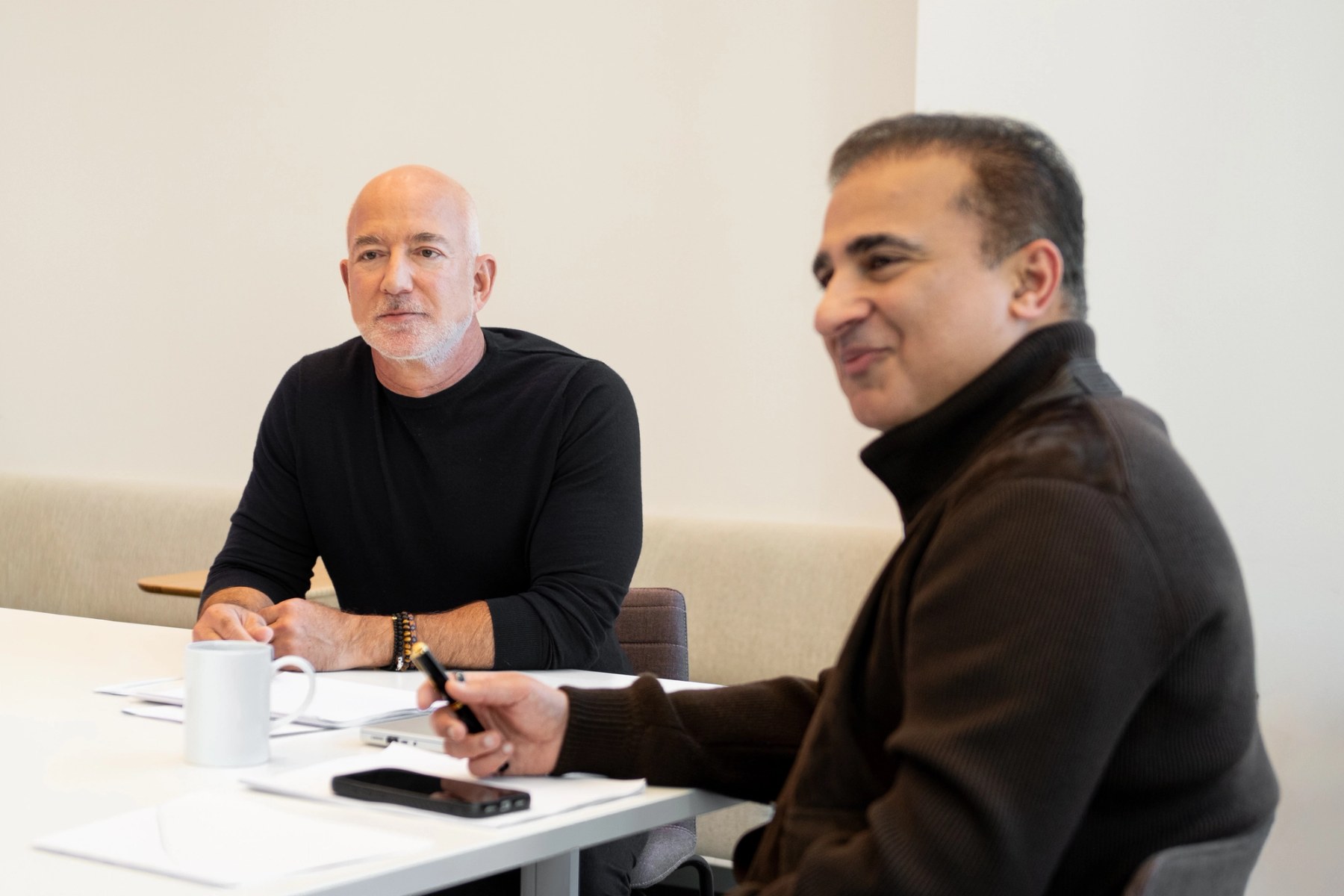
The co-CEO arrangement drew an obvious question: how do two people divide the company? Bezos said they talk several times a day and both take part in decisions. Bajaj, asked whether the arrangement was working, said he enjoyed working with him. Bezos offered to leave the room for a more candid answer. It was a brief joke, and one of the few relaxed moments in an interview full of funding and technical ambition. Bajaj then described a shared interest in understanding the customer all the way through: who engineers are, what frustrates them, and what they want to make. The scene did more to explain the partnership than an organization chart might.
Prometheus is also a reminder that money and proof move on different schedules. The $12 billion Series B announced in June 2026 followed a $6.2 billion earlier round. The new valuation was roughly $41 billion. Those figures show the scale of backing; they do not say how much time any future tool will save on an actual machine. In the same interview, Bezos described internal progress on simulation benchmarks while saying it was early to discuss the work in detail. For a venture built around the physical world, the meaningful evidence will eventually be stubbornly concrete: a faster iteration, a better design, a shorter passage through a real manufacturing process.
An appetite for the difficult middle
What distinguishes Bajaj’s story is the middle. Public accounts of invention often jump from a bright idea to the finished thing. His own examples dwell on everything in between: generating useful data, assembling a group that knows the real problem, proving a design, and coping with processes that refuse to fit into a neat diagram. In his June 2026 interview, he used the phone as an example of how old and new manufacturing methods live together. An everyday object can contain processes with roots in Bronze Age casting alongside methods developed recently. The future arrives through a supply chain with a very long memory.
His earlier work offers a clue to how he thinks about this. Berkeley honored him for ways of making hidden signals legible. At Foresite Labs he discussed the human and technical machinery needed to create useful evidence. At Prometheus he talks about shapes and physics, and about engineers who know when a proposed solution is genuinely helpful. That is a continuity visible in his own public descriptions, even if the company’s eventual products remain to be judged. The physicist’s instinct is still there: first find a way to measure what matters, then see what can be built.
There is an appealing modesty in calling engineers unsung heroes while announcing one of the larger financing rounds in technology. It also sets a demanding test. An engineer will care less about the size of the round than about whether a tool understands the problem in front of them. A design has to hold together. A prototype has to behave. A factory has to make the thing again and again. Bajaj has spent much of his career moving between those who ask ambitious questions and those who must make answers reliable. Prometheus gives him an expansive version of that old assignment. The engine on the drawing board remains the clearest way to understand it: the story ends only when the object works.