The pressure was high, the temperature was higher, and Lisa Graham was delighted. Fresh from graduate school, the young chemical engineer had been trusted to run industrial experiments at Union Carbide. Responsibility arrived before apprehension. Graham has said she tends to tumble into an opportunity enthusiastically, only later discovering its full size. This one became large when she had to present her findings to research fellows who had spent careers knowing more than she did.
There is a particular silence in a technical room when the questions begin. A result is only the beginning; now come the assumptions, the path, the awkward corner where judgment was required. Graham had two mentors nearby, one from the business side and one from the technical ladder. They taught her something that sounds obvious only after someone has taught it: ownership does not require solitude. She could ask more questions. She could seek guidance. She could test her thinking before defending it.
Decades later, the same method survives in her description of leadership at Seeq, the Seattle industrial analytics company she has run since 2021. Bring clever people to the table. Pressure-test the thinking. Then move. A factory, a boardroom, a machine-learning model: all are expensive places to fall in love with your first answer.
She speaks science, then asks what it is for
Graham's route to software leadership began with a childhood appetite for puzzles. She grew up in a military family, changing schools and environments around the world. Change was not a quarterly initiative. It was ordinary weather. Chemical engineering gave that habit of adaptation a discipline: observe the system, identify the variables, and resist the pleasing answer until the evidence cooperates.
At Oregon State University, she earned a bachelor's degree in chemical engineering in 1995 and a doctorate in 1999. Her working life then moved through a remarkable catalog of materials and processes: early silicon wafers, pulp and paper, window insulation, controlled-release medicines, spray-dried dispersions, agricultural sensors, and software. The list has the cheerful disorder of a hardware store. Its organizing principle is process. Something enters, conditions act upon it, and something more useful should emerge.
Bend Research was where the engineer became an operator. Graham joined in 2002 as a research chemical engineer and rose through engineering management to vice president, chief operating officer, and senior vice president. The work sat close to the practical stakes of pharmaceutical development: better process understanding could mean more effective medicines and a faster path from laboratory insight to repeatable manufacturing.
By 2014 she was chief scientist at PARADIGMisr, working across data analysis, sensors, software, and agricultural systems. Then she founded Alkemy Innovation to help scientists develop models and extract useful knowledge from large datasets. The company name suggested transformation; the daily problem was less romantic. Scientists possessed plenty of data and too few quick ways to interrogate it.
The software had already survived her skepticism
Graham did not meet Seeq through a recruiting deck. She met it as a customer. The distinction matters because industrial software is judged in hours saved, anomalies caught, and production questions answered before a shift disappears. She saw a platform built to work with time-series data, the constant stream of temperature, pressure, flow, level, and other signals that process plants have collected for decades.
Factories are often described as being newly awash in data. Graham's sharper observation is that process manufacturers became digital veterans long ago. Sensors and control systems have been generating dense histories for roughly half a century. The modern bottleneck is less collection than comprehension. Engineers may still spend weeks cleaning, aligning, and contextualizing signals in spreadsheets before the interesting analysis even begins.
She joined Seeq in 2018 as vice president of analytics engineering. It was an engineer's choice as much as an executive's: the company was built by industry specialists for problems she recognized. By 2020 she was chief operating officer. On November 17, 2021, the board appointed her CEO, succeeding co-founder Steve Sliwa, who moved into a vice-chair role.
Her promotion came after Seeq had raised a $50 million Series C. Three years later, the company announced another $50 million in Series D financing led by Sixth Street Growth, bringing its reported total funding to roughly $165 million. The money supplied scale; Graham supplied a test for where scale should go. The product had to help operational experts move from a one-off answer to a reusable way of working.
This explains her emphasis on the relationship between information technology and operational technology. IT worries, properly, about systems, access, governance, and change that will still work next year. OT worries, also properly, about what is happening to the process before lunch. Graham argues that the two cannot be handled in sequence. The plant does not pause while the org chart negotiates.
Her AI thesis begins where the data ends
In 2026, Graham gave a name to the asset industrial companies routinely undervalue: decision capital. It includes operational knowledge, past investigations, judgment, and the reasons behind earlier actions. A veteran engineer may glance at a pattern and remember three shutdowns, a maintenance quirk, and the afternoon a harmless-looking oscillation proved expensive. A database has the measurements. The engineer has the plot.
Generative AI makes the problem more urgent, not less. Graham is enthusiastic about conversational tools, faster onboarding, and analysis that can spread across fleets of equipment. She is equally direct about the limits. Models lack private industrial context unless it is supplied. Training data can carry bias. Confidential information requires careful boundaries. Domain experts remain necessary because a fluent answer and a sound operating decision are not the same species.
The decision-capital loop
At Seeq's 2025 conference, she said users had submitted more than 188,000 AI prompts and reported more than $1 billion in value created through the platform. The figures were a company view of customer activity, but her framing was revealing. The point was not prompt volume as a parlor trick. It was the path from a question to a change in energy use, reliability, production, or time spent wrestling a spreadsheet.
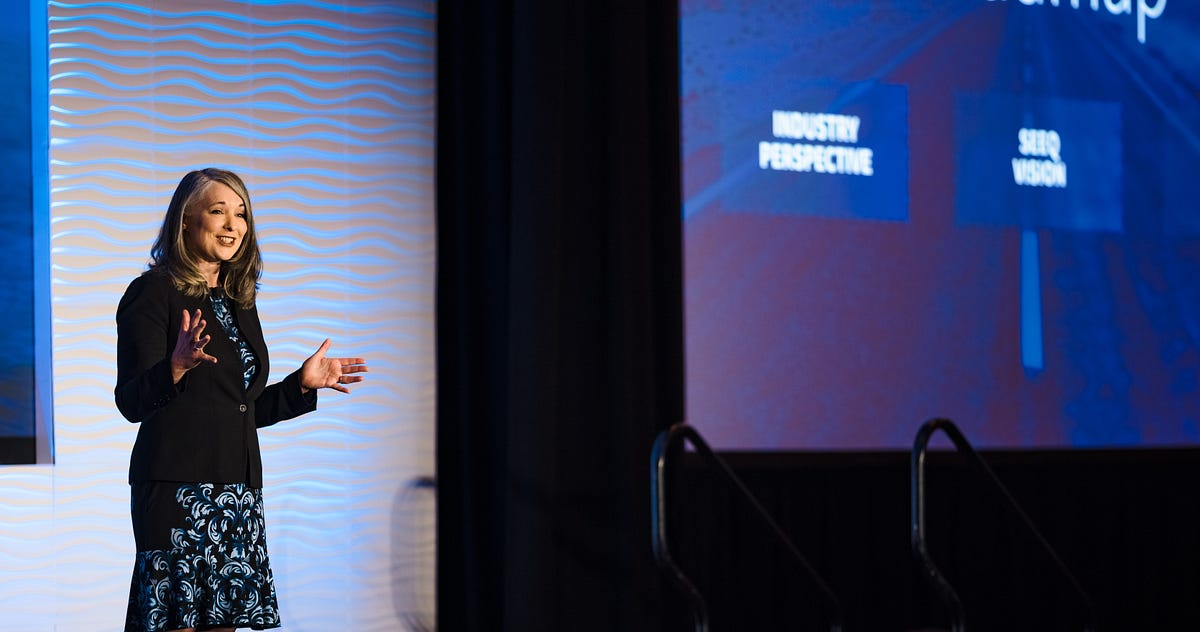
At the 2026 gathering, the language moved from analytics toward intelligence. Graham placed the human operator at the center. Every resolved issue could strengthen the next investigation if the reasoning were captured. Every experienced employee could leave behind more than a folder of charts. Artificial intelligence, in this picture, is less an oracle than a very attentive apprentice, quick with precedent and still in need of supervision.
A technical career with an educational conscience
Graham's account of progress repeatedly includes other people. “I didn't get here on my own,” she said when Oregon State inducted her into its Academy of Distinguished Engineers in 2016. People had taken time they did not have to open doors for her. The sentence carries an engineer's respect for infrastructure. A door appears simple until one notices the frame, hinges, wall, and person holding it.
She has tried to return the favor institutionally. Graham served on the Oregon Governor's STEM Investment Council and spent two terms on the Oregon Institute of Technology Board of Trustees, including years as chair. She has advocated mentoring, clear communication, collaboration over internal competition, and visible recognition for women in technical fields. Her interest is not ceremonial representation. It is whether someone receives the learning opportunity, encouragement, and authority to do the work.
That principle was also worked out at home. Graham and her husband both wanted engineering careers and parenthood. They organized family life with him as the primary caregiver and her as the primary breadwinner, at a time when the arrangement was less common. Their two sons later pursued college paths of their own. She has spoken about the choice without self-mythology: it was a shared design that let two ambitions and a family coexist.
For all the industrial gravity, Graham retains a fondness for the amateur's fresh start. She has mentioned learning to paint and taking on a new language. Her favorite advice is “Don't mind the little things,” which is perhaps the only sensible creed for someone overseeing systems where the genuinely important little things already have alarms attached.
She also offers a pair of questions: What is your dream? How can I help you pursue it? The first grants permission; the second accepts responsibility. Together they form the humane counterpart to decision capital. Knowledge compounds when it is captured. People grow when someone makes room.
The puzzle is still made of people
Seeq's latest chapter comes with a new line, “Human Intelligence. Amplified.” Branding is usually where precise ideas go to acquire fog, but this one fits Graham's biography with suspicious neatness. Her career began by learning that responsibility could be shared without being surrendered. It advanced through jobs that translated between scientists, operators, managers, and data. Now she is asking software to remember how experts reach decisions without pretending that expertise is merely another column to ingest.
The tension will not disappear. Companies want speed, scale, and consistency. Industrial reality supplies context, exceptions, and people who know why the manual says one thing while the pump says another. Graham's wager is that technology can hold both: the repeatability of a platform and the judgment of a practiced human being.
Back in that early presentation room, her mentors did not rescue her from accountability. They improved the process by which she met it. That may be the most useful description of her ambition for AI. Give the person facing the hard question better access to evidence, accumulated experience, and colleagues' reasoning. Let the machine carry more of the search. Keep the judgment where it belongs.